Buying Guides
What Makes a Box Feel Sturdy: Greyboard and Wrap Specs
What makes a box feel sturdy: 1200 g greyboard, 157 g wrap, corner geometry and lamination explained by our rigid box factory in Dongguan. MOQ from 100 pcs.

<!-- META_EXCERPT: What makes a box feel sturdy: 1200 g greyboard, 157 g wrap, corner geometry and lamination explained by our rigid box factory in Dongguan. MOQ from 100 pcs. -->
Opening
Ask buyers to praise a box in one word and most choose sturdy. The word runs through five-star reviews of gift and retail packaging like a refrain, and it reads as an emotion. It is not. Sturdiness is engineered, and it is the sum of three decisions taken before any artwork is printed: the mass and construction of the board, the tension of the wrap that covers it, and the geometry of the corners and lid that hold the shape. In rigid box materials, those three inputs explain nearly everything a hand can feel.
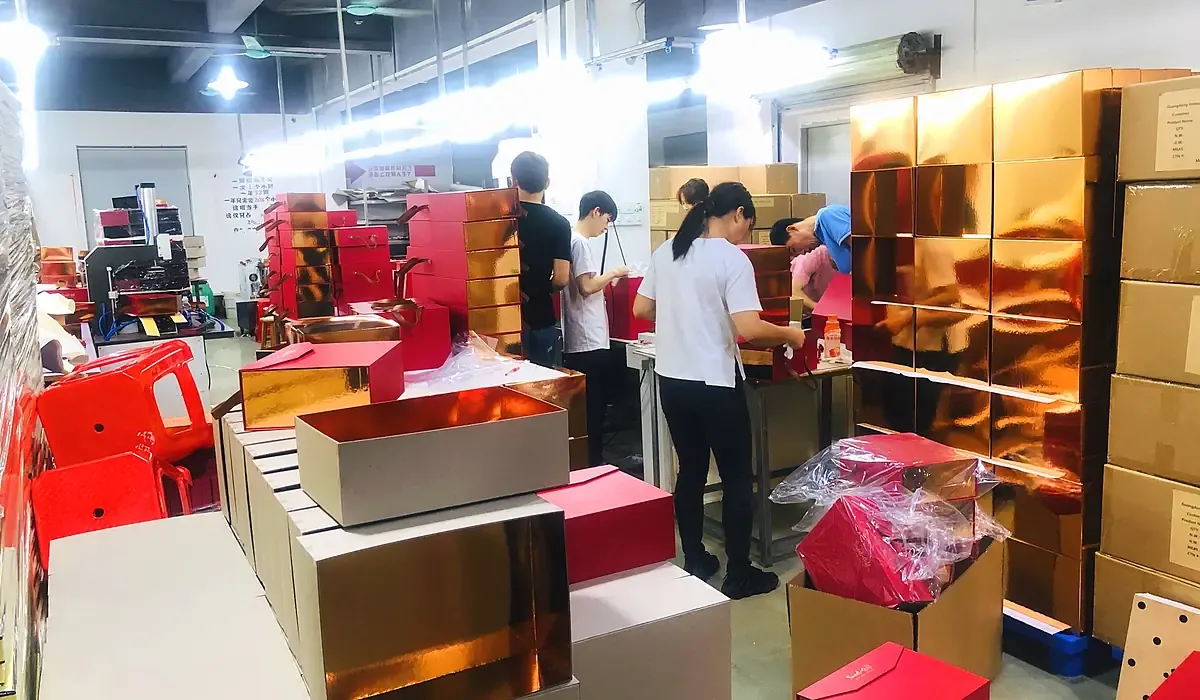
Our factory in Humen, Dongguan has engineered rigid and folding packaging since 1998, and the pattern across that work is consistent. Buyers who specify the source of the feel receive it on the first sample. Buyers who describe it only as an adjective receive whatever the line happened to run, and they discover the difference when their customers do. This article takes the adjective apart: what 1200 g greyboard contributes, what the 157 g wrap contributes, where each can fail, and how far a specification can be lightened before the hand notices.
Read it once before your next brief. The gap between a box that photographs well and a box that sells well is usually the gap between a buyer who understood these choices and a buyer who left them to the production schedule.
Rigid Box Materials: Where the Hand-Feel Comes From
Start with the board, because the board decides almost everything. Greyboard is a multi-ply board built from compressed fibre, and its resistance to bending rises steeply with thickness: double the caliper and the stiffness rises by several times rather than a fraction. That is why 1200 g greyboard is the anchor weight for rigid boxes. At that mass the walls stay flat when a hand grips them, the panels refuse to oil-can when the lid is lifted, and the whole object carries a quiet weight that the brain reads as value. A box with mass in its walls feels expensive before a single logo is seen, and there is no print finish that substitutes for it.
The wrap is the second input. We wrap rigid boxes in 157 g art paper, printed, laminated and bonded under tension around the board. The paper is far thinner than the greyboard, so it contributes little bending strength of its own. What it contributes is a skin in tension: pulled tight and secured over the wrap edges, it locks the corners and removes the soft, hollow note of a loose surface. Lamination adds a little surface firmness on top and, more usefully, resists the scuffing and moisture pickup that would otherwise let a wrap go dull in a humid warehouse. The board does the structural work; the wrap makes that work visible and keeps it visible after months of transport.
Corners and lid close the loop. A sturdy box has corners that meet without a visible seam gap and a lid that slides with an even resistance along all four walls. Run a thumb along a wrapped corner: on a well-made rigid box the wrap lies bonded flat with no bubble at the radius. Tap the centre of a panel with a knuckle and a well-built box answers with a dull, dense note rather than a rattle. None of these checks requires equipment. All of them can be run on a sample in two minutes, and a buyer who runs them at sampling never has to run them again on a customer complaint instead.
The three inputs are not additive; they are ordered. Board mass sets what is possible, wrap tension makes it legible to the hand, and corner geometry preserves both through handling, which is why a specification that trades one against the other always loses the cheapest one first. A buyer asking for a lighter box with the same feel is really asking which of the three the programme can afford to shorten, and the honest answer is usually none of them on a gift format, or the finish schedule on a retail stack that never gets gripped.
The Weight Ladder: From Carton Board to Greyboard
Between a folding carton and a rigid box sits a ladder of board weights, and knowing where a programme belongs on it prevents both overspending and the reviews that complain about flimsy board. At the bottom of the ladder, 300 to 500 g carton board covers the workhorse folding carton. It is the correct choice when the box is small, the product inside is light, and the carton travels inside a mailer or a master carton that carries the real protection. A folding carton at these weights feels honest on a shelf, but flex it between two fingers and it bows; that is not a defect, it is the material class.
The crossing points to rigid construction are four. Wall span comes first: any panel wider than an outstretched palm will visibly flex at carton weights, and flex is what buyers photograph when they complain. Lid span comes second, because a lid is a beam unsupported at two edges and it shows sag before the walls do. Product mass comes third: above a few hundred grams the box must resist being carried by its contents rather than with them. Channel expectation comes fourth, and it is the quiet one: a gift customer squeezes the box before opening it, and the squeeze is part of the product experience they paid for.
At the top of the ladder, 1200 g greyboard is our default rigid anchor because it satisfies all four crossing points on compact formats while keeping the logistics sane. Packed 100 pcs per master carton, a compact rigid programme holds the carton at or below 22 kg, which keeps freight per unit predictable. Wider formats break that arithmetic, and when the division between carton ceiling and pack quantity stops working, the honest answer is a lighter structure with an engineered insert rather than a heavier sheet. Where sustainability matters to your programme, the factory is FSC-ready and can supply certified board on request for both the greyboard and the wrap; flag it at quotation so the stock is allocated before scheduling.
Two quick tests sort a brief onto the right rung before any money is spent. The two-finger squeeze on the widest panel, closed eyes optional, tells you whether the walls resist or drape; if the panel bows visibly, the weight is below what the format and channel expect. The lift test tells you whether the box carries as one object or as a bag of parts; a box that feels sturdy returns a single dense note to the hand, while a box with loose contents or an unbraced wall separates under the lift. Run both on a competitor box you admire and on your current packaging, and the ladder will place itself.
Where Sturdiness Fails: Racking, Delamination, Soft Corners
Sturdiness has three characteristic failure modes, and all three are visible before a container is packed if the sample is handled with intent. The first is racking: a box whose wall span outruns its board mass leans into a parallelogram the moment weight lands on it. You will not see it on an empty bench; you will see it when a full master carton is stacked on top. The second is delamination: greyboard is built from laminated plies, and humidity cycling can open those plies so the wall goes hollow and the wrap bubbles at the corners. The third is soft corners, which come from glue starvation where the wrap turns or where corner joints meet, and which announce themselves as a corner that crushes under a thumb instead of resisting it.
Each failure has a matching check that costs minutes. Stack a packed master carton on the sample and watch for lean. Tilt the closed box through a shallow arc and listen for the insert shifting inside. Peel a wrap edge gently at one corner and confirm it holds the board rather than lifting with the paper. Rap each panel and listen for the dense note. Across 1,000+ cases we have found these four checks catch nearly every sturdiness complaint before production, which is why they run alongside AQL inspection at the packing stage rather than after a customer photographs the failure.
Order matters when a sample fails one of the checks, and the order is the reverse of the cost. A racking failure is a board decision first and a geometry decision second, because a support platform adds cost for the life of the programme while a caliper step adds it once. A delamination failure is a glue and humidity question before it is a board question. A soft corner is a making-floor instruction before it is a specification change. Running the fixes in that sequence means the cheapest correction is tried first and the specification is only rewritten when the material itself is the cause.
Reducing Cost Without Losing the Sturdy Feel
Every sturdiness conversation eventually meets a budget, and the honest answer is that the specification can be lightened, but only in the right order. Keep the board mass; simplify the finish. One foil colour instead of three, a matte lamination instead of a longer finishing sequence, an insert trimmed of features nobody touches: these protect the hand-feel while removing cost the customer cannot feel. The reverse order is the expensive mistake. Thin the board below the flex threshold for the span and no finish recovers it, because the hand detects the loss in the first second of handling, and that is the exact moment the review language flips from sturdy to flimsy.
There is a second, quieter lever: consolidation. Sharing one dieline across sizes, or standardising a programme on two structures instead of five, removes set-ups rather than material, and set-ups are where small programmes bleed. Our 5,000 m² floor in Humen, Dongguan runs about 100 staff with wrapping and inserting arranged as consecutive cells, so a specification decided at sampling moves into production without a second set-up. The plant runs about US$10 million in annual output and ships to 80+ countries, and 50+ brands have walked this cost conversation with us, most of them keeping the board and surrendering the foil. A decision taken here lands inside a normal production run of 10 to 20 working days, with payment of 30 percent deposit and balance before shipment, rather than turning into a re-engineering project.
Frequently Asked Questions
What board weight makes a box feel sturdy?
Rigid boxes feel sturdy at 1200 g greyboard wrapped in 157 g art paper, a pair that keeps walls flat and corners square on compact formats. Folding cartons in 300 to 500 g board feel appropriate for small, light products travelling inside a protective mailer. The reliable test is the two-finger squeeze on the widest panel: if it bows visibly, the weight sits below what your channel expects.
Does a heavier wrap make a box sturdier?
No. The wrap is a print carrier and a tensioned skin, not a structural layer, and moving above 157 g art paper adds cost without adding strength. Sturdiness comes from the greyboard mass and from wrap tension at the corners. Spend on the board, keep the wrap standard, and put lamination over it for scuff resistance and a slight gain in surface firmness.
Why does a rigid box rack out of square?
Racking happens when a wall span outruns the board mass, usually on wide panels or large lids, and it shows under a stacked load rather than on an empty bench. The fix is a board-weight upgrade or a geometry change such as a shorter lid or an inner platform. We stack a full master carton on the sample during approval, so racking is caught before production, not after delivery.
Can a lighter box still feel sturdy?
Yes, within limits. Creased face panels, corner returns, tighter lid clearance and an inner platform that carries the product all raise perceived firmness without adding board. What does not work is thinning the greyboard below the flex threshold for the span, because the hand finds it immediately. We advise where that line sits for your exact panel sizes on the first physical sample, which takes about 5 days.
Is lamination necessary on a rigid box?
Lamination is not structural, but it earns its place. It resists scuffing on surfaces that are handled constantly, slows the moisture pickup that would otherwise dull the wrap, and adds a slight surface firmness. Matte lamination suits gift and jewellery boxes that are touched immediately, while gloss suits retail stacks read at a distance. On rigid programmes we laminate by default and print interior logos directly on the wrap.
What MOQ and lead times apply to rigid boxes?
MOQ starts from 100 pcs per size and design, and a free digital sample takes about 5 days from a complete specification. After sample approval, mass production runs 10 to 20 working days, with payment of 30 percent deposit and balance before shipment. Boxes pack 100 pcs per master carton at or below 22 kg, checked to AQL inspection standards before the cartons are sealed for shipment.
Conclusion
A box feels sturdy because someone decided it would: the greyboard mass matched to the wall spans, the 157 g wrap pulled tight and laminated, the corners bonded flat and the lid cut to an even resistance. None of it is expensive; all of it must be specified. Put the board weight, the wrap and the lid tolerance into your brief, run the two-finger squeeze and the knuckle rap on the sample, and the adjective your customers reach for will be the one you engineered. Send your sizes, structure and quantities to our Dongguan factory and Request a Wholesale Quote, so the specification questions are answered before artwork is finalised and the first sample is a checkpoint rather than a restart.