Buying Guides
From CAD File to Golden Sample: Closing the Spec Gap
From CAD file to golden sample: why a file cannot carry a spec alone, what the sealed sample locks, and the approval gates that keep production honest.
<!-- META_EXCERPT: From CAD file to golden sample: why a file cannot carry a spec alone, what the sealed sample locks, and the approval gates that keep production honest. -->
Opening
The CAD file was perfect. The carton was not. The creases landed where the drawing said, the panel was the width the file promised, and still the box in hand was wrong: the board lighter than assumed, the print shifted a panel across, the glue tab hiding a seam nobody expected to see on the front face. Files carry geometry. They do not carry intent, and the distance between the two is where specifications are lost, silently and in both directions at once.
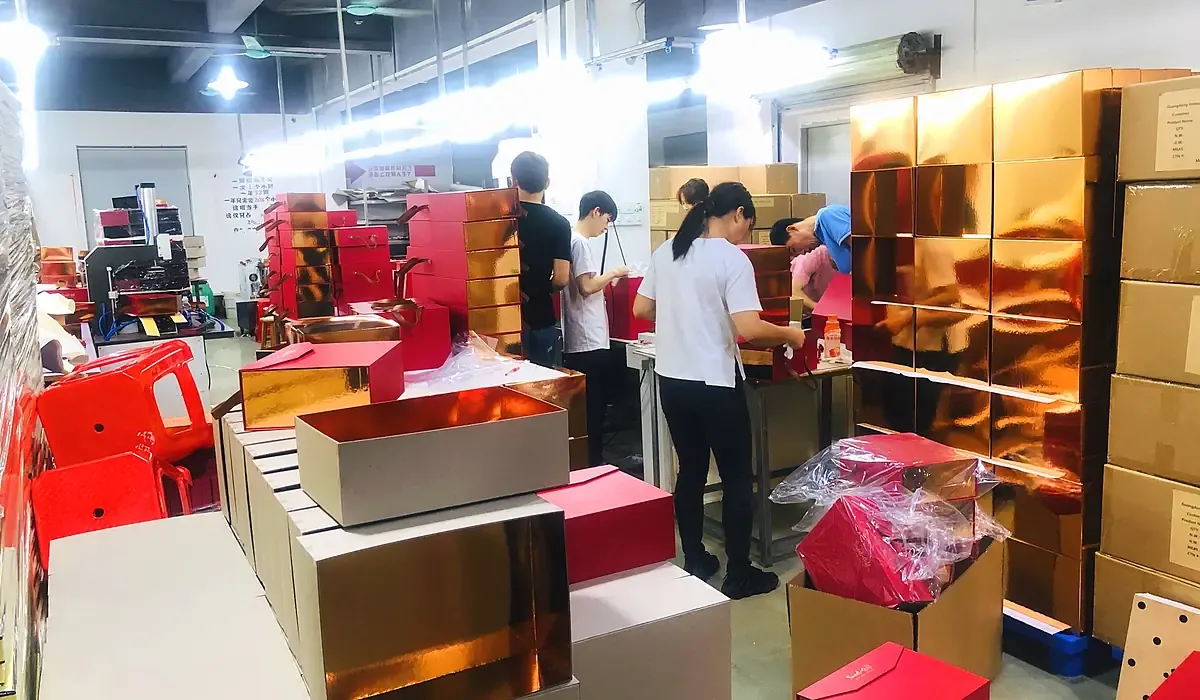
The bridge across that distance is the golden sample: a physical reference approved by both sides and sealed before production, so that every later box is measured against an object rather than an opinion. Our factory in Humen, Dongguan has run that bridge since 1998, on rigid programmes in 1200 g greyboard and folding cartons in 300 to 500 g board alike, and the complaints that reach us from other suppliers' customers are almost all stories about a file that was treated as a specification. This article explains why a file alone cannot carry a spec, what the golden sample locks and what it cannot, the approval gates from CAD to production, and how the seal keeps reorders honest.
Why a CAD File Alone Cannot Carry a Specification
A CAD file records lines and their positions. Production needs a dozen decisions the file does not contain: the board and its caliper, which change where every fold lands; the crease rules, which decide whether a fold is sharp or living-hinge soft; the glue tab width and which seam it sits on; the bleed and the safe zones; the tolerance class of every mating dimension; the print colours, the finishes and the order they are applied; and the wrap behaviour if the structure is rigid, where a printed sheet is pulled around a board rather than folded from it. Two factories given the same file will build two different boxes, and both will say they followed it exactly.
Versions make the gap wider. A programme that lives in email produces file-v3-final-revised, and nobody can later say which version the die was cut from. Different software renders the same file with different defaults for stroke meaning and scale, so a dashed line interpreted as a cut in one office is a crease in another. And a file travels without a caliper: it cannot tell the die-maker whether the wall it draws is 1200 g greyboard or a light carton, yet every fold position on the dieline depends on that answer. A file, in short, is evidence of intent, not a specification of it.
None of this makes CAD files useless; it makes them the start of the conversation rather than the end of it. The file becomes production truth only after the factory returns a dieline built on the chosen material, the buyer countersigns it, and the pair of them have handled the same physical object. Everything before that moment is negotiation; everything after it is replication. The buyers who suffer spec misses are almost never careless, they are simply unaware that the conversation stopped one document too early.
The Golden Sample: What It Locks and What It Cannot
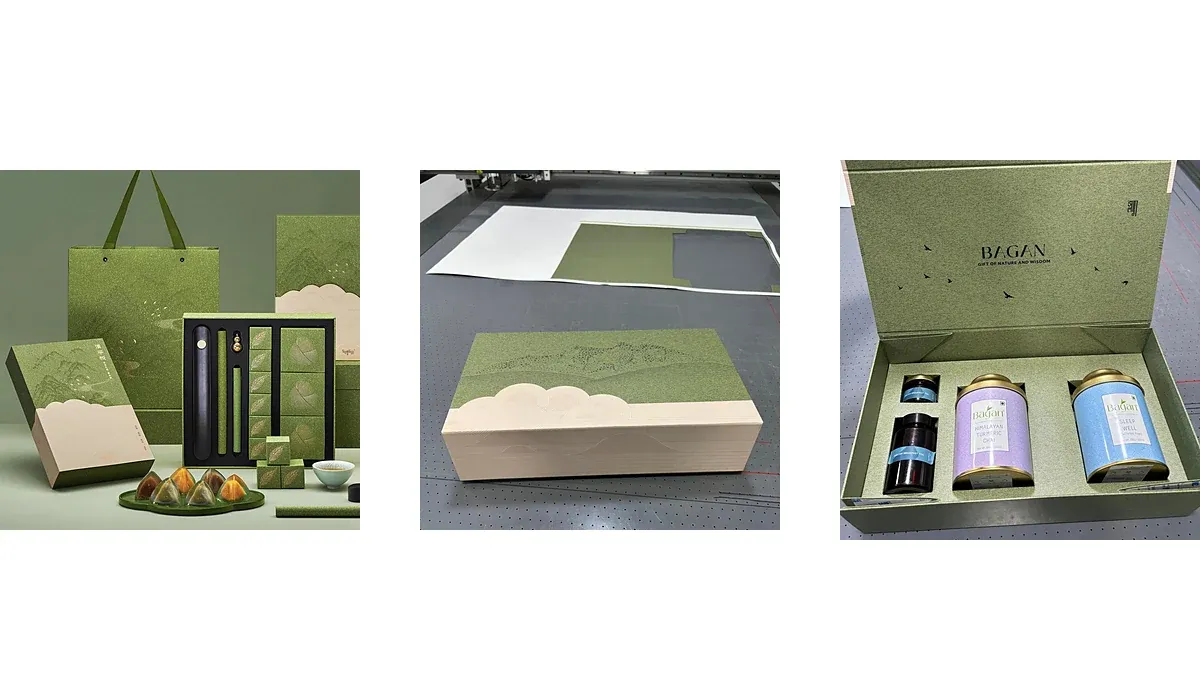
A golden sample is the approved physical reference for a programme, produced on production materials and production processes, signed and sealed before mass production begins. We seal it in more than one place: the factory retains a master, and the buyer holds a copy of the same run, so neither side is ever measuring against a memory. Once sealed, it locks the structure and its tolerances, the board and wrap, the print colours and finishes, the insert fit and the assembly sequence. Any box in any later batch can be held next to it, and the question of whether the factory did what was agreed stops being a debate and becomes a comparison.
What it locks, precisely, is everything present in it. A rigid set in 1200 g greyboard wrapped in 157 g art paper locks the board, the wrap and the tension that goes with them; a carton programme locks its place in the 300 to 500 g range; a foil locks its colour and its position. What it cannot lock is anything absent from it: a price, a lead time, a material that may or may not be available in two years, a finish nobody included in the sample. That is why the golden sample travels with a written specification sheet that states the materials and dimensions in words and numbers, so the object and the document answer for each other. An unlabelled sample is a relic; a labelled one paired with a spec sheet is a standard.
The seal also has a discipline, and it matters most at the moment everyone wants to skip it: the sample is approved with the real product inside. A proxy block fits in ways the product does not, especially where inserts are engineered to grip rather than to fill. The sample is opened and closed five times, tilted, and lightly stacked before the signature, because approval is a statement about the future behaviour of a thousand boxes, not about the charm of one of them. Approval given that way holds for the life of the programme; approval given from a desk chair is renegotiated in review form later.
The Approval Gates From File to Production
Between the CAD file and a packed master carton stand six gates, each with one owner and one date, and each preventing one specific class of surprise. Gate one is the dieline countersign: the factory issues the production dieline built on the agreed material and returns it for signature, so caliper, crease allowances and glue tabs are resolved in one document with one version number. Gate two is the digital proof, which settles content, colours and placement but deliberately settles nothing structural. Gate three is the physical sample, ready in about 5 days from a complete brief, checked with the real product inside.
Gate four is the golden sample seal itself, with sign-off from both sides and the retained masters labelled and dated. Gate five is the first-article check at line start, when the die is mounted and the first pieces off the run are measured against the sealed master before the run is released. Gate six is AQL inspection before packing, which samples the finished batch against the same master rather than merely counting cartons. The gates do not overlap, which is the quiet design behind them: a colour question raised at gate two never contaminates the structural approval at gate three, and a structural change at gate three restarts the sequence instead of being folded into it.
Buyers sometimes experience six gates as slowness, and the arithmetic says otherwise. Each gate costs hours or days; each class of surprise it prevents costs weeks and a reprint. The calendar that holds is the one built on the gates: about 5 days to the physical sample, 10 to 20 working days of production after approval, payment of 30 percent deposit with the balance before shipment, and a quotation issued within about 24 hours of a complete specification, with technical replies inside 12 hours. A programme that skips a gate does not save the gate's cost; it defers it, with interest, to the least convenient moment in the schedule.
A worked example shows why the order matters. A buyer who approves artwork on a proof but skips the physical sample typically discovers the miss at first-article check, when the box in hand will not accept the insert the artwork assumed. At that point the dieline is reopened, the die is re-cut, and the calendar loses the two weeks the sample stage would have cost, plus the re-proof. The same buyer who runs gate three spends five sample days and a courier week, and starts production on an object both sides have held. The gates are not a queue to be shortened; they are the sequence in which each type of uncertainty is retired, and each one is cheapest in its place.
Keeping the Golden Sample Honest on Reorders
The seal earns its keep on the second order. At reorder, the purchase order cites the seal identifier, the retained master comes out at set-up, and the first article is compared against it before the run proceeds, so the programme restarts from the approved object rather than from a buyer's recollection of it. Substitution of material, wrap or finish requires written change control, meaning both sides sign the change and a new seal is cut, because a silent substitution is where reorder quality quietly dies. Batch records tie every shipment to the master it was checked against, which is what makes a claim six months later verifiable instead of anecdotal.
Re-approval has honest triggers, and they are worth agreeing in advance: when the material changes, when the artwork changes, when a dieline revision is introduced, and when a programme has been dormant long enough that materials and print conditions should be re-confirmed against a fresh sample. None of these is an accusation; they are the maintenance schedule of a specification. Buyers who treat re-approval as routine get reorders that match order one, and buyers who treat it as friction get the other experience, at the worst possible moment, which is after their customer has already noticed.
Receiving checks stay inside the same discipline, and they are short. On arrival, the buyer compares the batch against the copy of the golden sample held on their side: structure and wrap first, print position second, insert fit with the real product third, and any deviation is photographed against the master while the cartons are still sealed, because a claim made from a sealed comparison is accepted in a day while a claim made from memory is argued for a month. Two minutes of comparison per pallet is the entire cost, and it is the reason the buyer copy exists.
Scale is what keeps the discipline affordable rather than ceremonial. Our 5,000 m² floor in Humen, Dongguan runs about 100 staff, the plant operates at about US$10 million in annual output and ships to 80+ countries, and 50+ brands and 1,000+ cases have passed through the same six gates, which means the paperwork is factory-standard here rather than a special favour. Boxes pack 100 pcs per master carton at or below 22 kg, MOQ starts from 100 pcs per size and design, and the factory is FSC-ready with certified board available on request. A specification closed through the gates does not drift, because at every step there is an object, a signature and a date to answer to.
Frequently Asked Questions
What exactly is a golden sample?
It is the approved physical reference for a programme, made on production materials and processes, signed by both sides and sealed before mass production. It locks structure, board and wrap, print and finishes, insert fit and tolerances. The factory retains a master and the buyer holds a copy, so every future batch is measured against an object rather than a memory, and quality claims become comparisons instead of debates.
Who keeps the golden samples?
Both sides. The factory retains a labelled master at the plant and pulls it at every set-up for the first-article check, while the buyer holds a copy of the same sealing run for receiving checks and internal approvals. Keeping a sample on the buyer side matters more than most realise: it is the only reference that survives staff changes on both sides of the programme.
Can I just use my CAD file as the dieline?
Send it as intent, but the production dieline is issued by the factory on the chosen material, so caliper, crease allowances, glue tabs and tolerance classes are resolved in one document with one version. You countersign that dieline, which is the moment it becomes the specification. A file that goes straight to a die without that loop is where the sample-does-not-match-the-drawing stories begin.
What happens if the physical sample is wrong?
Say so, and the loop restarts at the dieline, not at the die: the cause is identified, the correction is issued as a revision, and a new sample follows in about 5 days. This is why sampling happens before tooling: a die is cut once, and corrections after it are re-tooling. A wrong sample caught honestly is a cheap event; the same wrongness caught in a production batch is not.
When does a golden sample need re-approval?
Four honest triggers: a material change, an artwork change, a dieline revision, and a programme that has been dormant long enough that materials and print conditions deserve reconfirmation. Each trigger produces a fresh sample and a new seal with a new date. Re-approval is the maintenance schedule of a specification, not an accusation, and it is what keeps the tenth order matching the first.
What are the MOQ, lead time and payment terms?
MOQ starts from 100 pcs per size and design. Expect a quotation within about 24 hours and technical replies within 12 hours, a physical sample in about 5 days, and production of 10 to 20 working days after the golden sample is approved. Payment is 30 percent deposit with the balance before shipment, and boxes pack 100 pcs per master carton at or below 22 kg, AQL-checked before packing.
Conclusion
The gap between a CAD file and a correct carton is not a trust problem; it is an information problem, and it closes with objects and signatures rather than with more emails. Let the factory issue the production dieline, approve a physical sample with the real product inside, seal a golden sample before tooling, and let every batch answer to that seal through first-article checks and AQL inspection. Six gates, one owner each, and a purchase order that cites the seal: that is the whole discipline, and it is the difference between a first order and a programme. Send your file, your product and your quantities to our Dongguan factory and Request a Wholesale Quote, so the specification gap closes at sampling and never opens again in production.