1
Offset printing
Offset presses are the standard for custom packaging because they hold colour registration across long runs and take Pantone inks. Sheet-fed printing covers art paper, folding boxboard and corrugated litho labels, in CMYK full colour or Pantone spot colours.
Print
2
Die-cutting
Die-cutters cut the printed sheet into the box shape — windows, tabs, score lines and custom shapes. Laser-cut dies cover short runs; metal-rule dies run production volumes. Designs that need a clear window are patched on a separate line.
Cut & crease
3
Lamination
Laminators apply matte, gloss or soft-touch film over the printed sheet before it is mounted to greyboard. The film seals the surface, locks the print and adds the scuff resistance transit requires.
Finish
4
Folding and gluing
A folder-gluer line folds the scores, applies the side-seam adhesive and stacks finished cartons. Folding cartons ship flat; rigid boxes are never machine-glued.
Form
5
Hand assembly
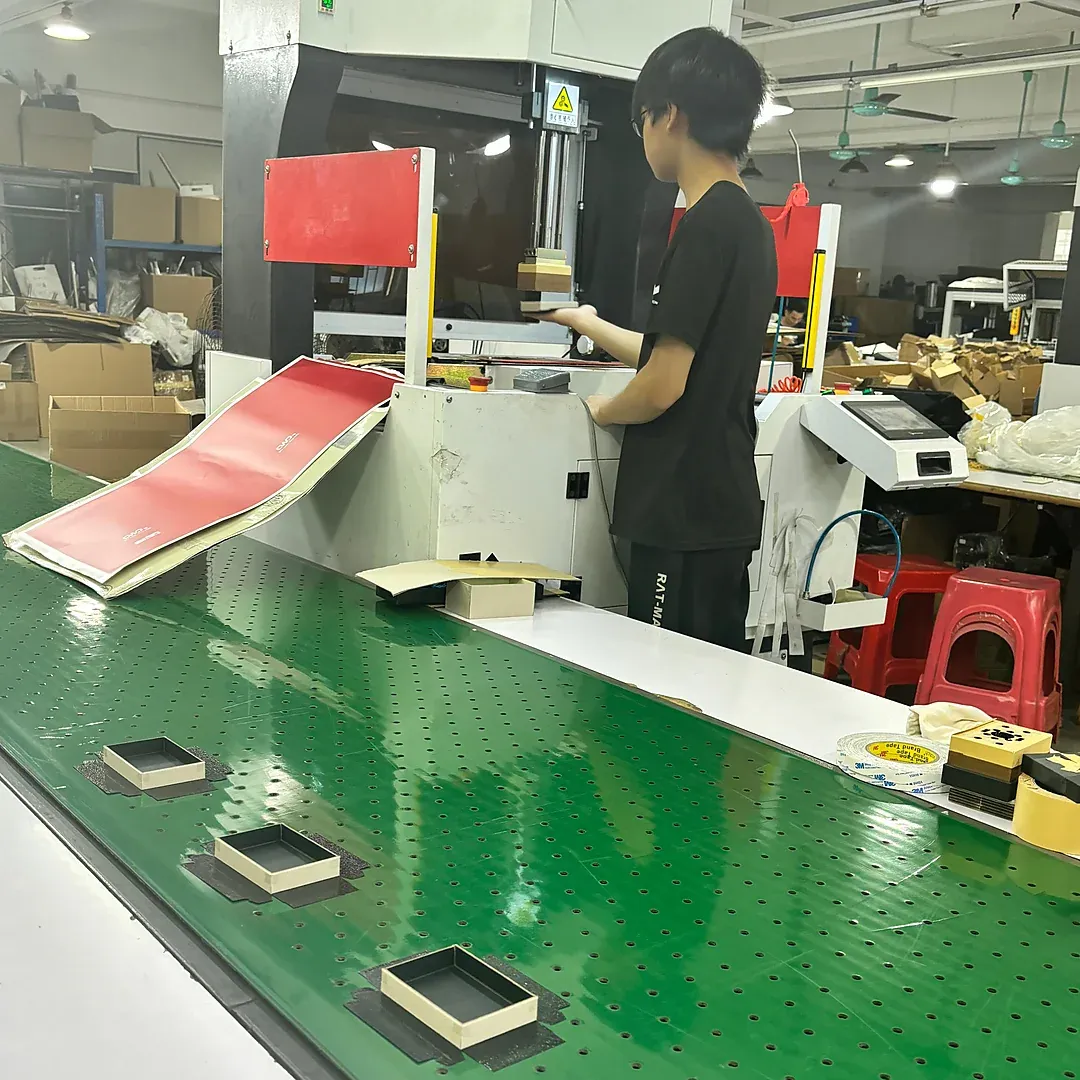
Every rigid box is built by hand at the bench: corners folded, wrap glued, edges pressed square. The bench line assembles lid-and-base, book-style, drawer and collapsible structures, sets magnets and fits inserts. Hand work is why small runs from 100 pcs are possible.
Build
6
Inspection and packing
Every lot is inspected to AQL sampling standards before it leaves the floor: print registration, colour against the signed sample, insert fit, closure alignment and packing count. Boxes pack 100 pcs per master carton, with carton weight kept at or below 22 kg.
Check & pack