
Buying Guides
Five Specs a Real Box Factory Answers in One Email
Five spec questions separate a real China box manufacturer from a trading company in one email: board weights, carton plan, calendar, process and payment terms.
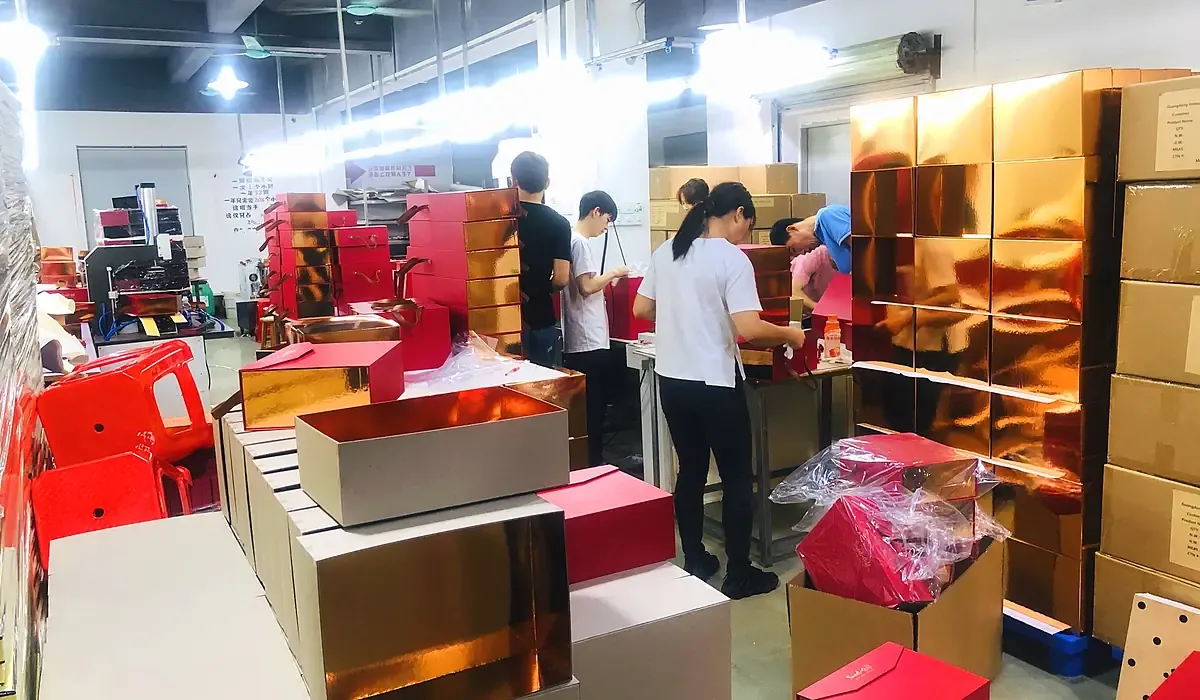
<!-- META_EXCERPT: Five spec questions separate a real China box manufacturer from a trading company in one email: board weights, carton plan, calendar, process and payment terms. -->
Opening
Shortlisting a China box manufacturer rarely happens on a factory tour; it happens in one email, sent to six suppliers and answered six very different ways. The question set matters more than the tone. Five specification questions, each with a number inside it, will separate a plant that runs the machines from an office that forwards files, because only one of them can answer without leaving the desk to ask somebody else. This article gives you the five questions, what a genuine answer contains, and the reply patterns that should end a conversation before it costs you a sample cycle.
The five questions are deliberately narrow: materials, packing plan, calendar, process ownership and commercial terms. Each can be answered in a sentence by a factory and only in a paragraph of hedging by an intermediary, because each touches the floor where the work actually happens. A trading company can discuss quality indefinitely; it cannot tell you which greyboard weight it mounts, or what its packing bench caps a carton at, because it does not own either operation.
We write as the plant side of that inbox. Our factory in Humen, Dongguan has engineered and produced custom boxes since 1998, and the answers described below are the ones our engineers give every day. Use the five questions on any supplier, including us: a real plant welcomes a specification-laden email, because it removes a round of questions and moves the quotation forward.
Why One Email Sorts the Field
The email works as a probe because of an asymmetry in where the answers live. Specification knowledge sits with the people who adjust the machines: what a mounting table holds flat, what a gluing line folds cleanly, what a carton holds when a pallet sits on it. A trading company does not have that knowledge in the room, so every spec question becomes a message to somebody else, and the delay or the vagueness in the reply is the honest signal. A plant answers from the floor, in units, within the hour.
Speed itself is diagnostic, but only in combination with content. A reply that arrives within 12 hours and contains board weights, a packing plan and a calendar is a plant talking about its own operations. A reply that arrives in the same 12 hours and contains only adjectives is somebody relaying enthusiasm. This is why the questions must carry numbers: numbers force the answer to come from a source, and the source is what you are actually testing.
The scale behind the inbox matters too. A plant that has delivered 1,000+ cases to 50+ brands across 80+ countries, on roughly US$10 million in annual output, has answered these five questions thousands of times, and the answers arrive structured because the operation behind them is structured. Our own sales engineers quote within about 24 hours of a complete specification and answer technical questions within 12 hours, not because speed is a policy poster, but because the people who know the answers sit within walking distance of the machines. That is the difference the email is designed to detect, and no video tour fakes it as convincingly.
Five Specs a China Box Manufacturer Answers
The first question is materials. Ask which board weights the plant runs for rigid and folding construction, and wait for units. A real plant answers that rigid boxes are built on 1200 g greyboard wrapped in 157 g art paper, which is the pair that keeps walls flat and corners square on a small format, and that folding cartons run on 300 to 500 g board depending on the channel and the product weight. The answer should come with a trade-off attached, because material choice is always a trade: heavier board protects more and ships denser, lighter board packs more units per carton and costs less freight per piece. An answer without a trade-off is a brochure, not a factory.
The second question is the packing plan. Ask what the minimum order looks like and how finished boxes leave the line. A plant answers that MOQ starts from 100 pcs per size and design on most structures, that boxes pack 100 pcs per master carton, and that the gross weight is kept at or below 22 kg so the carton remains liftable and stackable in a normal warehouse. This question is the quiet eliminator: intermediaries rarely know packing ratios, because packing happens at the plant, after the trader has already gone home. If the reply cannot connect unit count, carton count and weight ceiling into one coherent plan, the reply does not come from the packing floor.
The third question is the calendar. Ask how long a sample takes and how long mass production takes after approval. A plant answers that a digital sample takes about 5 days from a complete specification, and that production runs 10-20 working days after sample approval, and both numbers move with structure and finish rather than with enthusiasm. The calendar answer should also name its gates: quotation within about 24 hours, technical replies within 12 hours, deposit received before scheduling. A trader's calendar tends to be a single optimistic number with no gates, because the trader does not control the gates and cannot see them move.
The fourth question is process ownership. Ask which steps happen in-house: printing, surface finishing, die-cutting, mounting, gluing, hand assembly, inspection. A real plant draws its own map and can name the floor behind each step; ours runs on a 5,000 m² site in Humen, Dongguan with about 100 staff covering the sequence from printed sheet to packed carton. The value of the question is not the map itself but the specificity: a plant knows which operations it subcontracts and says so plainly, because it lives with the consequences. An intermediary claims everything and describes nothing.
The fifth question is terms and controls. Ask what inspection the goods pass before packing, and on what payment schedule. A plant answers that AQL inspection runs on the production lot before packing, that payment is a 30 percent deposit with the balance before shipment, and that FSC-ready board is available with certified stock supplied on request when the requirement is flagged at quotation. Each element is verifiable and each commits the speaker: inspection standards imply a QC bench, deposit terms imply a finance routine, certified board implies mill relationships. Vague terms are as diagnostic as vague weights.
How a Trading Company Answers
The first pattern is adjective inflation. Where the plant wrote 1200 g greyboard, the intermediary writes premium quality greyboard; where the plant wrote at or below 22 kg, the intermediary writes sturdy cartons suitable for international shipping. Nothing in the adjective answer can be checked, quoted, or held to contract later, and that is not an accident: unanswerable language is the language of a business that will not be bound by its own email. When you see quality words where numbers should be, you have your answer about who wrote it.
The second pattern is the mirror question. Ask about board weight and the reply asks you what weight you would like; ask about the packing plan and the reply asks what packing you prefer. Some of this is legitimate — a plant also asks about your channel and product weight — but there is a difference between clarifying a load case and outsourcing the specification entirely. A factory asks questions because the answer changes what it builds; a trader asks questions because it has nothing to add until you supply the answer yourself. The telling version is when your own numbers come back to you days later, restyled, as the supplier's proposal.
The third pattern is the unbounded yes. Every structure is possible, every lead time is achievable, every certification is no problem. Real plants say no constantly: a rigid box at a given size needs a minimum board weight or it racks in the carton; a foil schedule adds days to the calendar; a 100 pcs run on a complex magnetic structure costs disproportionately because set-up dominates. The plant's no is useful information purchased with experience. The trader's yes costs nothing to give and everything to believe, and the first sample or the first reorder is where the belief is usually invoiced.
Reading the Reply Like a Plant Manager
Read for units before you read for tone. Every number in a plant's reply carries its unit and its condition: 1200 g greyboard, 157 g art paper wrap, 100 pcs per master carton, at or below 22 kg, about 5 days for a sample, 10-20 working days for production. Units mean the number came from a specification the speaker expects to be held to. Numbers without units, or ranges so wide they exclude nothing, came from a price list at best.
Read for volunteered trade-offs. The strongest signal in a factory reply is the sentence that costs the supplier something: the recommendation to simplify a structure, the warning that a finish will add days, the note that a lighter board is available but the carton will not survive the same stack. Trade-offs mean the speaker has built this before and remembers what went wrong. You cannot fake a memory of failure.
Read for the questions the supplier asks you. A plant wants the distribution channel, the product weight and fragility, the shelf context, the destination market, because those inputs change board weight, insert design and carton grade. Our engineers ask them before quoting, because a quotation issued without them is a guess with a price on it. The depth of the questions aimed at you is a mirror of the depth of the operation behind the reply — and unlike a certificate or a showroom, a mirror question cannot be borrowed.
From Reply to Shortlist
Turn the five answers into five columns and compare suppliers line by line. The comparison is fast because the answers are quantitative: board weights against board weights, packing plans against packing plans, calendars against calendars. Where a supplier left a column empty or filled it with adjectives, the column itself is the finding. Keep the sheet: it converts naturally into the specification schedule of a purchase contract, so the email that sorted the field also becomes the document the first order is placed against.
Then run the sample gate. A specification written from the reply should produce a digital sample in about 5 days, and the sample is where the reply is audited: the board weight you were told is the board weight you weigh, the wrap you were told is the wrap you see under a corner. After approval, the calendar you were given should hold, with production in 10-20 working days against a 30 percent deposit and the balance before shipment. A supplier whose sample matches its email will usually match its contract; the discipline is the same discipline.
Finally, keep the five-question email as a standing check on reorders. The specs that were true at quotation — the weights, the carton plan, the inspection routine — are the specs the reorder must reproduce, and the email format makes the drift visible before the shipment does. A China box manufacturer that answers the same way on order fifty as on order one has a production system, not a good week. That repeatability, not the first price, is what you are actually buying when you send the email.
Frequently Asked Questions
What should go into my first email to a box factory?
Send the five questions with your product context: board weights for rigid and folding structures, the packing plan with carton quantity and weight ceiling, the sample and production calendar, which processes are in-house, and the inspection and payment terms. Add your distribution channel and product weight, because a real factory needs both before it can answer the first two questions properly.
How quickly should a genuine factory reply?
Technical questions deserve answers within about 12 hours and a complete specification deserves a quotation within about 24 hours. Speed alone proves nothing, but speed plus units does: a fast reply containing board weights and a packing plan means the person answering sits near the production floor. A fast reply of pure adjectives is still an intermediary, just a responsive one.
What minimum order should I expect for custom boxes?
A workable benchmark is MOQ from 100 pcs per size and design on most structures, which keeps a multi-SKU trial realistic. Complex builds such as magnetic hinged boxes run higher, typically 300 pieces or more, because the magnet placement die and hand assembly dominate cost at small volumes. Exact quantities belong on the quotation, not in a brochure.
Can I really tell a trader from a factory without a video call?
Yes, in most cases, because spec answers cannot be outsourced in real time. The three strongest tells are units on every number, volunteered trade-offs, and a calendar with named gates. A trader can borrow certificates and showroom photos, but it cannot tell you what its packing bench caps a carton at, because the bench belongs to someone else.
Which of the five answers matters most?
The packing plan, because it is the least improvisable. Board weights and calendars can be researched, but connecting MOQ, the 100 pcs per master carton ratio and the 22 kg ceiling into one coherent plan requires the desk to sit next to the packing line. Suppliers who answer this question precisely usually answer the other four precisely too.
Do these questions still work for a small first order?
They work best on a small order, because small orders expose set-up realities that large orders hide. A plant quoting a 100 pcs run will talk about structure choice and cost per unit honestly; an intermediary quoting the same run will promise whatever the catalogue shows. Send the five questions before the sample request and the trial order starts with facts instead of hopes.
Conclusion
Five specification questions, sent once, sort a supplier field faster than any directory or trade show. Ask about materials, packing plan, calendar, process ownership and terms; read for units, trade-offs and gates; and put the answers straight into the comparison sheet that becomes your contract. A real plant answers from the floor with 1200 g greyboard, 100 pcs per master carton, a 22 kg ceiling, about 5 days for a sample and 10-20 working days for production, because those are its own numbers. Send your specification to our factory in Humen, Dongguan and Request a Wholesale Quote — the quotation arrives within about 24 hours, and the five answers come with units attached.