
01
We handle
Structure and dieline, board selection, print and finishing, hand assembly, in-line inspection, export packing and the documents that travel with the goods.
How we work
What we do, what you do, and what the quote covers. Most friction on a first order comes from a handover nobody wrote down, so this page writes it down.
Every order
Four facts that hold whether the run is a hundred pieces or a container.
What you can hold
A swatch pack, a material sheet and a made sample — the three things that answer most questions before a production run.
The split
Most first orders go wrong at a handover nobody agreed on. This is the split we work to.
Structure and dieline, board selection, print and finishing, hand assembly, in-line inspection, export packing and the documents that travel with the goods.
Brand design, the artwork itself, and any product claims printed on the pack.
Size and quantity: you know the product, we check the fit and the carton count.
Food contact, toy safety, cosmetics labelling and similar rules depend on your market. We confirm what the material can support; the certification stays with you.
On the floor
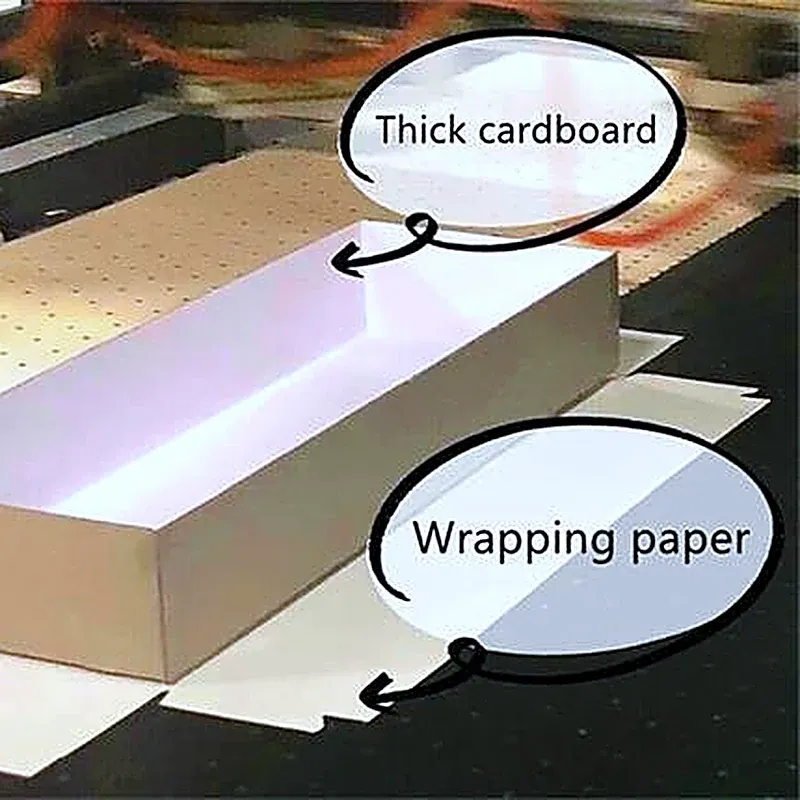
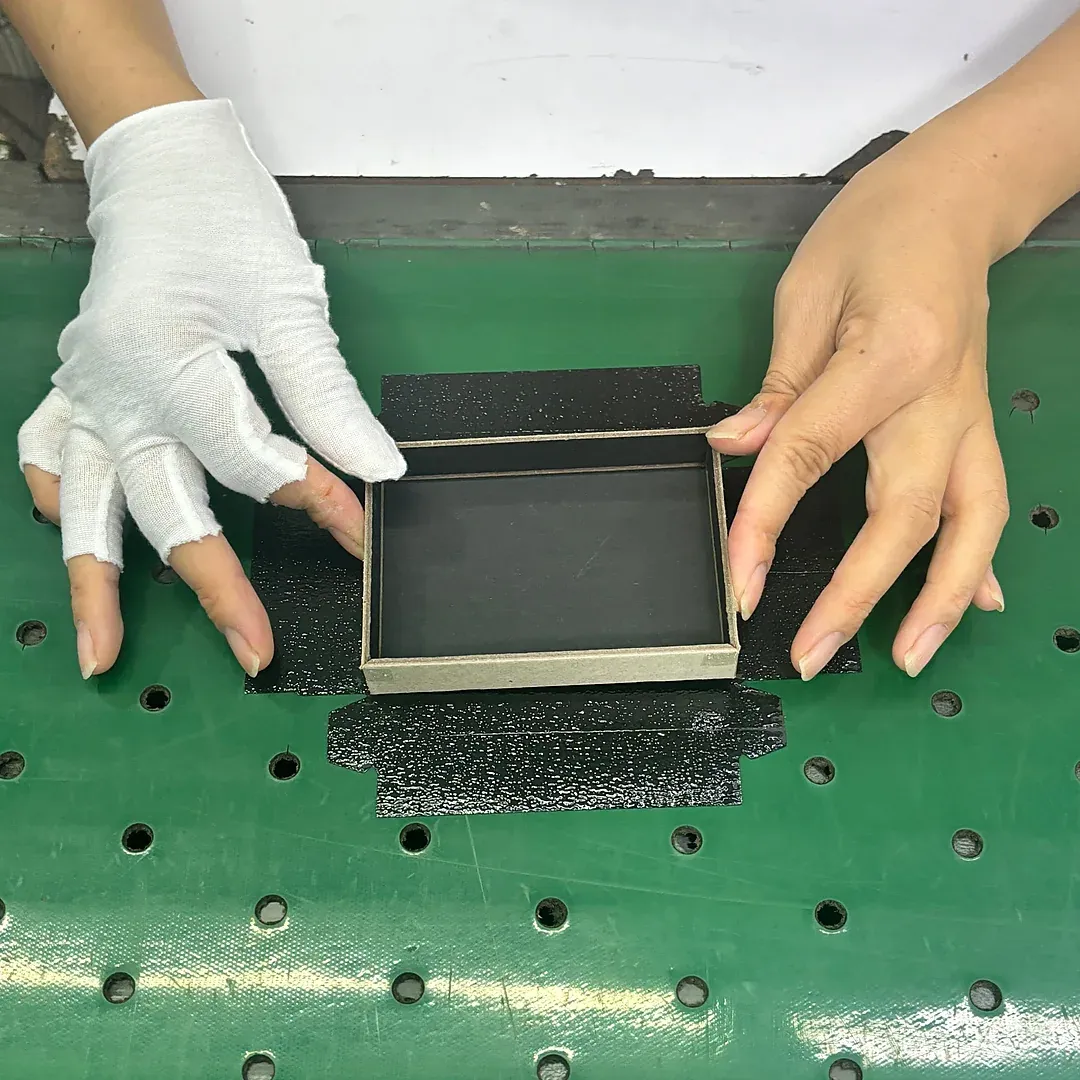
The wrap, the lining and the insert are put together at a bench, not on a line. That is why a rigid run takes longer than a folding carton and why small quantities are possible.
Corners, glue lines and the fit of the lid are checked as each box is finished, before the lot goes to packing.
Finished boxes are counted, wrapped and photographed before they are cartoned, so a shortfall or a dent is caught here rather than at your warehouse.
Scope limits
Being clear about this saves both sides a conversation.
Every quote is read by a person. There is no calculator that can price a construction it has not seen.
We work from your artwork and a dieline. We do not provide a self-serve design tool.
We do not hold finished stock for call-off deliveries. Each order ships when it is made.
Everything is made to order. There are no off-the-shelf sizes waiting to ship.
Picking, packing and posting individual orders to consumers is outside what we do.
We can advise on structure, print and finish. Creating a brand identity is a different job.
Tooling
Cutting dies and print plates are the least understood line on a quote. Four points settle it.
The die is a one-off cost on the first order. It is not repeated on a reorder at the same size and design.
The same die keeps the size identical between runs, which is why reorders price lower.
We hold the die between orders. If a long gap is expected, tell us so we can confirm storage.
A new size means a new die. That is the point at which a reorder behaves like a new order.
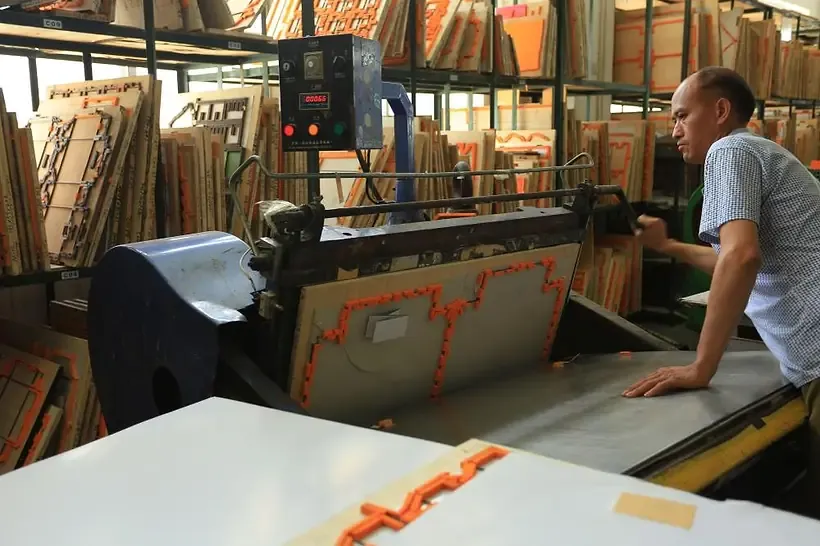
Tooling in practice
The cutting die is a wooden or steel form with the shape of your box. Change the size and the old die no longer fits — that is the whole reason a new size costs more.
Each print colour needs its own plate. Two colours, two plates; add a Pantone and it is one more.
We store the die and plates after the order ships. A reorder at the same size and colours skips that setup cost entirely.
Terms
The same four points apply to a first order and a reorder.
30% to start production, 70% before shipment. Bank details are on the proforma invoice, not in an email body.
A proforma invoice confirms the specification and price before production; the commercial invoice travels with the shipment.
Hand-assembled and printed runs can finish slightly above or below the ordered quantity. The tolerance that applies is stated on your quote.
Board, print, finishing and packing are listed separately. Freight, duty and tax are quoted according to the terms you choose.
Your category
The box is the same; the rules around it are not. These are the questions we ask before quoting.
Food-contact rules apply to the board and any coating that touches the product. Tell us if the box touches food directly or only holds a sealed item.
Ingredient and batch information is usually printed on the pack. We need the final copy and the panel layout before artwork is approved.
Age marking, small-part warnings and safety testing apply to the product. Packaging carries the warnings; the test report stays with you.
Inserts and clearance matter more than print. We size the cavity first, then design the print around it.
Boxes are usually sized to the folded garment. Send the fold dimensions, not the flat garment size.
Bottle fit, neck clearance and weight distribution decide the insert. A bottle sample is the fastest brief.
If you buy for clients
Agencies, studios and sourcing agents order differently from brands. These three points decide whether the paperwork works.
The invoice goes to the buying entity. If your client needs to appear as the importer, the paperwork is set up differently from the start.
Neutral outer cartons and unbranded packing notes are possible. Tell us before production, not after.
Decide whether your studio signs off, or your client does. Two approvers on one file is how a reprint happens.
If one order goes to several addresses, the packing list and carton marks change per destination. That is arranged at booking.
We do not publish client work, brand names or artwork without permission. If you need it in writing, we can include it.
A reorder from your client at the same spec is possible. Tell us at the first order so the die and specification are recorded under the right name.
Samples
Free samples are useful. They are also usually a stock construction in a stock board.
Construction, how the lid closes, insert style and general print quality on a standard board.
A stock sample is not made from the paper you chose, so texture and stiffness will differ.
Brand colour on a different stock reads differently. A printed sample on your board is the only proof.
A swatch pack for material, and a paid sample in your board and colour when the decision depends on it.
Even a free sample has courier cost and a declared value. Ask who pays before it ships.
A stock sample ships in days; a made-to-spec sample takes about five days plus courier.
Glossary
Plain definitions, so the next email from a supplier reads faster.
A flat drawing of a box or bag showing every cut line and fold line. Artwork is laid out on top of it.
Artwork that extends past the trim line — usually 3 mm — so no white edge shows after cutting.
The folded side or bottom panel of a bag that lets it open out and stand. A gusset is what gives a bag depth.
A fine corrugated board, around 1.5 mm thick, used for mailers and small cartons where a full double wall would be too bulky.
Acceptable quality limit: the sampling standard used to decide whether an inspection lot passes or fails.
Delivered duty paid: the seller arranges freight, duty and tax, and the buyer receives the goods without a customs step.
Get a quote
Send the product, the size and the quantity. We will answer with the scope and the questions we still need answered.
Inquiry
Share your product, size and quantity.