Buying Guides
Thermoformed Trays or Paper Inserts: How to Choose
Thermoformed trays and paper inserts solve different problems inside the same box. Compare protection, presentation, tooling and cost to make the right call.
Opening
Thermoformed trays and paper inserts are the two interiors buyers most often compare, and the comparison is worth making carefully because they embody different philosophies. A thermoformed tray wraps the product in precision molded plastic; a paper insert locates it with folded or die cut board. Both hold products securely, but they feel different, cost differently and carry different sustainability stories.
This guide compares the two across protection, presentation, tooling, cost and compliance, then outlines the hybrid constructions that combine them. Use it to choose with confidence rather than by habit or by whatever the supplier happens to prefer making.
Two Interiors, Two Philosophies
A molded tray is engineered as a negative of the product: every curve has a corresponding wall, and the item clicks into position. A paper insert is engineered as a system of ledges, collars and pads that locate the product at key points while leaving it visually open. Neither approach is universally better. The tray wins on precision and clean surfaces; the paper wins on warmth, print and recycling. Understanding which philosophy fits your product is the first decision.
Inside the Forming Process
A tray starts as plastic sheet that is heated until pliable and drawn over or into a mold by vacuum and pressure. The mold can be machined quickly for prototypes, so tray development is often faster than buyers expect. Cavities, pedestals, ribs and retained tolerances come from the mold itself, which is why trays reproduce so reliably across batches. Once the mold exists, every tray is identical, which simplifies both assembly training and quality control.
How Paper Inserts Are Made
Paper interiors are cut and creased from board, typically in the 300–500 g range, then folded into collars, pads, cells and platforms. Tooling is a die, which is economical and long lived. Paper accepts print directly, so instructions, patterns and brand color cost little extra. Assembly is usually manual, which adds labor to each box but also allows late adjustment: a fold can be revised between runs without re-molding anything. The craft lies in creasing and fold sequencing.
Protection: Where Each Excels
Trays protect by enclosing: the product sits in cradled contact with walls on all sides, which suits glass, electronics and anything that must not shift at all. Paper protects by location and cushioning: collars stop movement while pads absorb shock. For drops and vibration, foam or corrugated layered with either interior carries the real load. The honest answer is that both interiors protect well when engineered properly, and most failures come from poor fit rather than from material choice.
Presentation and Perceived Value
Presentation differs more than protection. A clear or color matched tray looks technical and precise, ideal for devices and tool sets. Paper reads warm and crafted, ideal for food, beauty and gifts. Inside a rigid shell wrapped from 1200 g greyboard with a 157 g art paper face, either interior can be staged beautifully; the choice is about the story the interior tells when the lid opens. Consider how the interior photographs for launch materials too.
Tooling: Molds Versus Dies
Tray tooling is a mold, milled from the three dimensional data of your product, with revisions made by editing the model. Die tooling is flat, cut from the dieline, with revisions made by rebuilding the die. Molds cost more upfront but make each part cheap; dies cost less and suit the flat geometry of board. For ranges of many sizes, tray molds multiply quickly, while one paper die can sometimes serve several formats by scaling the outer ring.
Cost at Volume and at Reorder
At volume, thermoformed trays often win on unit cost because forming is fast and material usage is efficient. Paper costs more per unit in labor because each insert is folded and placed by hand. At small volumes the picture reverses: mold cost makes trays expensive to start, while paper needs only a die. Reorders follow the same pattern. The correct comparison is total cost over a year of programs, including assembly labor, freight and waste, not just the unit price on the quote.
Because the 60-day guarantee covers the early weeks of use, transit damage should be reported before the window closes.
Weight, Space and Freight
Trays are light and thin, adding almost nothing to shipping weight, and they nest well. Paper interiors are also light, but assembled pads and cells occupy more height inside the box, which can push carton sizes up. Both travel packed at 100 pcs per master carton with weight kept under the 22 kg limit. For air freight programs where every gram is billed, the difference between interiors is rarely decisive; the box itself dominates the weight budget.
Fit Precision for Complex Products
Precision is the tray's home ground. Multi surface products, items with buttons, lenses or curved backs, benefit from cavity walls that touch without pressure. Paper can achieve surprising precision with collars and cutouts, but complex three dimensional holds usually need foam or a tray. Ask how the product will be handled: if it must click into place with a confident feel, a molded cavity delivers that sensation more reliably than any folded construction.
Food, Cosmetics and Regulated Categories
Categories with contact requirements lean on trays: material families exist for direct food contact and cosmetic use, and molded cavities wipe clean. Paper inserts can serve these categories too, with appropriate board grades and barrier coatings, but anything wet, oily or loose favors a sealed surface. Share the regulatory context early, because material choice, testing and documentation all flow from it. The factory can advise which interior family fits the compliance picture of your market.
Color and Surface Options
Trays come in clear, tinted, opaque and soft touch finishes, and color can match the brand precisely. Clear trays showcase the product; opaque ones hide clutter. Paper carries print directly, so patterns, instructions and interior graphics are natural, and uncoated surfaces give a tactile, crafted feel. One useful contrast pairs a dark printed paper platform with a clear tray above it, combining warmth with precision. Surface choice should follow the unboxing story you want told.
Where the brand color must look identical on every carton, offset printing is the safer production choice at volume.
Sustainability Tradeoffs
Paper interiors recycle with the box and can be specified FSC-ready, which makes them the default for brands with recyclability commitments. Trays bring polymer into the package, though modern programs mitigate this: reduced material designs, recyclable resin families, and trays that separate cleanly from paper components. Honesty helps here: a small, well designed tray may still beat an oversized paper build on total material use. Evaluate the whole package, not the insert in isolation.
When Pulp and Corrugated Enter the Comparison
Molded pulp and corrugated inserts extend the paper side of this comparison. Pulp brings a molded, three dimensional fit with strong environmental credentials, at the cost of coarse surface detail. Corrugated inserts bring economical protection, dividers and flat stacking, at the cost of visual refinement. Neither replaces a precision tray or a printed paper platform; they complement them, especially in outer cartons and secondary fittings. When a buyer asks simply for the cheapest safe interior, corrugated is usually the answer, and when a buyer wants molded fit with the best sustainability story, pulp earns its place.
Hybrid Interiors: Using Both Together
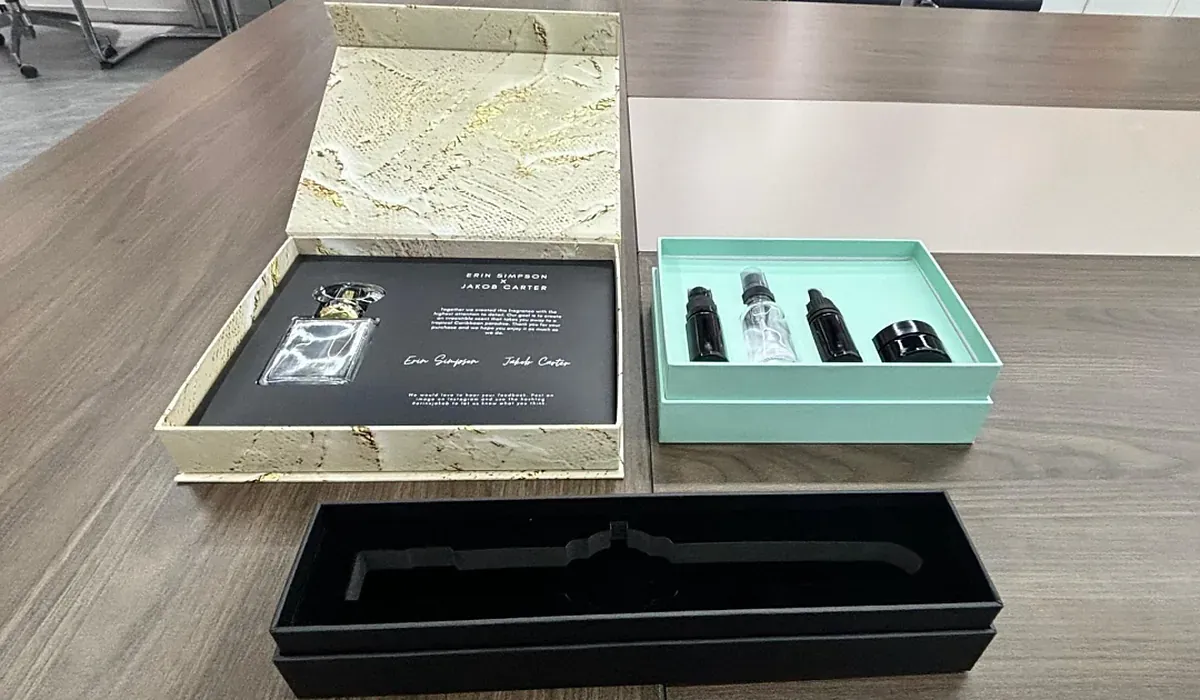
The strongest interiors often combine both philosophies: a thermoformed tray holding small components, seated on a printed paper platform; or paper collars locating a main product while a tray carries accessories beneath. Hybrid builds let each material do what it does best and usually reduce polymer content at the same time. Design them together rather than sequentially, because the connection points between tray and paper decide whether the combined interior feels engineered or improvised.
Common Failure Modes by Interior Type
Trays fail by fit: cavities sized from drawings without production samples crack tight products or rattle loose ones, and thin walls whiten or split at stress points. Paper fails by folding: collars that loosen with humidity, creases that crack on coated board, and pads that bow under lid pressure. Both fail when the product changes size between seasons without the interior being revised. Insist that interiors are validated against production intent products, not only against artwork files.
QA for Tray and Paper Interiors
Inspection follows AQL sampling with checks specific to each interior. Trays are measured for cavity registration, wall thickness feel and freedom from flash at parting lines. Paper interiors are checked for fold integrity, aperture grip and print alignment. For both, inspectors assemble the interior into pulled boxes with representative product weight and confirm nothing shifts or squeaks. Retention samples from the approved batch anchor future reorders, so drift is caught early.
Packing and Transit Notes
Trays stack and nest efficiently; folded paper interiors pack flat in pads. Boxes travel nested at 100 pcs per master carton with weight under the 22 kg limit, and interiors rarely change that planning. Label cartons to show whether interiors are pre fitted or shipped separately for local assembly, since a tray installed backward or a pad installed upside down is a common and entirely preventable packing error at receiving warehouses.
Matching Interior to Product Category
Categories guide the choice. Thermoformed trays dominate electronics, tools, medical and food service where precision and clean surfaces rule. Paper interiors dominate premium food, beauty, stationery and gift packaging where print and warmth matter. Jewelry and watches often use foam or trays; candles and confectionery usually paper. When a category is mixed, hybrid interiors resolve the tension. Treat these patterns as starting points and validate with sampling, because products within a category vary enormously.
Ordering: Sampling and Terms
Both interiors can be developed within modest programs: runs begin at 100 pcs per design, and thermoformed trays benefit especially from small first batches because mold revisions are cheaper than tooling regrets. Samples arrive in about 5 days; production takes 10-20 working days after approval; payment terms are a 30% deposit with balance before shipment. Sample both interiors if the decision is close, since handling the real article with the real product settles debates that drawings cannot.
Factory Capability for Both Interiors
Our factory has produced both interior families since 1998 from a 5,000 m² plant where 100 staff cover forming, die cutting, wrapping and assembly, with annual output near US$10 million. Buyers across 80+ countries and programs for 50+ brands, over 1,000+ cases, mean both tray and paper interiors have long production histories here. That matters for hybrid projects especially: when one team controls both materials, the interfaces are designed rather than negotiated between separate vendors.
A Decision Checklist in Prose
Work the decision in this order. Define protection needs by product weight and fragility. Define presentation needs by how the interior should look and photograph. Check compliance context for food, cosmetic or technical categories. Then compare tooling and total cost at your real volumes, including assembly labor. Finally, sample the leading option against the production intent product. Buyers who follow this sequence rarely change interiors after launch, which is the true measure of a correct decision.
Frequently Asked Questions
When does a thermoformed tray beat a molded pulp insert for electronics?
Trays win when the product has complex geometry, tight tolerances or surfaces that must not rub. A molded cavity touches the device exactly where engineering intends, while pulp pads locate more coarsely and can shed fibers onto black surfaces. For devices with lenses, ports or coated casings, the tray's precision and clean surface usually decide the comparison.
Can a plastic tray be tinted to match brand colors exactly?
Yes. Resin can be tinted during forming, and opaque or translucent effects are both achievable. Exact matches are confirmed on molded samples rather than on swatches, because forming changes perceived tone slightly. For brands needing precise color across many batches, keep a retained reference tray and specify it as the approval standard for every reorder.
Do clear trays scratch easily inside a rigid box?
Clear surfaces show scuffs more than opaque ones, but in normal use a tray is protected by the box itself. Scratching happens mainly during packing or when trays slide against each other without interleaving. Requesting interleaved packing, choosing textured or matte surfaces, or using a soft touch finish all reduce visible wear in retail environments.
How are molded trays held in place so they cannot shift inside the box?
Trays are sized to the interior with locating ledges, small glue dots at corners, or retention features molded into the base. Wide flat trays gain stiffness from ribs so they do not dome under lid pressure. The validation is simple: a packed box is shaken and the tray must not travel. Any movement found in sampling is fixed by adjusting the ledge or adding discrete anchors.
Which interior is cheaper when a brand reorders small quantities often?
Paper usually wins that pattern. A die lasts for years and small runs are quick to produce, while tray molds make short reorders expensive per unit. If volumes are genuinely small but precision demands a tray, ask about existing mold families that can be adapted, or reserve the tray for the flagship size and use paper across the rest of the range.
Can one tray serve products that vary slightly between production batches?
Trays tolerate small variation through cavity clearance and spring in the walls, but they are less forgiving than foam or layered paper builds. If your product varies between batches or suppliers, tell the factory at design time. Relief cuts, softer wall sections or a hybrid cavity with a paper pad can absorb the range without loosening the fit noticeably.
Conclusion
The tray versus paper decision rewards buyers who define the problem before choosing the material. Precision, compliance and volume favor molded trays; warmth, print and recycling favor paper; most ambitious packages combine the two. Whatever the direction, validate the interior against the production intent product and revisit total cost, including assembly labor, before committing. Our team builds both interiors under one roof and can price each path quickly. Send product details and target volumes, and Request a Wholesale Quote for factory direct pricing on thermoformed trays and paper insert alternatives.