Buying Guides
Round and Hat Boxes: Building the Circle
Round and hat boxes: curled wall forming, lid and base discs, diameter and depth sizing, bouquet and textile gifting, MOQ from 100 pcs, factory since 1998.
Opening
Round hat boxes are the oldest silhouette in premium packaging and still one of the hardest to make well. A square box is five flat panels joined by four folds; a circle has no folds at all, only one continuous curved wall that has to hold its shape from the day it leaves our factory in Humen, Dongguan until the day a customer lifts the lid. This guide explains how that curve is actually formed, how diameter and depth drive the size ladder, where round hat boxes earn their place in gifting today, and where a round build needs reinforcement before it can be stacked and shipped.
The buyers who order rounds from us run a consistent set of categories. Millinery and apparel labels want the heritage hat box with a ribbon handle. Florists and subscription services want a deep round with a lid that lifts cleanly off a bouquet. Textile houses roll scarves and knitwear into wide, shallow rounds that photograph beautifully and live on as drawer storage. Across 1,000+ cases since 1998, the same lesson repeats: the circle forgives nothing at specification stage, because every weakness in a round build — a soft rim, an undersized disc, a loose lid — shows on the finished box and cannot be folded away the way a square box hides its faults in a crease.
Use this guide in one pass before briefing a quotation. Buyers who arrive with diameter, depth, board weight and closure already decided receive a digital sample in about 5 days that settles the remaining questions; buyers who leave the geometry open receive a sample that answers questions nobody asked. The sections below follow the order in which those decisions should be fixed, forming logic first and the production calendar last.
How Round Hat Boxes Are Formed
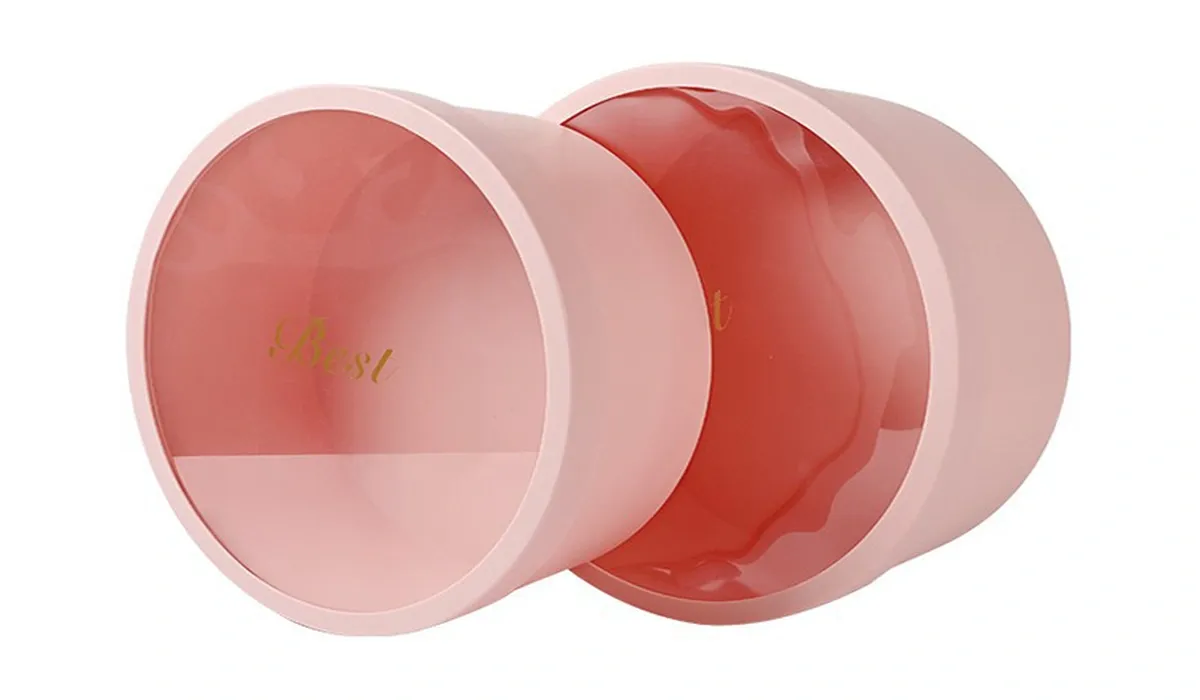
A round box is assembled from three parts: a bottom disc, a wall band curled around that disc, and a lid that is itself a shallow drum with its own top disc. The wall band starts as a strip of 1200 g greyboard wrapped in 157 g art paper; the strip is rolled around a former until the wrap closes on itself, then the bottom disc is fitted into the curl, the joint is secured and the wrap is smoothed to a continuous surface. The lid repeats the exercise at a slightly larger diameter, so it drops over the base wall with a clearance of a fraction of a millimetre — tight enough to stay put when the box is lifted by the lid, loose enough to remove with one hand.
Forming is largely a bench operation, and that shapes the economics. Every seam is aligned by an operator, every lid is checked against its own base, and the wrap must be worked around the curve without creases, because a curved surface shows every ripple under shop lighting. This is why round builds sit at the premium end of a product range and why the unit cost per size holds its character as quantities rise: the material is not the expensive part, the judgement in the forming is.
The structure also explains the behaviour under load. A curved wall distributes a radial load around its circumference instead of concentrating it on a flat panel, so a round box resists crushing better than a square one of the same board weight. But the same geometry gives the build almost nowhere to hide. There is no corner to stiffen the wall, no flap to double the board at an edge, and no place where a fault can be tucked out of sight. What strength a round box has is decided by the board call and by the disc fits, both of which are chosen at specification, long before the box reaches a shelf.
One consequence matters for artwork planning: the seam where the wrap closes on itself is a visible line on every round box. It can be positioned — usually at the back of the drum, aligned with the lid seam so the two read as a deliberate vertical line — or it can be worked into the design as a feature. What it cannot be is hidden. Buyers who plan the seam position with the artwork avoid the most common complaint on first samples, which is a seam that lands in the middle of a logo.
Diameter, Depth and the Size Ladder
Sizing a round box is a two-number decision with a quadratic sting. Capacity grows with the square of the diameter, so a circle twenty per cent wider across holds nearly half as much again, while depth adds only linearly. Buyers who scale a round box by eye usually overshoot the diameter first, because a proportion that looks restrained on screen balloons in the hand. We ask for the product rather than the target size: laid flat, a rolled scarf or a coiled belt dictates the minimum inner diameter, and the number of items stacking inside dictates the depth.
Proportion is the second decision, and it is a stylistic one with engineering limits. Deep, narrow rounds read as hat boxes and carry the heritage cue; wide, shallow rounds read as textile or confectionery presentation. As a rule of thumb, the depth of a hat-style round sits between half and two-thirds of the diameter. Below a third, the box starts to read as a plate; above three-quarters, the lid becomes awkward to lift with one hand and the rim carries more load than it was engineered for. The lid overlaps the base wall with a shallow return, and that return is what a customer grips, so it needs enough height to hold a thumb comfortably.
Board follows geometry. Shallow rounds at the small end of the diameter range run comfortably in 300 to 500 g folding board where an outer carton shares the protective work; deep rounds and hat formats move to 1200 g greyboard because the curved wall carries the load alone. The 157 g art paper wrap is standard on both, thin enough to take lamination and foil without burying the seam line or rounding the edge of a printed panel. Buyers upgrading a programme from shallow to deep formats should expect the board specification to change with the geometry — the wrap, print and finish carry across, the structure does not.
There is also a nesting decision to make early. Rounds can be engineered so bases nest inside one another for transit and lids stack separately, which raises the count per carton and lowers freight per unit, at the cost of packing labour at your warehouse. Or each box can be assembled before packing, which protects the seam and rim better but costs cube in the master carton. Both are legitimate; the right answer depends on whether your team assembles or fulfils direct.
Gift Scenarios: Hats, Bouquets and Textiles
The hat box survives because the heritage cue still sells. Apparel and millinery brands use the round box with a ribbon handle as a keepsake container that outlives the purchase, and the proportions have barely moved in a century: deep body, fitted lid, handle anchored through the rim. What has moved is the expectation of finish — the modern version arrives matte-laminated, foil-stamped in a restrained palette and packed with tissue, closer to a jewellery purchase than to the bare board of the tradition it borrows from.
Florists and gift subscription services approach the same silhouette from the other direction. A bouquet round needs depth for the stems, a lid that lifts fully clear rather than hinging out of the way, and a rim strong enough to survive being handed across a counter; where fresh stems are packed, ventilation and an inner surface that tolerates moisture are confirmed on the specification rather than assumed. The round shape flowers naturally — the bouquet sits in the centre and the petals find the curve — which is why the format has replaced the fluted box in many premium flower programmes.
Textile brands use wide, shallow rounds for rolled scarves, folded knitwear and bundled socks: categories where the product is soft, the box provides the form, and the container often becomes drawer storage afterwards. That second life matters commercially. A box that survives as storage keeps the brand in a wardrobe for years, which is why textile buyers spend on interior finish rather than exterior complexity — a clean printed interior and a fitted lid earn more repeat impressions than a third foil colour.
The common thread across all three is the reveal. A round box opens with a circular unwrapping motion that films well, and gifting categories keep choosing it for launches for exactly that reason. Specifying for the moment — a lid that lifts without scraping the wall, an interior that reads clean in close-up, a ribbon that falls rather than creases — costs nothing at sampling and cannot be retrofitted after production. Ask for the reveal to be tested with the real product at sample stage, not described in a drawing.
Reinforcement and the Stacking Question
Rounds have three known weak points and all three are visible at sampling if you look. The first is the lid rim: a shallow return flexes under a stack, so deep or large-diameter lids take a board upgrade or an inner return folded back on itself. The second is the base disc, which carries the whole column load when cartons are stacked in a warehouse; deep formats take an additional disc or a thicker call so the base domes less under load. The third is the seam, where the wrap closes under tension; a seam under stress whitens and lifts, so its position and finishing are part of the wrap plan rather than an operator decision on the day.
Stacking is where round and square diverge most. Square boxes bear on corners and stack in a solid column; rounds bear on curved surfaces and rock unless the lid return is engineered for the load. On a shelf, two or three stacked rounds present beautifully when the diameters step down in a deliberate ladder. In a master carton, the voids between circles cost freight, so nesting matters more than density. A small round can pack 100 pcs per master carton inside the 22 kg ceiling; a hat-format box packs a fraction of that, and the carton count is calculated per size before the quotation is issued, not discovered on the first freight invoice.
Verification is practical rather than theoretical. At sample stage we load a master carton, stack it and tilt it, watching for lid lift, seam stress and base dome; at production, finished boxes are sampled to AQL before packing so the cartons that leave the line have been checked against the approved master. An empty round that passes on a bench can still fail the loaded-carton test, which is why the loaded check is part of the sampling sequence for every new round size and every new diameter.
The reinforcement budget is best spent in one place rather than spread thin. A board upgrade at the wall protects the rim, the base and the stack in a single decision; three small patches and inserts add cost and assembly passes without changing the behaviour of the structure. When a buyer brings us a round box that failed in transit, the fix is usually one specification line — wall board, disc thickness or lid return — not a redesign.
Specification, Sampling and Production
MOQ starts from 100 pcs per size and design, which keeps a size ladder affordable: a three-size hat programme is three 100-piece decisions rather than one large gamble. A digital sample in about 5 days shows the proportion, the lid fit and the seam quality; after approval, mass production runs 10 to 20 working days. Payment is 30 percent deposit with the balance before shipment. A complete specification receives a full quotation within about 24 hours, and technical questions are answered within 12 hours, so the calendar from brief to shipment holds before you commit.
The floor behind those numbers: our 5,000 m² factory in Humen, Dongguan runs about 100 staff across forming, wrapping and inserting as consecutive cells, with annual output near US$10 million. We ship to 80+ countries and work with 50+ brands, so a first 100-piece order sits inside a normal production flow rather than at its margins. FSC-ready board is available on request for both the greyboard and the wrap; flag the requirement at quotation so certified stock is allocated before production scheduling and the delivery date does not move.
Send three things with the brief and the quotation nearly writes itself: the product or its flat dimensions, the channel the boxes ship through, and the gifting moment you want the unboxing to deliver. Add the colour call for interior and exterior, and any ribbon or handle requirement, at the same time, because both alter the wrap plan. Questions that arrive mid-production cost days; the same questions asked with the brief cost a paragraph in an email.
Frequently Asked Questions
What board weight do you use for round hat boxes?
Deep rounds and hat formats are built in 1200 g greyboard wrapped in 157 g art paper, which keeps the curved wall smooth and the rim firm. Shallow, small-diameter rounds can run in 300 to 500 g folding board when an outer carton shares the protective work. The final call follows the diameter, the depth and the transit route, confirmed on the sample before mass production.
Are round boxes stronger than square boxes?
A curved wall spreads a radial load around its circumference, so a round box resists crushing better than a square one of the same board weight. The trade-off is stacking: rounds bear on curved surfaces and need an engineered lid return, while squares bear on corners. We reinforce deep formats with an extra base disc and test stacking with a loaded master carton at sampling.
What sizes can round and hat boxes be made in?
Diameter and depth are both made to order, so there is no fixed size ladder — the inner diameter is set by the product laid flat, and the depth by how many items stack inside it. As proportion guidance, hat-style rounds run with a depth between half and two-thirds of the diameter. Bring the product or its flat dimensions and we calculate the rest on the dieline.
What is the MOQ for custom round boxes?
MOQ starts from 100 pcs per size and design, so a three-size ladder is three separate 100-piece decisions. Because forming is largely a bench operation, there is no complex-tooling threshold on most rounds; the quotation confirms the exact quantity for your diameter, closure and finish. A full quotation is issued within about 24 hours of a complete specification.
Can round hat boxes ship nested in master cartons?
Yes, and nesting is the sensible default because circles leave voids between them in a square carton. Lids and bases can be packed as components where the format allows, which raises the count per carton. A small round can approach 100 pcs per master carton within the 22 kg ceiling, while a hat format packs far fewer; carton counts are calculated per size at quotation.
How long does sampling and production take?
A digital sample takes about 5 days from a complete specification, and mass production runs 10 to 20 working days after sample approval. Payment is 30 percent deposit and the balance before shipment. Technical questions are answered within 12 hours and the quotation follows within about 24 hours, so the calendar from brief to shipment is predictable before you commit budget.
Conclusion
A round box succeeds or fails on decisions artwork cannot rescue: the diameter and depth that fit the real product, the board that carries the curved wall alone, the lid return that lets it stack, and the seam position that survives close inspection. Fix those four at briefing and the circle becomes the most memorable silhouette on the shelf; leave them open and no foil or ribbon saves it. Send the product dimensions, the sales channel and the gifting moment you want filmed, and Request a Wholesale Quote from our factory in Humen, Dongguan — the quotation arrives within about 24 hours and the digital sample within about 5 days.