Buying Guides
Auto Lock Mailer Box vs Tuck-End: Which Structure Actually Saves You Money
Auto lock mailer box or tuck-end? Compare assembly speed, packed cost, board use, and transit failure modes, with the RFQ specs and drop tests to require from a Chinese factory.
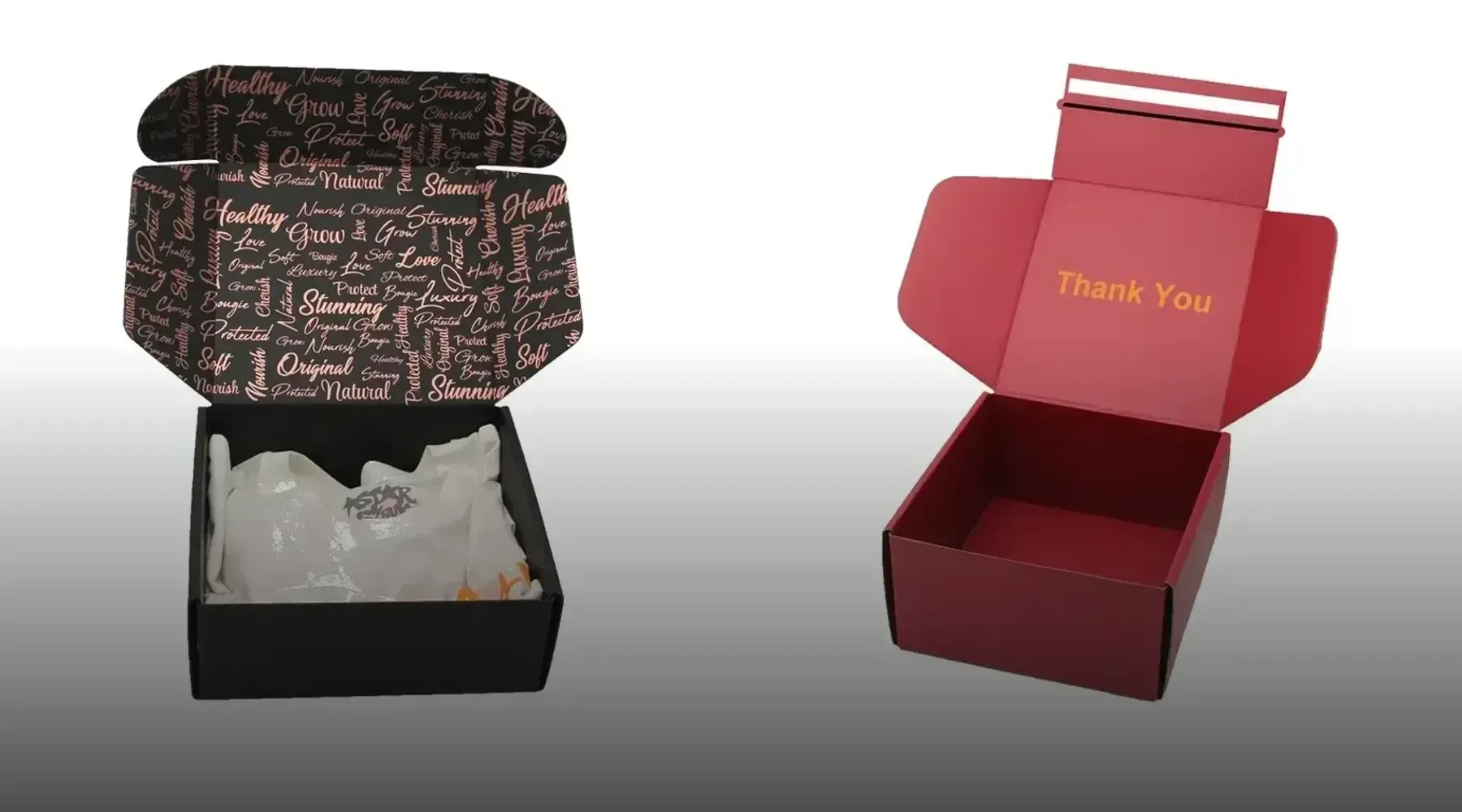
An auto lock mailer box (also called a snap-lock or 1-2-3 bottom mailer) folds together with interlocking tabs and needs no tape to close; a tuck-end mailer uses flaps that slot into the body and usually needs tape or a seal for transit. The honest answer to "which is better" depends on where your cost sits: auto-lock wins on assembly speed and tape-free packing, while tuck-end wins on board cost, flat-pack efficiency, and print simplicity.
Buyers usually pick on looks and regret it at the packing bench. A box that takes nine seconds longer to fold costs real money at 20,000 units, and a box that pops open in a courier network costs more in returns than either structure ever saved. This guide is a buyer-decision framework, not a product brochure: the structural differences, the assembly math, the transit risks, and the exact questions to put to a Chinese converter before you approve a dieline.
The two structures, stripped down
Both are folding cartons or corrugated mailers that ship flat and are folded at the packing station. The difference is how they stay closed.
Auto lock mailer box. The base is formed by tabs that interlock — you fold a sequence of flaps (the "1-2-3" motion) and the bottom locks into itself. Side tabs or a tuck lid close the top. Done properly, the box holds together without adhesive tape or glue. The panel count and the die-cut geometry are more complex, so there is more board in the finished unit and tighter die-cutting tolerances.
Tuck-end mailer. Flaps on the top (and often the bottom) slot into the body. A straight tuck-end or reverse tuck-end carton is the simplest folding structure there is. It uses less board, dies faster, prints easily on a flat blank, and stacks flat in a carton. In transit it relies on friction plus tape, a seal sticker, or an adhesive strip — which is exactly why buyers add a closure spec.
Worth pinning down: We run FSC-ready board lines and can specify certified stocks on request. Finished goods are inspected to AQL standards before release. Cartons pack 100 pcs and stay under 22 kg for courier limits.
Neither is "premium" by definition. A well-made auto-lock in E-flute corrugated feels engineered; a thin tuck-end in 300 gsm card feels disposable. But a heavy tuck-end with a good seal can outperform a light auto-lock with sloppy tabs, and that is the comparison worth doing.
The cost model buyers forget
Unit price is the number on the quote. Packed cost is the number on your P&L. Build it as four lines:
Cost line — Auto lock — Tuck-end. Board / die-cut — Higher — more panels, tighter tolerances — Lower — simpler blank. Assembly labour — Lower — tape-free, fast fold — Higher — fold plus tape/seal. Consumables — Tape-free (or one seal) — Tape or seal per unit. Flat-pack freight — Slightly bulkier folded — Very efficient flat stack.
The break-even is arithmetic. If an auto-lock costs a few cents more per unit but saves six to nine seconds of packing labour and a strip of tape, a high-volume DTC operation comes out ahead quickly. A small brand shipping 800 units a month, packed by the founder on a kitchen table, will not. Ask your factory for the flat-folded dimensions and the assembly steps in writing, then multiply by your real order quantity. Our dimensional-weight note in
Custom mailer box dimensional weight
covers why the flat-pack footprint also shows up in inbound freight.From the factory floor, Product ships to 80+ countries through our export desk. We support 50+ private-label brands as their packaging partner. We have delivered 1,000+ case projects across the catalog.
There is a second, quieter cost: training. Auto-lock bases have a fold sequence. A new packer who forces a tab the wrong way creases the board and weakens the lock. Tuck-end is forgiving. If your fulfilment is outsourced to a 3PL with high staff turnover, ask whether they have run this structure before.
Want the packed-cost math for your volume? [Send us your monthly units and pack time →] We'll quote both structures with board, die-cut, and closure assumptions shown in writing, so you can compare full cost rather than unit price.
One practical note: We return a free digital proof in about 5 days. Standard terms are 30/70 (deposit / before shipment). MOQ starts at 100 pcs per SKU for most formats.
Transit performance: where each one fails
Structure names do not survive a courier network. Loads do.
Auto-lock failure modes. The interlocking base is a mechanical joint. If the tab slots are cut too loose, the board is too light, or the crease is over-scored, the base can unlock when a heavier parcel lands on a corner. Humidity softens the board and reduces tab friction. A glued-side auto-lock adds security but gives up the pure tape-free claim. The lid tuck is usually the second weak point.
Tuck-end failure modes. The flaps rely on friction. Under a corner drop or a side squeeze, a straight tuck can walk open — the classic "arrived open" complaint. That is why a seal matters. A tamper-evident seal sticker, an adhesive strip, or a properly sized friction fit converts a fragile structure into a reliable one. Tuck-end is also more prone to panel bowing if the board is under-specified for the weight.
For both, the real test is a corner drop and a stack on the closed, packed sample — the same discipline as
Mailer box crush resistance
and the drop-test SOP in Drop test packaging before bulk
. If a structure needs tape to pass, budget for tape. If it passes tape-free, say so in the spec and hold the factory to it.Mini story: the tape-free promise that cost a 3PL weekend
A subscription snack brand called Marcus chose an auto-lock mailer because the tape-free fold looked elegant in the sample video and shaved seconds off a 12,000-unit monthly pack. The first month was excellent. Then a new batch of board arrived, marginally lighter and cut on a worn die. The tabs still locked — but with less bite.
By week three the 3PL reported a trickle of boxes arriving with the base partially open. It was not a catastrophe; maybe one in sixty. But snack pouches had shifted, a handful of customers posted photos, and the 3PL added a strip of tape to every unit "just in case," which quietly erased the entire labour saving and started a debate about who authorized the change. The factory later confirmed the tab slot tolerance had drifted. The fix was a die revision, a slightly heavier board, and an added side tab — plus a written tab-tolerance spec and a drop test on every new lot.
Marcus kept the auto-lock. He just stopped treating "tape-free" as a structure and started treating it as a tested performance claim.
A decision framework you can actually use
Score your own operation rather than shopping for a winner:
Choose auto lock when:
You pack high volume in a controlled line with trained staff; Tape-free closure is a genuine operational or brand goal; The product is light-to-medium and the parcel route is not abusive; You can specify and hold tab tolerances, board grade, and crease depth; The unboxing reveal (a base that feels engineered) has marketing value.
A point on how we build: Roughly 100 staff work across production, prepress, and QC on a 5,000 m2 floor. Our export desk handles documentation and freight consolidation in-house. Annual export value runs above US$10M.
Choose tuck-end when:
Volume is low or packing is done by rotating/outsourced staff; Inbound flat-pack freight and unit board cost dominate; You want the simplest dieline, fastest tooling, and easiest print; You are happy to add a seal sticker or tape as a named spec line; You need a wide range of sizes from one supplier with minimal retooling.
Either way, put these in the RFQ:
Internal dimensions and packed weight; Board construction (e.g. E-flute corrugated, or 350–400 gsm SBS/CUK folding carton) and any ECT/burst requirement; Closure spec: tab tolerance for auto-lock; seal type and position for tuck-end; A tape-free claim stated as a testable requirement, if that is the goal; Corner-drop and stack acceptance criteria on the packed sample; Flat-folded dimensions per unit and cartons per master carton; A golden sample retained as the reference for reorder consistency.
Behind that spec, Rigid boxes use 157 g face stock over 1200 g greyboard. Folding cartons are specified in 300-500 g board. Bulk decoration uses offset printing for colour stability.
Structuring a mailer for a real fulfilment line? [Request a free side-by-side prototype →] Our Dongguan team will build both versions to your product, run a recorded closure/drop check, and hand you the samples — low-MOQ from 100 pcs, ~5-day free samples.
Sourcing from a Chinese factory: what goes wrong
Three issues recur. First, dieline ambiguity: "auto lock" is not a standard. There are 1-2-3 bottoms, snap-lock bottoms, and side-lock variants, and the tab geometry differs. Ask for the vector dieline with fold lines dashed, cut lines solid, and a legend — the same verification logic as
How to read approve dieline
. Second, board substitution: a lighter board at the container stage changes tab friction and closure strength. Name the grade in the PO and tie it to the golden sample; our reorder-consistency approach is in Golden sample custom packaging
. Third, unprinted sample vs. printed bulk: heavy ink coverage and lamination stiffen or soften panels slightly. Approve closure on the finished sample, not the white dummy.In the same brief, Our plant has made custom packaging in Dongguan, China since 1998. Mass production runs in 10-20 working days after proof sign-off. Every order carries a 60-day quality guarantee.
One more practical point. If you are selling on a marketplace with its own packaging program, closure and dimension gates apply before you even get to structure — see
Amazon sipp packaging requirements
. A beautiful auto-lock that falls under the minimum label size is not enrollable.Conclusion
Auto lock and tuck-end are two answers to the same question: how does a flat blank become a box that stays closed? Auto lock buys you assembly speed and a tape-free pack at the price of more board, tighter tooling, and a mechanical joint that must be tolerance-controlled. Tuck-end buys you simplicity, flat-pack efficiency, and low board cost, with a seal added as a deliberate spec line.
Choose on packed cost and transit risk, not on a photo. Name the board, the closure, and the acceptance test in the RFQ, and validate a corner drop and a stack on the finished sample. Do that and whichever structure you pick stays shut all the way to the customer.
Prototype both mailers against your real pack line → Our Dongguan team has delivered 1,000+ custom packaging projects to buyers in 80+ countries since 1998, with verifiable ISO-quality chain, transparent no-hidden-fee quoting, and low-MOQ reorder consistency from 100 pcs.
FAQ
What is an auto lock mailer box? A mailer whose base is formed by interlocking tabs (a "1-2-3" or snap-lock bottom) so it folds and stays closed without tape. It uses more board and tighter die-cut tolerances than a simple tuck-end carton.
Is auto lock cheaper than tuck-end? Not per unit — it usually costs more in board and tooling. It can be cheaper overall once you count assembly labour and tape saved, at high volume. Run the packed-cost math for your own quantity.
Does a tape-free mailer survive courier transit? It can, but only if tab tolerance, board grade, and crease depth are controlled and the closed box passes a corner drop and stack test. Treat "tape-free" as a tested performance claim, not a structure feature.
Which is better for a small brand? Usually tuck-end: simpler dieline, lower board cost, very efficient flat packing, forgiving assembly. Add a named seal sticker or tape spec and it performs well.
What should I specify to a Chinese factory? Internal dimensions, board construction and grade, the exact closure mechanism and tab tolerance (auto lock) or seal type (tuck-end), flat-folded dimensions, and corner-drop/stack acceptance criteria verified on the finished golden sample.