Buying Guides
Window Boxes: Choosing the Film Behind the Aperture
Window boxes: PET, rPET and compostable film trade-offs, clarity versus haze, patching and die costs, film-free options, MOQ from 100 pcs, factory since 1998.
Opening
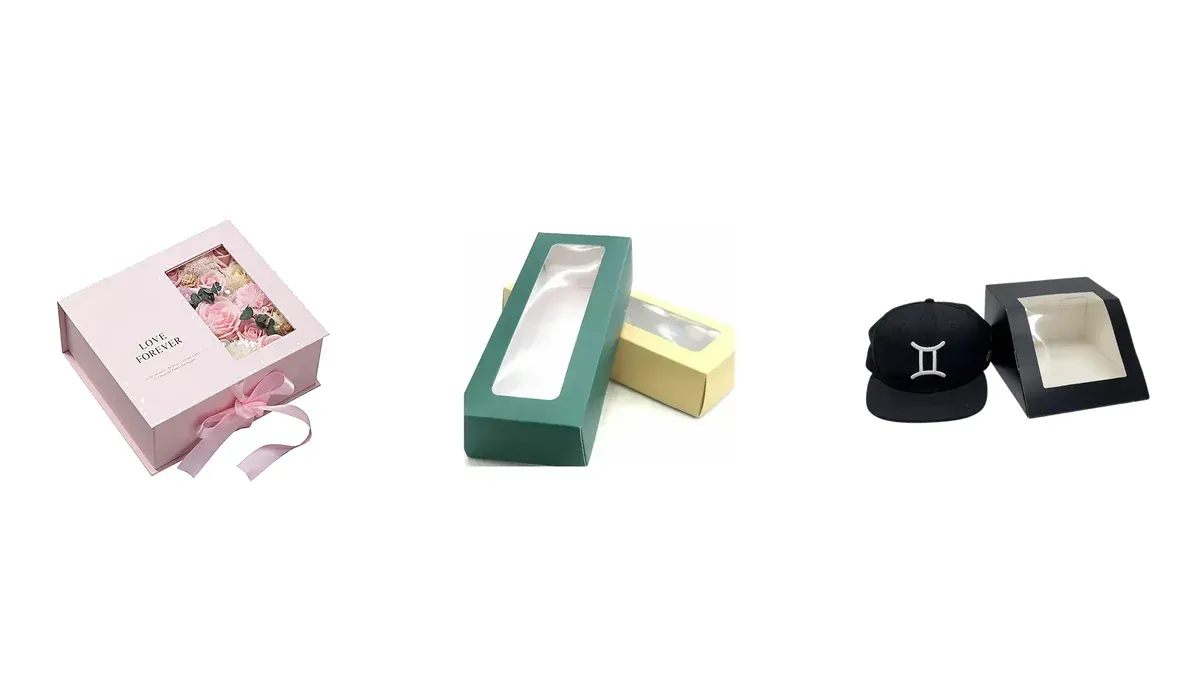
A window box is a promise: what is printed around the aperture is the frame, and what shows through it is the product. The film behind that aperture decides whether the promise lands. Clarity, haze, crease behaviour and the way a film accepts a glue line are all material decisions made before artwork, and they change how a shelf reads from two metres away. Window boxes are one of the few structures where a component the customer never touches does most of the selling, which is why the film deserves a specification of its own rather than a line in the notes.
These notes come from our factory in Humen, Dongguan, where we have produced windowed rigid and folding boxes since 1998. They answer the questions buying teams actually raise when a window moves from a designer mock-up to a specification: which film, how clear, how it is applied, what the aperture shape costs, and when to leave the window open entirely. Where the answer is a rule it is stated as one, and where it depends on the product and channel the trade-off is laid out so the decision can be made at the sampling table.
One boundary first. This guide covers film as a material and process decision. Anything that touches food, cosmetics or products with regulatory exposure is confirmed with documentation at quotation, and this article deliberately stays on the structural and optical side that packaging buyers control directly.
Film Types for Window Boxes: The Trade-Off You Are Choosing
Three film families cover the market, and the choice is a trade-off rather than a ranking. Standard PET film is the default: high clarity, stable on the glue line, predictable through a window-patching line, and the cheapest route to a crisp window. rPET carries recycled content and a different story on shelf, with the practical trade-offs that availability and batch-to-batch clarity need confirming per order. Compostable films exist as a category and are improving steadily, but today they trade optical clarity and cost against the claim, which is why they suit brands whose whole proposition is the claim rather than brands whose window exists to show sparkle. There are also specialty faces — matte films that read frosted, ultra-thin films that crease with the board — and each is chosen for an effect, not a default.
None of these are commitments a factory should make loosely. If recycled content or compostability is part of your brand message, the film specification and its documentation are confirmed at quotation, per order, not assumed forward from a previous job. The same discipline applies to the board behind the film: our programmes are FSC-ready, and certified board is allocated on request before production scheduling so the claim on the box and the material in it travel together. A window programme is exactly the place where environmental claims and physical components meet, so both halves of the statement get specified.
The practical starting point for most buyers is simple. If the window is doing optical work — showing colour, glitter, texture, fill level — standard PET earns its place on clarity and cost. If the marketing story needs recycled or compostable content, budget for specification work at quotation and accept that the film may haze slightly or cost more per unit. What fails in the field is choosing a film for a story it cannot carry, or discovering the story requirements at the packing line when the film is already ordered.
Clarity, Haze and the Crease Line
Clarity and haze are different measurements that buyers often blur. Clarity is how crisply you see through the film straight on; haze is how much light the film scatters, which reads as milkiness at an angle. A film can be clear face-on and hazy in raking shelf light, which is why we check film under lighting similar to the intended channel at sampling rather than against an office window. What matters commercially is that haze dulls the very detail a window exists to show: glitter on a candle, foil on a confectionery band, the colour of a soap or the fill level of a gift set. Two metres away, haze reads as a film; clarity reads as product.
Thickness changes behaviour more than it changes optics. A thicker film stands stiffer, resists denting on a rigid box face, and survives handling without scuffing through. A thinner film creases with the board, which matters enormously on a folding carton that ships flat, because film that will not crease cleanly buckles at the fold, and the buckle is visible exactly where the eye goes — the frame of the window. On folding cartons in 300 to 500 g board we match film to the crease first and the optics second; on rigid faces in 1200 g greyboard the film never creases, so stiffness and clarity lead the choice instead.
Static and scratch belong in the same conversation. Film on a dry production line attracts dust to the glue bead and inside the aperture, and a surface that scuffs in transit turns a premium window into a used one before it reaches the shelf. Both are specification items rather than surprises: state the channel and the climate, and the film choice accounts for the rub and the static it will actually see. A window specified for a boutique counter and one specified for marketplace fulfilment are different films, and the difference is cheaper at quotation than at the returns pile.
How the Film Meets the Aperture
Application is a process with tolerances, not a sticker. In volume, a window-patching line feeds the die-cut blank, applies a glue pattern around the aperture, registers the film and presses the two together in one pass. The buyer-visible consequences are three. The glue pattern must sit inside the film margin so no adhesive shows through the window. Registration must hold the film square to the aperture, because a film that drifts reads as a misprint rather than a window. And the film must lie flat with no curl at the edges, since edge curl catches light and dust in exactly the line the customer follows. When any of the three drifts, the window reads as dirty rather than premium, and no print quality rescues it.
Quantity decides the method. Above the MOQ of 100 pcs per design, patching on the line is the norm and the set-up is amortised across the order. Short runs and prototypes are hand-applied, which costs more per unit in labour but avoids committing to a patching set-up before the structure is proven. Neither method is inferior; they answer different stages of a programme, and the same box can move from hand-applied at trial to line-patched at rollout without changing its specification. A free digital sample in about 5 days shows the aperture proportions and position before either method is chosen, and the sampling stage is where aperture size and placement are settled cheaply.
Our floor is arranged for both methods running as consecutive cells. On our 5,000 m² site, 100 staff move die-cut blanks into patching and then into folding or rigid assembly without a second hand-off, which is why a window specification change at sampling moves cleanly into production scheduling. The mass production window after approval runs 10-20 working days, and patching sits inside that calendar rather than extending it, provided the film and aperture are frozen at approval the way board weights are.
Aperture Shapes and What They Cost
Aperture shape is a die decision, and dies sort into three cost tiers. A rectangular window with square or radiused corners cuts from standard tooling and is the cheapest aperture a box can carry. A shaped window — an arch, a circle, a silhouette traced from the product outline — needs a dedicated cutting die, a one-time cost amortised over the order and worth paying when the shape is part of the brand. A complex window with internal islands or fine fillets adds both die cost and patching difficulty, because the film must clear details the eye inspects closely and the glue line must follow a longer edge. Most programmes live happily in the first two tiers.
Two geometry rules save money without hurting the design. First, round every internal corner of the aperture, because radiused corners distribute stress and resist the film lifting at the corner, which is where windows fail visually first. Second, keep a printed margin between the aperture and any critical artwork, since the glue line and the registration tolerance live in that margin. An aperture that butts directly against a foil logo or a character illustration is asking the patching line for a precision the unit cost does not buy, and the result at production speed is a slightly ragged frame on some units in every run.
Scale settles whether a custom shape is worth its die. Across 1,000+ cases the pattern is consistent: programmes that will run for many cycles absorb a shape die quickly and use the shape as a shelf signature, while one-shot seasonal runs stay rectangular and spend the difference on the print around the window. The same arithmetic runs through packing, because the window does not change the carton: 100 pcs per master carton, capped at 22 kg, whether the aperture is plain or elaborately shaped. For 50+ brands the window has become part of the logo system itself, repeated across a range with the same corner radii and margins, which is the moment a packaging detail turns into brand property. The volume behind that pattern is real: about US$10 million in annual output, shipped to 80+ countries, with window programmes running on the same floor as every other structure.
When a Window Works Without Film
An open aperture — no film at all — is a legitimate choice, and it wins in three situations. Where the customer is meant to touch or smell the product, an open window is honest in a way film is not. Where the box is a sleeve or band around a product that already carries its own container, the aperture needs no protection because the product protects itself. And where the surrounding pack is handled quickly, from shelf to basket within days, the dust and scuffing that film prevents never accumulate. The trade-offs are equally direct: an open window admits dust, offers no tamper indication, and transfers moisture from the room straight to the product edge, so it asks more of the storage discipline around it.
Structure changes the answer. On a rigid face in 1200 g greyboard the aperture edge stays crisp through handling, so open windows read cleanly and deliberately. On a folding carton in 300 to 500 g board an open aperture can look limp unless the panel is reinforced or the aperture kept small. The 157 g art paper wrap on a rigid window box frames the aperture and carries the print that makes the frame worth looking at, which is why rigid gift boxes with open windows feel finished while folding ones with the same idea can feel accidental. For anything edible or cosmetic that contacts the aperture edge directly, requirements are confirmed with documentation at quotation rather than assumed from a sample.
The decision test is the product, not the film. If what the buyer needs before purchase is confidence, film the window. If what the buyer needs is access, smell or touch, leave it open and design the aperture edge properly. Commercially both routes run on the same terms from our side — 30 percent deposit with the balance before shipment, inspection to AQL before packing — so the choice stays a design decision rather than a procurement penalty, and it can be reversed at the next run without renegotiating anything.
Frequently Asked Questions
Which film should I choose for a custom window box?
For most programmes standard PET film is the right default: high clarity, stable on the glue line and predictable in patching. Choose rPET when recycled content carries the brand story, and compostable film only when that claim justifies lower clarity and higher cost. Film specification and its documentation are confirmed at quotation, so the claim printed on the box always matches the material applied to it.
Does the film affect how the box creases?
Yes, on folding cartons. Film that cannot crease cleanly buckles at the fold line, and the buckle sits exactly at the frame of the window where the eye lands. On cartons in 300 to 500 g board we match film to the crease first and optics second. On rigid faces in 1200 g greyboard the film never creases, so stiffness and clarity lead the choice instead.
What does a shaped window cost compared with a rectangle?
A rectangular aperture cuts from standard tooling and is the cheapest window a box can carry. A shaped aperture needs a dedicated cutting die, a one-time cost amortised across the order, so programmes that run for many cycles absorb it quickly while short seasonal runs usually stay rectangular and spend the difference on print. Radius every internal corner either way, because corners are where film lifts first.
Can the window be left open without film?
Yes, and it suits products meant to be touched or smelled, sleeves around already-contained goods, and fast-turning retail where dust never accumulates. The trade-offs are dust, no tamper indication and direct moisture contact at the aperture edge. Open apertures read best on rigid faces in greyboard; on folding board the panel may need reinforcement so the edge stays crisp through handling.
What is checked on a window box at inspection?
Inspection to AQL covers the window specifically: no glue visible inside the aperture, film registered square to the cut, film lying flat without edge curl, and no scuffs or static-held dust on the visible face. Because 100 pcs per master carton is a fixed packing pattern, transit rub on film is a packing question we settle before dispatch rather than a claim to arbitrate afterwards.
How do sampling and production run for window boxes?
A free digital sample in about 5 days settles aperture size, position and film choice before tooling is committed. After approval, mass production runs 10-20 working days, with patching, folding or rigid assembly running as consecutive cells on our floor. Orders start from 100 pcs per design, payment is 30 percent deposit with the balance before shipment, and the film specification is frozen at approval like every other line.
Conclusion
A window box earns its cost at two metres, and the film behind the aperture is what makes it earn. Choose the film for the story it can carry, match it to the crease behaviour of the structure, keep apertures radiused and margined, and leave the window open only when touch or smell is the point. Send your product, channel and aperture idea, and Request a Wholesale Quote from our Dongguan factory — the specification questions are answered within about 24 hours and a digital sample follows in about 5 days.