Buying Guides
Custom Tea Packaging: Cartons, Tins and Pouches Compared
Custom tea packaging: cartons, tins and pouches compared for light, moisture and crush protection, inner bag portioning, tin gift builds, MOQ from 100 pcs.
Opening
Tea is a dry product that fails in three quiet ways: light dulls the aroma, moisture stales the leaf, and pressure turns intact leaf into dust that reads as poor quality in the cup. Custom tea packaging is the discipline of deciding which container fights which of those three, because no single container fights all three equally well. Cartons, tins and pouches each protect differently, and that comparison is the whole decision.
The judgments below come from our factory in Humen, Dongguan, where we have engineered paper packaging for tea, wellness and gift brands since 1998. We build the paper components — cartons, rigid gift boxes, sleeves and inserts. Tins and film pouches are compared here as a buyer's field, because the right answer often combines containers rather than choosing one, and the combination is where the paper factory does its work.
Read it once before briefing. A specification that names the container, the inner bag plan and the channel up front receives a quotation within about 24 hours and a free digital sample in about 5 days; a specification that leaves the container open receives three quotations and no decision.
What Tea Asks of Its Packaging
Light is the first enemy. The compounds that carry aroma and colour degrade under light exposure, which is why transparent windows are rarer in tea packaging than in cosmetics: what shows the leaf also ages it. A tea box that must display its contents does the displaying in print, not in plastic, and the inner layer takes over the light duty completely.
Moisture is the second. Kitchens are humid rooms, and tea spends its whole life near kettles. Staling is moisture and air finding the leaf, and the speed of staling decides whether a customer's second cup tastes like the first. No outer container wins this fight alone; the question is how much of it the inner bag must do by itself.
Crush is the third, and it is the one buyers underestimate. Whole leaf is a price position: broken leaf reads as dust in the cup regardless of what went into the bag. The crushing happens weeks before the customer — master cartons stacked in warehouses, on trucks, under other cartons — so the structural behaviour of the container under stacking is a quality decision, not a logistics detail.
The container decision is therefore a question of how much work the inner layer must do alone. A container that blocks light and resists crushing lets the inner bag concentrate on moisture; a container that does none of the three forces the inner bag to carry everything, and the format of that bag starts to constrain the brand.
Which enemy leads depends on the tea, and general category knowledge is enough to rank them. Green and lightly processed teas are the most sensitive to light and heat, which is why they dominate the opaque, tightly sealed end of the category. Darker and roasted teas tolerate light better but still stale on moisture, and herbal blends mostly fear crush and humidity, since their value sits in intact flowers and leaves rather than in delicate oils. Brief the tea type, not just the SKU count — the ranking changes the container recommendation more than the artwork does.
Custom Tea Packaging Compared: Cartons, Tins and Pouches
The paper carton is the workhorse. A folding carton in 300 to 500 g board offers the best print canvas of the three, ships flat, packs densely and keeps unit cost in line for supermarket and e-commerce volumes. It blocks light completely, resists crushing adequately when the board weight is chosen for the lane, and leaves the moisture work to the inner bag. For most tea brands, most of the time, the carton is the correct answer.
The tin, as general knowledge in the category, blocks light completely, seals tightly and signals value in the hand through weight alone. The trade-offs are unit cost, freight weight and denting in transit; tins are typically sourced from metal specialists rather than from a paper factory. The paper contribution is around the tin: the printed sleeve, the carton that carries it, and the gift box that presents it. A tin inside a printed outer is the standard premium build.
The stand-up pouch carries the strongest barrier films at the lowest weight and cost, and it loses on the shelf: it slumps, it reads as commodity, and its print surface is constrained. Its natural home is inside a carton — pouch for barrier, carton for presence. Sold alone, a pouch works for refill clubs and subscription refills where the shelf moment belongs to a box the customer already owns.
Hybrid builds are common enough to plan for. A sleeve over a pouch gives the shelf a printed face and keeps the pouch's barrier; a carton with an inner pouch gives both; a tin inside a printed outer gives weight and story. The pattern to notice is that the paper component appears in every hybrid, because print and structure are what paper does best and barrier is what film does best — the hybrid works when each layer stays in its own specialty.
The rigid gift tier wraps around any of the three: a rigid box in 1200 g greyboard wrapped in 157 g art paper turns a carton or a tin into a gift object, with flat walls, square corners and the print depth the category expects at gift prices. The tier decision is a channel decision, which is why it belongs at the start of the brief rather than the end.
The Inner Bag Does the Barrier Work
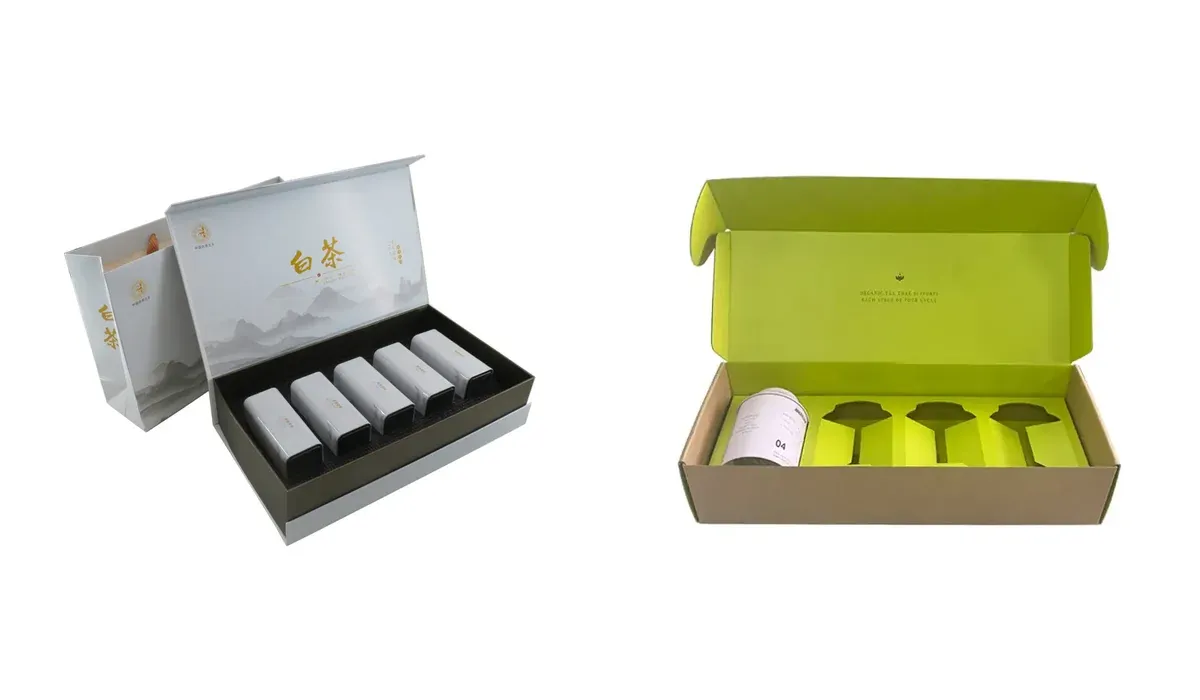
Portioning is the first mechanical question. Single-serve sachets, loose-leaf inner bags and two-chamber layouts each set different demands on the carton: sachet count drives the cavity, loose-leaf volume drives the depth, and a two-chamber layout — tea beside a strainer or a cup — drives the insert. The carton holds the count, the order and the presentation; the bag holds the atmosphere.
Tea is not a venting product: nothing inside the pack needs to escape, so the interior priority runs one way — keep air and moisture out, and keep them out for the whole shelf life. That is why tea cartons stay sealed and dense rather than airy, and why the inner bag's seal integrity is the specification detail to verify with the bag supplier. The box's contribution is to protect that seal from being the failure point through pressure and abrasion.
Closure styles belong in the same division of labour. A tuck-end carton closes cheaply and suits sachet-led packs that are consumed by the sachet; a reversible-lid carton opens flat and suits loose-leaf formats poured daily; a two-piece telescoping lid belongs to the gift tier. Resealability is the inner bag's job in all three cases — the carton closes the box, the bag closes the atmosphere — and a specification that asks one component to do both jobs usually pays for two.
Where a material claim touches the leaf, the rule is the same as in every consumable category: any food-contact or material suitability question is confirmed with documentation at quotation. The factory supplies material specifications; the brand confirms suitability with its own advisers. The division is deliberate, and it is applied across 1,000+ cases in categories where packaging touches consumables.
The master carton arithmetic runs on tea's paradox: the product is light, so actual weight rarely binds first. Small formats pack at 100 pcs per master carton with the carton capped at 22 kg, but dimensional weight can bite before actual weight does, because tea cartons fill with air faster than with grams. Compressing the cavity to the real volume of the portioned tea is both a freight decision and a crush decision — a loose box stacks worse and ships worse.
Gift Builds: The Tin in the Box
The classic tea gift build is a tin inside a rigid box: 1200 g greyboard wrapped in 157 g art paper, a platform insert holding the tin plus two caddies or an accessory, and a lid that opens to a composed scene rather than to loose product. The build works because each component does one job — the tin guards the tea, the platform holds the composition, the box carries the brand.
The economics are a set economics: the tin is sourced separately, the insert is engineered around the tin's actual dimensions, and the box is quoted for the set. If a tin already exists, send the tin rather than the drawing; the insert is cut to the real object, and a tenth of a millimetre of dent or seam decides whether the platform grips or rattles.
Across 50+ brands in tea and gift programmes, the pattern repeats: the gift box holds its structure across seasons while the wrap and the insert cards change with the collection. FSC-ready board is available on request for the box and the insert alike; flag the chain-of-custody requirement at quotation so certified board stock is allocated before production scheduling.
On our 5,000 m² floor in Humen, Dongguan, 100 staff run wrapping and inserting as consecutive cells, so a gift set is assembled as a scheduled pass rather than improvised at the end of the line. For a seasonal launch, that scheduling matters: the gift build books assembly capacity weeks before its dispatch date, and the brief that says so gets the slot.
Seasonal gifting extends the same build. A winter collection reuses the rigid structure with a changed wrap and new insert cards; a festival set swaps the tin for a double-caddy platform. The insert is the component that changes per season, and it is also the cheapest die in the build — which is why the gift programme should be designed from the start as a constant box with variable inserts, not as a new box every season.
Choosing by Channel, Then the Calendar
The channel picks the container. Supermarket and e-commerce ranges run carton plus inner pouch, where freight density and print decide the unit economics. Counter and gift ranges run tin in a rigid box, where presence and weight carry the price. Monthly tea clubs run carton with a variable sleeve — for the same reasons subscription programmes keep the box constant and move the novelty to lightweight print. Deciding the channel first collapses three quotations into one.
MOQ starts from 100 pcs per size and design, which makes a first collection across two or three container formats a realistic trial rather than a warehouse commitment. A quotation is issued within about 24 hours of a complete specification, and technical questions are answered within 12 hours.
A free digital sample takes about 5 days, mass production runs 10-20 working days after sample approval, and payment is 30 percent deposit with the balance before shipment. AQL inspection runs before packing, so every carton that leaves the line has been sampled against the approved master rather than merely counted.
Scale sits behind the calendar. The factory runs about US$10 million in annual output and ships to 80+ countries, which places a first order — and the seasonal reorder behind it — inside a normal production flow rather than at its margins. The calendar that works for the first collection works for the tenth.
Frequently Asked Questions
Which container should a new tea brand start with?
Start with a paper carton and an inner bag, because the combination covers all three protection needs at the lowest unit cost and the best print canvas. Upgrade to a tin-in-box gift build when a counter or gifting channel justifies the set economics. The pouch alone suits refill clubs, where the shelf moment belongs to a box the customer already owns.
How does a paper carton protect tea from light and moisture?
The carton blocks light completely, because opaque board is the cheapest light barrier in the category. Moisture is handled by the inner bag, whose seal integrity is the detail to verify with the bag supplier. The carton's remaining jobs are structural: resisting stacking pressure in transit and presenting the brand on the shelf.
How is tea portioned inside the box?
Three mechanisms cover most programmes: single-serve sachets counted into a cavity, a loose-leaf inner bag that sets the carton depth, and a two-chamber layout for tea beside an accessory. Sachet count drives the cavity dimensions, so the portioning decision belongs at the briefing stage, before the die is drawn.
Why put a tin inside a gift box rather than sell the tin alone?
The rigid box adds the gift reading — flat walls, square corners and a composed first impression — that a bare tin cannot carry, and the platform insert turns components into a scene. The set also lets the brand print the story on the box while the tin stays clean and reusable, which is the pattern most premium tea gifting follows.
What is the MOQ for custom tea packaging?
MOQ starts from 100 pcs per size and design on carton and rigid formats alike, so a first collection can trial two or three container formats at once. Complex gift builds with inserts carry quantities confirmed per design. Exact quantities are stated on the quotation, which is issued within about 24 hours of a complete specification.
What are the sampling and production timelines?
A quotation arrives within about 24 hours of a complete specification, with technical replies within 12 hours. A free digital sample takes about 5 days, and mass production runs 10-20 working days after sample approval. Payment is 30 percent deposit with the balance before shipment, and AQL inspection runs before packing.
Conclusion
Custom tea packaging resolves into one comparison and one division of labour: cartons, tins and pouches each fight a different share of light, moisture and crush, and the inner bag does the atmospheric work no outer container can do alone. Choose the container by channel, size the cavity to the portioning, and reserve the rigid tier for the channel that pays for presence. A brief that states the container, the inner bag plan and the quantities receives a useful sample in about 5 days. Send your tea format, portioning plan and channels, and Request a Wholesale Quote from our Dongguan factory — the quotation arrives within about 24 hours and the sampling calendar starts the same week.