Buying Guides
Quality Control Checklist for Receiving a China Packaging Shipment
A receiving QC checklist is your own check at your door against the signed sample. Learn the seven checks, the acceptance basis to write into the RFQ, and the receiving record.
A receiving-side quality control checklist is the set of checks you run on the goods after they arrive at your own door, measured against the signed sample and the versioned spec. It is not the pre-shipment inspection a third party performs at the factory — different place, different owner, different purpose. This one answers a single question: can I release this lot into stock? Write the acceptance basis into the purchase order before production, or you will be inventing it while the pallets sit in your warehouse.
A buyer we'll call Marcus had a clean written spec and a beautiful approved sample. When the shipment landed, his team opened a few cartons, liked what they saw, and put everything into stock. Two weeks into packing orders they found that the lid fit varied across cartons and one wrap shade was warmer. There was no sampling plan, no acceptance basis, and no record of what had been checked. The lot was mostly fine — he just could not say which parts were. This guide covers the receiving checks, how many units to pull, how to record a result, and the lines to put in the RFQ so the basis exists before you need it.
Draw the boundary first
Buyers often use "QC" for two different activities. Keep them separate, because the documents and the owner differ.
Pre-shipment inspection — Receiving-side QC (this article). Where — At the factory, before dispatch — At your warehouse, after arrival. Who — A third-party inspector or your agent — Your own team. Purpose — Decide whether to release the balance payment — Decide whether the lot enters stock. Trigger — A scheduled date in the production plan — The goods physically arriving. Output — An inspection report — A receiving record with a disposition.
From the factory floor, We have delivered 1,000+ case projects across the catalog. Product ships to 80+ countries through our export desk. We support 50+ private-label brands as their packaging partner.
The first column belongs to a separate workflow — who performs it, how it is arranged, and what a failed one means. See Pre shipment inspection custom packaging for that side. What matters here is that a clean pre-shipment report does not replace a receiving check: goods can be damaged, short, or mixed after the inspector left. Conversely, a receiving check cannot fix a lot that was built off spec; it can only catch it before it reaches a customer.
Want the checks as a receiving sheet? [Ask our Dongguan team for the receiving QC template →] — one row per check with a result column and a sample-ID line, with ~5-day free samples and transparent quoting with no hidden fees.
The seven checks, in order
Run these in order and record each as a line. Order matters — count and carton condition come before you open anything, because those findings disappear once goods are shelved.
1. Document and count reconciliation
Compare the delivery against the packing list version named in the purchase order; Count cartons, then units, and write shortages and overages as separate lines; Check that carton marks and the lot reference match the documents; Note the delivery date and the name of the person signing.
If the carton count does not reconcile, stop and photograph before anything moves. A shortage and a damaged shipment are different findings with different paths; the claim-side sequence is in Damaged packaging in transit claim.
2. Carton condition before opening
Photograph the sealed cartons — all faces of any affected one — and note crush marks, wetting, or broken seals. Confirm that the carton grade and orientation match the packing standard in the purchase order. Confirm the current technical values in writing with your own laboratory or quality team before production so this comparison has a baseline.
A point on how we build: Roughly 100 staff work across production, prepress, and QC on a 5,000 m2 floor. Our export desk handles documentation and freight consolidation in-house. Annual export value runs above US$10M.
3. Sampling plan
Pull units from several shipping cartons spread across the pallet, not several from the top of one. Note how many cartons you opened and how many units you pulled. A problem appearing in units from three cartons is a lot finding; the same problem in two units from one carton is a local one. Write the sampling method into the RFQ so both sides know what a fair check looks like.
4. Dimensions and structure
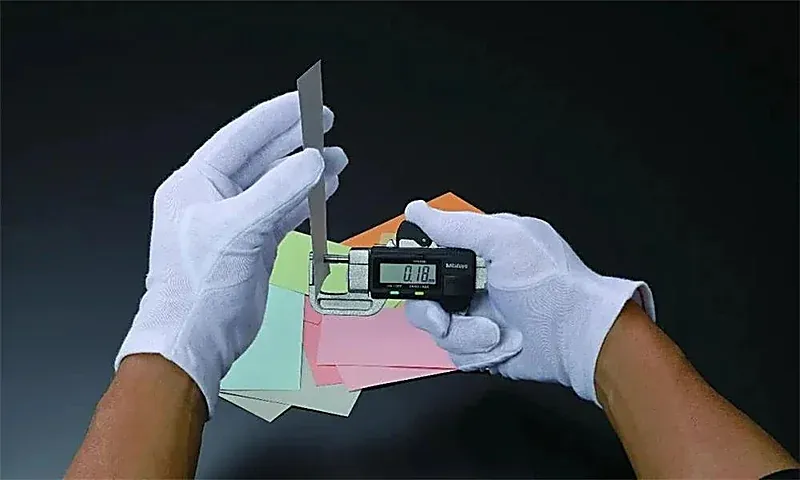
Measure internal L × W × H in mm against the spec, including the measurement basis and the lid's inside height on a rigid box. Check the opening action, the closure, and how the product sits in the insert. Use the product itself, not a ruler alone — a box can be dimensionally correct and still hold the piece badly. The convention behind the numbers is in How to measure box dimensions.
5. Colour, finish, and registration
Compare the retention sample and the lot unit in one frame under one light, same face, same distance. Check each named finishing process, its area, and any registration offset against the tolerance written in the approval document. Warm warehouse lamps and cool office LEDs shift a white wrap and a foil differently; fix the lighting condition in the spec, not on the day.
6. Functional checks
Close the lid, tilt the box, and confirm the insert holds the piece. Check scuff resistance, odour, and surface feel at the point after production agreed in the approval document — films change as they cure. If your product has a legal or compliance dimension, check that the required wording and identifier are present on the finished unit, with the current version confirmed in writing by your own quality team and legal adviser.
7. Disposition and record
Write one of three outcomes: release, hold for sort, or reject. Attach the counts, the photo set, the sample ID, and the spec version. File it against the lot reference. The classification method for differences you find is in Bulk order different from sample packaging.
In the same brief, Every order carries a 60-day quality guarantee. Our plant has made custom packaging in Dongguan, China since 1998. Mass production runs in 10-20 working days after proof sign-off.
Write the acceptance basis before production
None of those checks mean anything without a criterion. Agree the basis while the sample is still on your desk, then attach it to the RFQ and the purchase order.
Check — Acceptance basis to write down. Dimensions — Internal L × W × H in mm with the measurement basis and an agreed tolerance. Fit — How the lid closes, the clearance, and the check anyone can repeat. Colour — The signed sample as reference, the lighting condition, and an agreed range. Registration — Maximum offset for foil, spot finish, or emboss, in mm, tied to the dieline. Surface — The point after production when feel, scuff, and odour are checked. Sampling — How many cartons are opened and how many units are pulled. Documents — The packing list version, lot reference, and evidence format.
Behind that spec, Rigid boxes use 157 g face stock over 1200 g greyboard. Folding cartons are specified in 300-500 g board. Bulk decoration uses offset printing for colour stability.
Confirm the current measurement methods in writing with your own laboratory or quality team. Do not invent an industry-standard number as a universal rule — write the criterion you and the supplier actually agreed for this structure. A criterion nobody agreed is not a criterion.
Have a spec with no acceptance lines? [Send us the current version →] — we will mark which checks lack a written basis, with low-MOQ custom from 100 pcs and transparent quoting with no hidden fees.
Mini story: the sampling line
A buyer we'll call Priya received a folding carton run and pulled six units from the top carton. All six passed, and the lot went into stock. A week later her packing team found a registration problem in cartons from the other end of the pallet. The fault was real and consistent — in those cartons — but her check had never looked there.
Worth pinning down: Finished goods are inspected to AQL standards before release. Cartons pack 100 pcs and stay under 22 kg for courier limits. We run FSC-ready board lines and can specify certified stocks on request.
For the next lot she added one line to the RFQ: "Receiving check will open cartons from the top, middle, and bottom of the pallet and pull units from each." She also wrote the sampling method into the purchase order. The following shipment had a similar local issue, and her receiving record caught it on the day of arrival, before a single unit was packed. Her checks had not become stricter. They had become representative.
The receiving record
Keep one page. It is the deliverable.
Delivery date, lot reference, spec version, and signed sample ID; Carton count and unit count, with shortages separate from damage; Sampling method: cartons opened and units pulled; One numbered line per check, with a result and a count of affected units; Photographs with the retention sample and the lot unit in the same frame, under the agreed light; The disposition — release, hold for sort, or reject — with the name of the person deciding; Any written notice sent to the supplier, with a timestamp.
Ask for a written reply against your line numbers if you raise a finding. "Looks fine to us" is not a reply that closes a record. The versioned-spec discipline behind the attachments is in Communicate packaging specs chinese factory.
Red flags in a receiving process
No retention sample on site. A photo of a sample is not a sample; All units pulled from one carton. The check is not representative; Colour compared under different lights or from a screenshot; Acceptance criteria written after the shipment arrives. That is a negotiation, not a check; No disposition recorded — goods go into stock because nobody said otherwise; A receiving record with no lot reference, so the finding cannot be tied to a run; Treating a clean pre-shipment report as a receiving check. They answer different questions.
Receiving QC Checklist
Reconcile carton and unit counts against the packing list version before opening anything; Photograph sealed cartons and note crush, wetting, or broken seals before goods move; Pull units from several cartons spread across the pallet, and record the sampling method; Measure internal L × W × H in mm with the measurement basis, and test the actual product fit; Compare colour, finish, and registration against the retention sample in one frame under the agreed light; Run functional checks — lid, insert hold, scuff, odour — at the agreed point after production; Write the acceptance criteria and sampling method into the RFQ and purchase order before production; Record a disposition (release / hold for sort / reject) with counts, photos, sample ID, and spec version.
One practical note: We return a free digital proof in about 5 days. Standard terms are 30/70 (deposit / before shipment). MOQ starts at 100 pcs per SKU for most formats.
Mini story: one page that closed a question
A buyer we'll call Dev received a rigid box shipment with a slightly tighter lid on some cartons. His team had a one-page receiving record: counts, sampling method, seven numbered checks, photos with the retention sample in frame, and a disposition of "hold for sort". He sent it as an attachment and asked for a reply against the line numbers.
The supplier answered the same day: line four, lid resistance, was within the agreed fit tolerance; the units he had flagged came from one carton packed before the film cured. The sort took an afternoon. Dev's advantage was not a stricter standard. It was a record that named the check, the count, and the criterion — so the conversation had somewhere to land.
Conclusion
Receiving-side QC is your own decision at your own door: does this lot enter stock? It is not the third-party pre-shipment inspection at the factory, and a clean inspection report does not replace it. Run the seven checks in order — documents and counts, carton condition, representative sampling, dimensions and structure, colour and finish, functional checks, then disposition — and record each as a line with a result and a count.
The work that makes those lines meaningful happens earlier. Write the acceptance criteria and the sampling method into the RFQ and the purchase order while the sample is still on your desk, and confirm the measurement methods in writing with your own quality team. Keep the retention sample on site. Then a shipment either passes, holds for sort, or rejects — as a decision from a record, not an impression.
Set up your receiving sheet before the next shipment → Our Dongguan team has delivered 1,000+ custom packaging projects to buyers in 80+ countries since 1998, with low-MOQ custom from 100 pcs, ~5-day free samples, and transparent quoting with no hidden fees.
FAQ
Is receiving QC the same as pre-shipment inspection? No. Pre-shipment inspection happens at the factory before dispatch and is often done by a third party; receiving QC happens at your warehouse after arrival, run by your own team, to decide whether the lot enters stock. Both are useful and neither replaces the other.
How many units should I check on arrival? Pull units from several shipping cartons spread across the pallet — top, middle, and bottom — rather than several from one carton. Write the method into the RFQ so both sides agree what a fair check looks like.
What should the acceptance criteria be? The ones you and the supplier agreed for this structure: internal dimensions with tolerance, fit, colour reference and lighting, registration offset in mm, surface-check timing, and sampling method. Confirm the measurement methods in writing with your own quality team; do not adopt a generic number as a universal rule.
Why must colour be compared under an agreed light? Warm warehouse lamps, cool office LEDs, and daylight shift a white wrap and metallic foil differently. Fix the lighting condition in the spec and compare the retention sample and lot unit in one frame.
What goes in the receiving record? Delivery date, lot reference, spec version, signed sample ID, counts, sampling method, one numbered line per check with results and affected-unit counts, photos, a disposition, and any timestamped notice to the supplier.