Buying Guides
Mailer Boxes That Stay Closed: The Design Fixes
Mailer Boxes That Stay Closed: The Design Fixes: A subscription brand switched to a tape-free mailer to cut pack-out time and plastic. The first thousand...
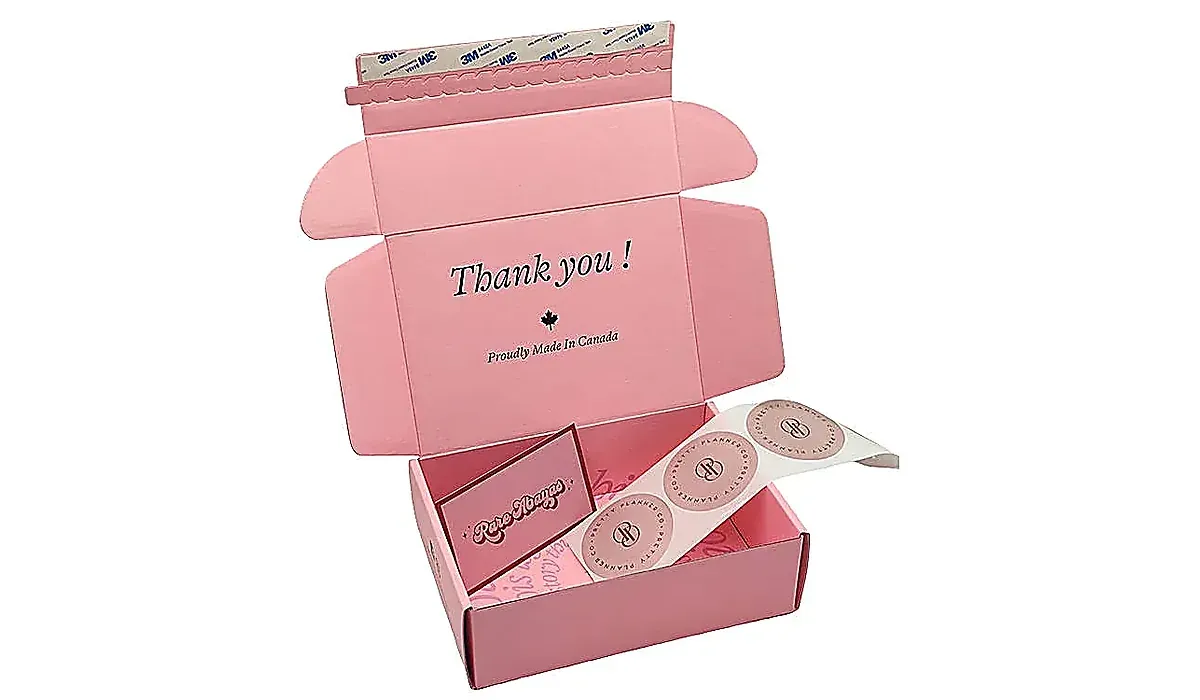
A subscription brand switched to a tape-free mailer to cut pack-out time and plastic. The first thousand shipped fine. The second thousand arrived with a third of the lids open, because the board had absorbed humidity in a warehouse and the tuck flap had lost the friction that held it. A mailer box that stays closed without tape is held by geometry and friction, and both are decided in the dieline.
The box was not badly made. It was designed for a dry day, and nobody had tested it for the conditions it would actually travel through.
At boxeschina, we engineer mailers that close without tape — Since 1998, 1,000+ projects, 80+ countries — and the difference between a mailer that stays shut and one that pops is almost always four millimetres of flap depth and one extra score line.
Why a Mailer Box That Stays Closed Still Pops Open
A tuck-front mailer holds closed through friction and geometry, not adhesive. Five forces work against it:
Board memory. Folded board wants to return to flat. On a single score, that spring-back is strong enough to walk the flap out of the slot. Insufficient tuck depth. A shallow front flap has little contact area and less resistance to being pushed back out by the contents. Contents pushing outward. An overfilled box bows the front panel, and a bowed panel releases the tuck. Humidity. Board absorbs moisture, softens, and loses stiffness — exactly the force that holds the flap in place. This is why a box that works in a dry sample room fails in a humid warehouse. Vibration in transit. Parcels vibrate for hours. A flap held only by a light friction fit will slowly work loose.
Understanding these turns "the box doesn't stay closed" into a set of specific, fixable design decisions.
The Anatomy of a Mailer
A standard roll-end tuck-front (RETF) mailer has:
A base panel and a lid panel Side wings that fold up to form the walls A front tuck flap on the lid that inserts inside the front wall A rear hinge connecting lid to base Optionally, side tuck flaps and a locking tab
Each element contributes to closure. Weakness in any one becomes the failure point.
The Design Fixes, Ranked by Effectiveness
1. Increase the front tuck flap depth
The single most effective change. A flap of 15 mm barely engages; 25–35 mm gives real contact area and real friction. For a box 40 mm deep, a 30 mm tuck flap is a reasonable target.
Trade-off: deeper flaps use slightly more board and need a slightly longer dieline. Almost always worth it.
2. Double-score the fold lines
A single score produces a rounded, springy fold. A double score — two parallel creases a fraction of a millimetre apart — produces a crisper fold with less memory, so the flap sits flatter and stays in.
Trade-off: minimal. This is one of the cheapest upgrades in the whole structure.
3. Add a locking tab or slit lock
A small tab on the tuck flap that engages a slit in the front wall converts friction into a mechanical lock. It is the difference between "held" and "latched."
Trade-off: adds a die feature and a small assembly action; makes opening slightly less smooth unless designed with a thumb cut.
4. Add an internal retention flap
A flap inside the lid that presses down on the contents stops the product from pushing the front panel outward — which is often the real cause of a popped lid.
Trade-off: a little more board and a slightly tighter pack-out.
5. Use the right board and flute
For mailers that must hold shape, E-flute corrugated (around 1.5 mm) gives stiffness with a clean fold. A heavy solid board (350–400 gsm) works for light contents but bows under load. B-flute is stronger but bulkier and harder to fold neatly at small sizes.
Trade-off: E-flute costs more than solid board but far less than a rigid box, and it holds a fold far better in humidity.
6. Get the grain direction right
Board folds cleanly along the grain and cracks across it. If the front tuck flap folds across the grain, the crease is weak and springy — and it may crack on the fold.
Trade-off: none, other than specifying it. Add "grain direction: parallel to the front tuck fold" to the dieline notes.
7. Taper the tuck flap corners
Slightly rounded or chamfered corners on the tuck flap help it enter the slot without catching, which matters when packers are working fast.
Trade-off: none. It is a die detail.
8. Add a thumb cut or tear strip for opening
Closure is only half the experience. A thumb cut or a perforated tear strip makes the box openable without a knife — and without tearing the print.
Trade-off: a tear strip weakens the panel slightly; place it away from the tuck engagement.
9. Consider a magnet or a crash-lock base
For premium unboxing, a magnetic closure gives a definite, satisfying close. For pack-out speed, a crash-lock (auto-bottom) base erects in one motion and removes a taping step entirely.
Trade-off: magnets add cost and hand assembly; crash-lock needs a larger sheet and a specific die.
The Fit Rule
Structure cannot compensate for bad fit. A mailer should be filled to roughly 90–95% of its internal volume, with enough void fill to stop movement and not enough to bow the walls.
Two failure modes:
Overfilled: the front panel bows, the tuck releases. Common when a product is added to a range without resizing the box. Underfilled: the contents shift, the box loses rigidity, and corners crush. Common when a brand uses one box size for several products.
If your SKU range varies in size, use two or three box sizes rather than one size with extra void fill. It costs a little more in tooling and a lot less in damage.
A Test Protocol That Reflects Reality
A mailer that closes on a desk proves nothing. Test it the way it will travel.
In practice the ranges work out as follows. Test: Fill test; Method: Pack to the declared weight and volume; Pass condition: Lid closes without force; front panel flat. Test: Shake test; Method: Shake vigorously for 30 seconds; Pass condition: No movement of contents; lid stays engaged. Test: Drop test; Method: Drop from 1 m onto each face and one corner; Pass condition: Lid remains closed; no unit damage. Test: Stack test; Method: Stack to the planned height for 48 hours; Pass condition: No bulging; lid still engaged.
The humidity test is the one most brands skip, and it is the one that predicts warehouse failures in summer and in sea freight. Board that loses stiffness at 85% RH will lose its grip on the tuck.
If you are shipping to a humid climate or by ocean, run it. It takes two days and a plastic box with a wet towel in it.
When a Tape-Free Mailer Is the Wrong Choice
Honesty about limits saves rework.
Heavy contents (over roughly 3 kg). Friction and tuck geometry cannot reliably hold a heavy load. Use a double-wall corrugated structure with a locking base, or a two-piece box. High-value fragile goods. The closure is the least of your risks; use a rigid box with an insert. Very small boxes. Below about 100 mm in one dimension, there is not enough flap length to generate meaningful friction. Multi-item orders with variable volume. A fixed-size mailer cannot stay tight across a range; consider a crash-lock base with a variable-depth lid, or two sizes.
What Tape-Free Actually Buys You
The reason to do this is not aesthetics alone.
Faster pack-out. No tape gun, no dispenser, one motion to close. Less plastic. No tape, no void fill if the structure holds the product. Better unboxing. The customer opens a box, not a parcel. Recyclability. A single-material corrugated mailer is easier to recycle than a taped, plastic-filled parcel. Lower damage in some cases, because a well-fitted mailer holds the product still.
The trade-off is tolerance: a taped box forgives a loose fit and a bad fold. A tape-free mailer does not. That means tighter specs, better dielines, and a pack-out that respects the design.
A buyer who puts all of this into one written brief gets a comparable quotation from the first reply, because every supplier then prices the same board, the same structure and the same packing pattern. A buyer who leaves the material open gets a number that looks lower and changes at the sample. That is why we ask for the grade, the dimensions and the destination together, and why the written material declaration travels with the order rather than arriving after it. Decide the specification once and the reorder becomes a repeat of a decision already proved on a physical sample.
The sample stage is where the argument is settled. Put the real product in the real box, close the lid, then pack the box into the real master carton and let it stand under a stacked load. A specification that survives that hour survives the channel; one that does not is a drawing change, not a gamble on the warehouse. We issue the free digital sample first and the physical approval sample second, and we ask that both be signed off against the same written specification, because a sample approved against a different one resolves nothing and merely moves the disagreement into production.
Factory Specification Baseline
Our factory in Humen, Dongguan has run since 1998, with 5,000 m² of floor and about 100 staff delivering 1,000+ cases to buyers in 80+ countries for 50+ brands on roughly US$10 million in annual output. Rigid boxes are built on 1200 g greyboard wrapped in 157 g art paper; folding cartons use 300 to 500 g board. Board is FSC-ready, and the mill's written material declaration is attached to the order so the grade can be checked against the specification before production is scheduled. MOQ starts from 100 pcs, a free digital sample takes about 5 days, and mass production runs 10 to 20 working days after sample approval on a 30/70 payment schedule. Finished cartons pack 100 pcs per master carton at or below 22 kg, checked to AQL inspection standards before despatch. Rigid boxes ship assembled rather than flat, and bulk runs are printed by offset lithography.
FAQ
Why does my mailer lid keep popping open?
Usually one of three causes: a tuck flap that is too shallow (under 20 mm), a single-score fold that springs back, or an overfilled box bowing the front panel. Check all three before changing the structure. Mass production runs 10 to 20 working days after sample approval.
Does a deeper tuck flap really make that much difference?
Yes — it is the highest-leverage change available. Going from 15 mm to 30 mm roughly doubles the contact area and the friction that holds the lid. Cartons pack 100 pcs per master carton at or below 22 kg. Board is FSC-ready, with a written material declaration attached to the order.
Is E-flute better than solid board for mailers?
For anything that needs to hold shape or carry more than about a kilogram, yes. E-flute resists humidity and impact better and folds more cleanly. Board is FSC-ready, with a written material declaration attached to the order. Finished cartons are checked to AQL inspection standards before despatch.
Can I ship a tape-free mailer internationally?
Yes, if it passes a humidity and drop test. Ocean freight exposes board to prolonged high humidity, so test at 80–90% RH before committing a container. Finished cartons are checked to AQL inspection standards before despatch. Folding cartons use 300 to 500 g board, while rigid boxes ship assembled rather than flat.
Do I need a locking tab, or is friction enough?
Friction is enough for light contents in a well-fitted box. Add a locking tab when the product is heavier, the box is handled repeatedly, or the destination is humid. Folding cartons use 300 to 500 g board, while rigid boxes ship assembled rather than flat.
Will a tape-free mailer survive a returns journey?
Often not, because the box is opened and re-closed by a customer. If returns matter, design a second closure — a slit, a tab, or a resealable strip. Payment follows a 30/70 schedule, with a 30% deposit and the balance before shipment. Bulk runs are printed by offset lithography once the approved sample is signed off.
Conclusion
A mailer stays closed when the geometry, the board and the fit all agree. Tape is not the fix for a weak structure; it is a way of hiding one. Four changes do most of the work: a deeper tuck flap, a double score, a locking tab, and the right flute. Then test it filled, dropped, stacked and humid — because the box that fails is almost never the one tested on a dry desk. Send your dimensions, structure and quantities to our Dongguan factory and Request a Wholesale Quote.