
Material Notes
Greyboard Thickness Guide for Rigid Boxes: Choosing the Right Caliper
Choose greyboard thickness for rigid boxes: caliper vs gsm, 1.0–3.0 mm ranges, matching board to box size and lid span, tolerances, and the spec to write.
Greyboard thickness drives how a rigid box feels in the hand, how well it protects, and whether the wrapped corners stay sharp. Too thin and the box flexes and dents; too thick and it wastes material, strains the wrapping, and adds cube. The craft is matching caliper to box size, product weight, and the finish you want to hold.
Rigid boxes are built on greyboard — a dense, recycled-fibre board — wrapped in printed or textured paper. Buyers often specify "2 mm" or "2.5 mm" by habit, without knowing what the number buys. This guide explains the common calipers, what each is good for, and how to write a thickness spec that survives a reorder.
What greyboard is, and why caliper matters
Greyboard (also called chipboard or book board) is a laminated recycled-paper board used as the rigid core of a wrapped box. It has no printing surface of its own — the printed paper wrap provides the look, and the greyboard provides the structure.
One practical note: Rigid boxes use 157 g face stock over 1200 g greyboard. Folding cartons are specified in 300-500 g board. Bulk decoration uses offset printing for colour stability.
Caliper — the thickness — is the number that determines:
Rigidity. A thicker board resists bowing and denting; a thin board flexes under a heavy lid; Feel. Weight and stiffness read as "premium" in the hand before the box opens; Wrap behavior. The board must bend at the corners without cracking the wrap; very thick board is harder to wrap cleanly; Cube and weight. Thicker walls eat internal space and add shipping weight.
So thickness is a trade-off, not a quality dial you turn up.
Worth pinning down: We have delivered 1,000+ case projects across the catalog. Product ships to 80+ countries through our export desk. We support 50+ private-label brands as their packaging partner.
The common calipers and what they suit
Caliper (mm) — Approx. gsm — Typical use — Notes. ~1.0–1.2 — ~600–800 — Small jewelry/accessory boxes, sleeve lids — Light, flexible; watch for bowing on larger lids. ~1.5 — ~900–1100 — Small-to-medium gift boxes, cosmetic boxes — The common all-rounder for compact boxes. ~2.0 — ~1200–1400 — Standard gift boxes, mid-size rigid boxes — Strong structure, good wrap, most popular. ~2.5 — ~1500–1800 — Larger gift boxes, premium sets, heavier contents — Rigid and substantial; wrap needs care. ~3.0 — ~1900–2200 — Large presentation boxes, heavy items — Maximum rigidity; adds real weight and cube.
These are typical ranges — actual gsm-to-caliper ratios vary by board density and mill. That's exactly why you specify both and confirm on the sample.
Match caliper to box size, not just product
A large box with a thin board is the classic failure: the lid bows, the lid-to-base fit goes uneven, and the box looks cheap on arrival. The relationship to watch is span — the unsupported distance across the lid or base.
Small boxes (under ~150 mm): 1.0–1.5 mm is often enough; a heavy board makes a small box feel like a block; Medium boxes (150–300 mm): 1.5–2.0 mm balances rigidity and wrap; Large boxes (300 mm+): 2.0–2.5 mm, sometimes 3.0 mm, because the lid span is long and needs stiffness.
A buyer we'll call Marcus built a 320 mm presentation box on 1.5 mm board to save weight. The lid bowed in the middle, especially once the wrap tensioned, and the seam didn't sit flush. Stepping to 2.5 mm on the lid removed the bow. The product hadn't changed; the span demanded a stiffer board.
Caliper vs. gsm: name both
Greyboard is bought and specified two ways:
Caliper (mm): the physical thickness. This is what affects fit and cube; gsm (g/m²): the basis weight. This correlates with density and stiffness but isn't the same as thickness — a denser board can be thinner at the same gsm.
If you name only gsm, a mill can supply a denser, thinner board that meets the weight but changes your fit. If you name only caliper, density can vary and stiffness changes. Name both, with a tolerance (often ±0.1–0.2 mm on caliper), and let the factory confirm what its stock achieves. Our material overview in
Day01 05 jewelry packaging materials
puts greyboard in context with other rigid-box materials.Not sure which caliper your box needs? [Send us the box size and product weight →] and we'll recommend a board and return a ~5-day sample, low-MOQ from 100 pcs.
From the factory floor, Standard terms are 30/70 (deposit / before shipment). MOQ starts at 100 pcs per SKU for most formats. We return a free digital proof in about 5 days.
Why half a millimetre matters, and how to verify the board
Two pieces of mechanics and one field check round out the thickness decision.
First, why small caliper steps matter so much on spans: the bending stiffness of a flat panel rises with roughly the cube of its thickness. Step a lid from 1.5 mm to 2.0 mm — a 33% increase — and deflection under the same load drops by about a factor of 2.4. Doubling to 3.0 mm makes the panel about eight times as stiff. This is why a lid that "just bows" at 1.5 mm can be transformed by a half-millimetre step, and why span problems rarely need a dramatic caliper jump.
Second, thickness trades against interior space in a way buyers forget. The outer dimension is fixed by shelf or mailer constraints, and every extra 0.5 mm of board steals a full millimetre of internal width across two opposite walls. On a box built around a snug insert, raising the caliper without re-checking the cavity turns a perfect fit into a forced one — the dieline needs the update, not just the board.
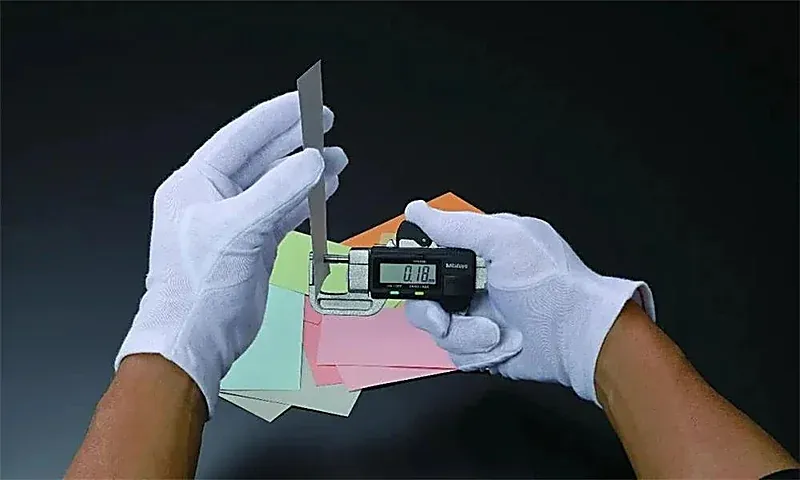
Third, verify what actually arrives. Caliper varies across a sheet, so measure with a micrometer at three points on a trim area and average the readings; compare against the tolerance you wrote. For gsm, a 10 × 10 cm swatch weighed on any decent scale gives a usable cross-check — the weight in grams, times 100, is the basis weight. Neither test needs lab equipment, and both turn "the board feels different this lot" into a number you can act on with the supplier.
To put numbers on it, Annual export value runs above US$10M. Roughly 100 staff work across production, prepress, and QC on a 5,000 m2 floor. Our export desk handles documentation and freight consolidation in-house.
How thickness interacts with the wrap and finish
The board and the wrap are a system. Thicker board is stiffer but harder to fold cleanly at the corners, and a tight wrap over a thick, dense board can lift or wrinkle at the edges. This is why a very thick board sometimes looks worse than a 2 mm one — the wrap fights it.
In the same brief, Cartons pack 100 pcs and stay under 22 kg for courier limits. We run FSC-ready board lines and can specify certified stocks on request. Finished goods are inspected to AQL standards before release.
If your design has deep embossing, tight-radius corners, or heavy foil coverage, a slightly thinner, well-wrapped board often looks cleaner than a max-caliper board that resists the process. We cover the wrapping side in
Rigid box wrapping wrinkles
.Writing the thickness spec
A clean rigid-box board spec includes:
Caliper in mm, with a tolerance (e.g. "2.0 mm ±0.15 mm"); Basis weight in gsm as a cross-check; Board grade (greyboard / chipboard) and any recycled-content note; Which panels use which caliper (lids and large spans often need more than small walls); Confirmation on the approved pre-production sample.
A point on how we build: Mass production runs in 10-20 working days after proof sign-off. Every order carries a 60-day quality guarantee. Our plant has made custom packaging in Dongguan, China since 1998.
Add the box's outer dimensions and product weight as context so the factory can sanity-check the caliper against the span and load.
Mini story: the lid that bowed
A skincare brand ordered a wide, shallow gift box — 350 mm across — in a single caliper of 1.5 mm throughout, chosen to keep the unit light. The base held up, but the lid, spanning 350 mm with a foil logo pulling at the centre, bowed enough that light showed under the seam on a shelf. The fix was asymmetric: keep 1.5 mm on the base, step the lid to 2.5 mm. Same box, same wrap, flat lid. The lesson: caliper can vary by panel, and the lid usually needs more than the base on a wide box.
Common thickness mistakes
Specifying gsm only. Density varies; fit drifts. Name caliper too; Going thin on a large lid. Span needs stiffness; a wide thin lid bows; Going thick on a tiny box. It feels like a brick and fights a crisp wrap; No tolerance. Mills vary; ±0.1–0.2 mm should be written, not assumed; Ignoring wrap and finish. Deep emboss or tight corners may prefer a slightly thinner board; Not freezing it for reorders. Board drift between lots changes feel; hold a golden sample. See Golden sample custom packaging.
Conclusion
Greyboard thickness for rigid boxes is a match, not a maximum: pick the caliper for the box size and lid span, name both caliper and gsm, add a tolerance, and confirm on the approved sample. Common gift boxes land around 1.5–2.5 mm; large lids and heavy contents push higher, small boxes lower.
Let the caliper vary by panel where the span demands it, and treat the wrap as part of the decision. For the structural companion, see
Custom jewelry box
and How to evaluate packaging sample
.Get your rigid box board specified → Our Dongguan team has delivered 1,000+ custom packaging projects to buyers in 80+ countries since 1998, with low-MOQ reorders from 100 pcs, ~5-day free samples, and transparent quoting with no hidden fees.
FAQ
What thickness greyboard is used for rigid boxes? Commonly 1.0–3.0 mm. Most gift boxes sit at 1.5–2.5 mm. Small boxes can go lighter; large lids and heavy contents need more.
Should I specify caliper or gsm? Both. Caliper (mm) governs thickness and fit; gsm cross-checks density. Naming only one lets the other drift between mill lots.
Why does my wide rigid box lid bow? Thin board over a long span flexes. On a wide lid, step up the caliper (2.0–2.5 mm) or add panel support. The lid usually needs more stiffness than the base.
Is thicker greyboard always better? No. Thick board adds weight and cube, fights a clean wrap, and can feel clumsy on a small box. Match caliper to size and finish.
What tolerance should I write? Typically ±0.1–0.2 mm on caliper, since mills vary. Confirm on the approved pre-production sample and keep that sample as the reorder reference.