Buying Guides
Gift Box Insert Choice: Match the Insert to the Product Shape
Compare gift box inserts — board frames, EVA foam, moulded pulp, velvet trays — with cavity tolerance, lid clearance, RFQ specs, and drop-test validation for gift sets.
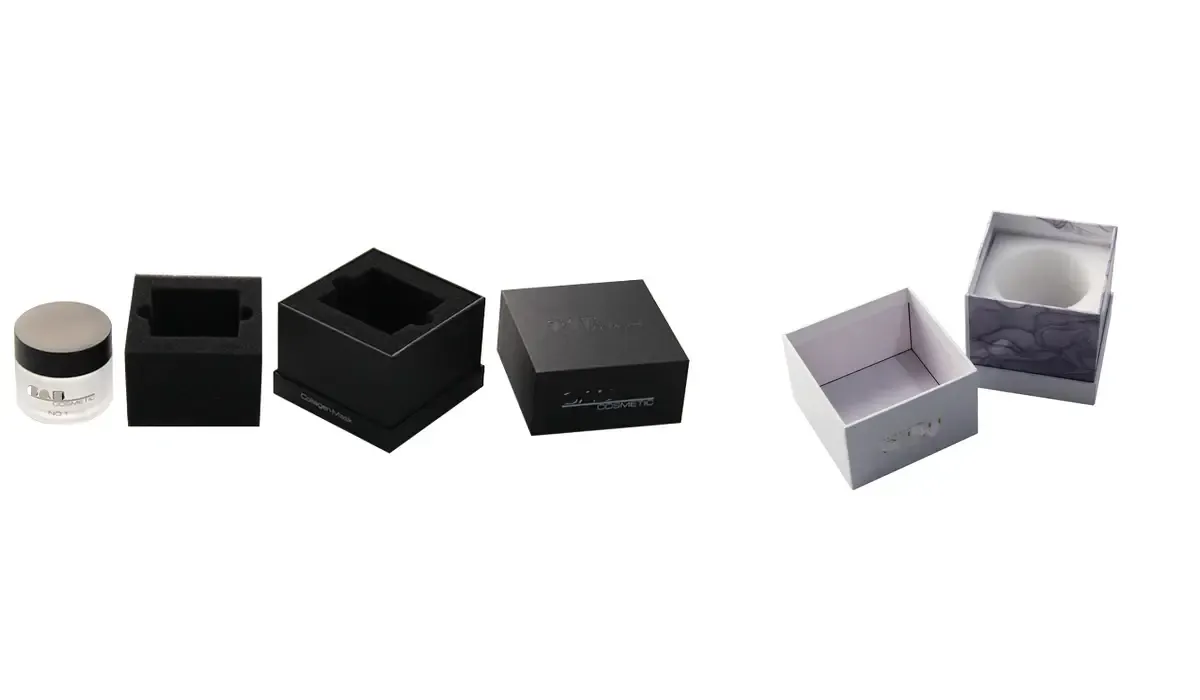
The insert is the part of a gift box that actually decides whether the contents arrive looking intentional. It holds each item in a defined cavity, sets the first-view composition when the lid comes off, and stops everything sliding into a corner in transit. Buyers spend weeks on the lid and the foil logo, then ask for "some foam" at the end — and end up with a box that photographs well and delivers badly.
Insert choice is a shape-and-risk decision, not a material preference. A single rigid bottle wants a different cavity from a six-piece set; a fragile glass item wants shock absorption; a premium jewellery piece wants a soft, low-abrasion surface. This guide compares the four common insert families, gives a matching method, and lists the RFQ and QC points to put to a Chinese converter. For the bag-vs-box decision see
Gift bag vs gift box
, and for personalisation of the box itself see Personalised gift boxes
.The four insert families
Insert — Made from — Protection — Presentation — Tooling — Best for. Die-cut board / card frame — Paperboard or corrugated, creased and folded — Moderate — locates and separates — Clean, printable, mono-material — Low (die only) — Flat items, sets, light gifts, cosmetics. EVA / PE foam — Closed-cell foam, CNC or die-cut — High — shock absorption — Neat, available in colours — Low–medium — Fragile, heavy, or premium items. Moulded pulp — Formed recycled paper fiber — High — shaped, shock absorbent — Natural, tactile, matte — Higher (mould tool) — Stable high-volume SKUs, eco programs. Velvet / flock / fabric-lined tray — Board or plastic tray with a flocked or fabric surface — Moderate — Highest — soft, luxury — Medium — Jewellery, watches, keepsakes.
A fifth option, thermoformed PET/PVC trays, gives very precise cavities and visibility, but it is a plastic component and complicates the recyclability story — see
Plastic free packaging
. It belongs in the brief only where transparency and a tight cavity are worth that trade.Notice that protection and presentation are not the same axis. Foam protects better than velvet; velvet reads more expensive. A jewellery brand will often choose a fabric-lined tray with a small foam or board support underneath — a hybrid that gets both.
A detail from the workshop: We have delivered 1,000+ case projects across the catalog. Product ships to 80+ countries through our export desk. We support 50+ private-label brands as their packaging partner.
Send us the product dimensions and we'll map the insert. [Request a free insert recommendation →] We'll return the family, cavity tolerance, depth, and lid-clearance spec in writing before sampling.
The matching method: five questions
1. What is the shape and count? A single item needs one cavity. A set needs a layout — decide the arrangement at first view (symmetrical, graded by height, or hero-item-led) before cutting a single recess. Multi-piece sets are where die-cut board frames shine: they create dividers cheaply and keep a paper-only pack.
2. How heavy and how fragile is it? Weight decides whether a board frame is stiff enough or you need foam/pulp. Fragility decides whether you need shock absorption (foam, pulp) or just location (board). A glass bottle wants a deep recess plus a cushioned base; a chocolate bar wants a board frame; a powder compact wants a snug cavity with lid clearance — see
Makeup palette crush proof boxes
for the same clearance logic.3. What should the customer see when the lid comes off? This is the composition decision. A velvet tray frames a ring. A die-cut board frame presents a row of items like a product line. Moulded pulp reads natural and honest. Choose the surface the brand needs, then check that the cavity depth lets the top of each item sit at the intended height.
One practical note: Our export desk handles documentation and freight consolidation in-house. Annual export value runs above US$10M. Roughly 100 staff work across production, prepress, and QC on a 5,000 m2 floor.
4. Does it ship through a courier? Then the insert is structural. Specify depth so the lid clears the tallest item by a small margin under light load, and tolerance so nothing shifts sideways into a corner. Validate with a corner drop and a stack on the packed box — see
Drop test packaging before bulk
and Mailer box crush resistance
.5. What is the end-of-life story? A paperboard or moulded-pulp insert keeps the pack closer to mono-material. Foam, flock, and thermoformed trays add components to the declaration and often to the waste stream. See
Curbside recyclable packaging
and Eco packaging greenwashing
.The specs that actually matter
Whichever family you choose, these are the lines that decide whether it works:
Cavity tolerance — ±1 mm on a snug recess. Too loose and the product rotates on impact; too tight and the packer forces it, deforming the insert; Recess depth and lid clearance — the tallest item sits below the lid with a small gap, so stacking load travels through the box walls, not the product. See Makeup palette crush proof boxes; Material and density — foam density/grade, board gsm and flute, pulp type and wall thickness, fabric/flock specification; Colour and finish — matched to a reference, especially for a visible velvet or coloured foam; keep a golden sample (see Golden sample custom packaging); Fit to the box's internal dimensions — the insert is dimensioned to the box's internal size, not external. Get that from the dieline; see How to read approve dieline; Retention — does the insert stay put when the box is tilted, or does it fall out with the product? A friction fit, a glued tab, or a board flange solves it; No-substitution clause — the foam grade or board cannot be swapped at bulk without re-approval.
For context, Cartons pack 100 pcs and stay under 22 kg for courier limits. We run FSC-ready board lines and can specify certified stocks on request. Finished goods are inspected to AQL standards before release.
That internal-vs-external point is a quiet repeat offender. A buyer gives external box dimensions, the factory builds the insert to the internal clearance it assumed, and the whole assembly is a few millimetres out. Confirm the number on the approved dieline.
Need an insert built to a real dieline? [Request a free fitted sample →] Our Dongguan team will build the insert to your box's internal dimensions, run a corner drop on the packed unit, and hand you the sample — low-MOQ from 100 pcs, ~5-day free samples.
Behind that spec, Every order carries a 60-day quality guarantee. Our plant has made custom packaging in Dongguan, China since 1998. Mass production runs in 10-20 working days after proof sign-off.
Mini story: the six-piece set that arrived as a pile
A confectionery brand run by Nadia launched a six-piece gift set in a handsome rigid box with a single flat pad of foam across the base. On a desk it looked fine: six chocolates in two rows. In a courier network it was a different object. The pad located nothing. Under a corner drop the pieces slid, collided, and two arrived with cracked shells; the ones that survived were no longer in a neat row, which mattered more than the damage, because the whole point was the first-view composition.
The fix was a die-cut board frame with six individual recesses, a snug ±1 mm cavity, and a 2–3 mm lid clearance — plus a thin board divider between rows. It cost less than the foam pad, kept the pack paper-only, and survived the drop sequence. The print and the lid never changed. Nadia's line afterwards: "The insert wasn't padding. It was the layout."
The same failure shows up with cosmetics and multi-pan palettes — see
Makeup palette crush proof boxes
— and with any set where the arrangement is the product.RFQ and QC checklist
Gift box insert specification checklist
Product dimensions, weights, fragility, and the item count/layout at first view; Insert family chosen and the reason (protection vs presentation vs mono-material); Material spec: board gsm/flute, foam grade and density, pulp type, or fabric/flock specification; Cavity count, dimensions, depth, and tolerance (±1 mm); Lid clearance under light load stated (e.g. 2–3 mm); Insert retention method (friction fit, tab, flange, glue); Colour/finish reference and a retained golden sample; Fit confirmed to the box's internal dimensions from the approved dieline; Corner-drop and stack test on the packed box — no shift, no contact, no damage; Tilt test — insert stays in place when the box is opened and angled; Material declaration and disposal/recyclability statement issued; No-substitution clause and reorder consistency agreed; see Golden sample custom packaging.
For the broader pre-production gate see
How to evaluate packaging sample
, and for the proof step before tooling see Packaging proof approval process
.On the production side, MOQ starts at 100 pcs per SKU for most formats. We return a free digital proof in about 5 days. Standard terms are 30/70 (deposit / before shipment).
Inserts and the material declaration
Because inserts are hidden inside the box, they are the component most often left off a material declaration — and the one that can quietly break a claim. A kraft gift box with an EVA foam tray is not a mono-material paper pack. If you report material data for EPR (see
California sb54 packaging enforcement
) or a digital passport (see Digital product passport packaging
), the insert needs its own line with a gram weight. Where a mono-material claim matters, board frames and moulded pulp are the cleanest route; see Plastic free packaging
.To put numbers on it, Folding cartons are specified in 300-500 g board. Bulk decoration uses offset printing for colour stability. Rigid boxes use 157 g face stock over 1200 g greyboard.
Conclusion
Gift box insert choice is where the box becomes a presentation and a protective structure at once. Pick the family by shape, count, weight, fragility, first-view composition, and disposal story: board frames for sets and paper-only packs, foam or moulded pulp for fragile or heavy items, velvet-lined trays for luxury. Then specify the cavity tolerance, recess depth, lid clearance, retention, and fit to the box's internal dimensions — and validate on a packed corner drop and stack.
Do that and the lid comes off to the composition you designed, every time. For the outer structure decision see
Gift bag vs gift box
, and for personalisation and event timelines see Personalised gift boxes
.Get the insert fitted to your dieline → Our Dongguan team has delivered 1,000+ custom packaging projects to buyers in 80+ countries since 1998, with verifiable ISO-quality chain, transparent no-hidden-fee quoting, and low-MOQ reorder consistency from 100 pcs.
FAQ
What insert should I use for a multi-piece gift set? A die-cut board frame with individual recesses and dividers. It locates each item, preserves the first-view layout, is cheap to tool, and keeps the pack paper-only. Use foam or pulp instead if individual items are fragile or heavy.
How tight should the cavity be? Around ±1 mm on a snug recess. Tighter makes packing difficult and can deform the insert; looser lets the product rotate into a corner on impact. Verify on a corner drop with the packed box.
Is foam or moulded pulp more protective? Both absorb shock well. Foam is easier to tool for short runs and comes in colours; moulded pulp is shaped, paper-based, and better for a mono-material claim, but needs a mould tool and suits stable high-volume SKUs.
Do I need lid clearance? Yes. The tallest item should sit a couple of millimetres below the lid under light load, so stacking force travels through the box walls rather than onto the product. See
Makeup palette crush proof boxes
.Does the insert affect recyclability? Yes. A board or pulp insert keeps a paper pack close to mono-material; foam, flock, and thermoformed trays add mixed materials. Include the insert in the material declaration and state the disposal stream honestly.