Buying Guides
Custom Tote Bag Manufacturer: 7 Wholesale Sourcing Steps That Hold Up
Source custom tote bags in 7 steps: fabric and gsm, seams and bar-tacked handles, print method, colour control, and a sewn-sample QC gate with AQL. Written for wholesale buyers.
A custom tote bag is a sewn product, not a printed box. That distinction explains most wholesale sourcing failures: buyers brief a tote like a carton ("here's the logo, make a few thousand bags") and never specify fabric weight, weave, seam construction, handle attachment, or print method. Then the handles detach, the print cracks after a wash, or the "natural cotton" colour drifts between lots.
The good news is that a tote is a simple product with a short, learnable spec. Seven decisions cover almost everything: fabric, weight, construction, handles, print, colour and compliance, and the sampling/QC gate. Get those in writing with a Chinese manufacturer and you get a bag that reorders consistently for years — which is exactly what a retail, event, or brand-program buyer needs.
This is a sourcing-method guide, not a product catalogue. For the fabric comparison itself see
Jute vs cotton bag
, and for the label/sticker side of a branded program see Custom label manufacturer
and Custom packaging stickers
.Step 1: choose the fabric
The fabric decision sets everything else.
Fabric — What it is — Good for — Watch out for. Cotton canvas / duck — Plain-weave cotton, heaviest grades are durable — Retail, premium, everyday totes — Shrinkage, natural shade variation, water staining. Cotton sheeting / calico — Lighter plain-weave cotton — Promo, events, low-cost giveaways — Too light for heavy loads. Jute / hessian — Coarse bast fiber — Rustic, grocery, gift hampers — Rough hand, sheds fiber, harder to print fine detail; see Jute vs cotton bag. Non-woven PP — Bonded polypropylene sheet — High-volume promo, conferences — Plastic-based; conflicts with plastic-free claims. Recycled cotton / rPET — Reclaimed fiber — Sustainability programs — Ask what the recycled content actually is, and verify documentation. Blends (cotton-poly) — Mixed fiber — Cost/performance balance — Changes hand-feel and recyclability claims.
Worth pinning down: Our plant has made custom packaging in Dongguan, China since 1998. Mass production runs in 10-20 working days after proof sign-off. Every order carries a 60-day quality guarantee.
Be explicit about the word "canvas." In common usage it means a heavy plain-weave cotton, but factories will quote a range of weights under the same name. Ask for the construction (e.g. 10 oz / ~340 gsm plain weave) and whether it is pre-shrunk, dyed, or raw. If you need a specific end-of-life claim, state it and check the disposal stream honestly — see
Plastic free packaging
and Compostable vs recyclable packaging
.Not sure which fabric fits your budget and load? [Send us the intended use and target weight →] We'll quote two or three constructions with the gsm, weave, and handle spec written out, so you can compare like for like.
Step 2: set the fabric weight
Weight is the single biggest cost and durability lever. Light calico (around 100–150 gsm) is fine for a conference handout carrying a brochure. A retail tote that will hold books or groceries wants something in the 280–400 gsm / 8–12 oz range. Heavier is not automatically better — it adds cost, bulk, and shipping weight — but under-weighting the fabric is the classic false economy.
Tie the weight to the load, not the look. State the intended carrying weight in the RFQ and ask the factory to confirm the construction is appropriate. Then validate it: a loaded bag with a defined weight, carried and lifted repeatedly, is a better test than a spec sheet.
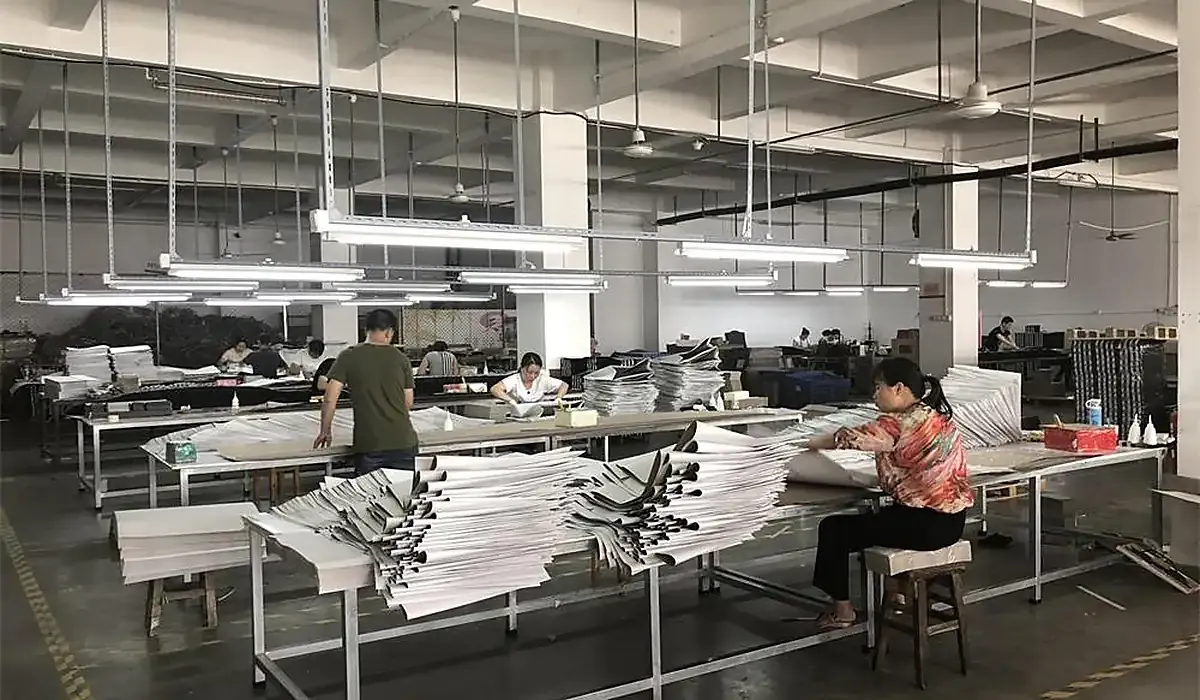
In the same brief, Annual export value runs above US$10M. Roughly 100 staff work across production, prepress, and QC on a 5,000 m2 floor. Our export desk handles documentation and freight consolidation in-house.
Step 3: specify the construction and seams
A tote is a bag of fabric held together by thread. The seams are the structure.
Seam type — plain/overlocked seams for light bags; French seams or bound seams for premium or unlined bags where raw edges show; Stitch density — stitches per inch; too few and the seam gaps under load; Bottom construction — a flat folded bottom vs a gusset (a separate panel that gives the bag depth). State the gusset width, and note whether the bag must stand upright on a shelf; Reinforcement — bar-tacks or a cross-stitch box at each handle attachment. This is where totes fail, so name it explicitly; Edge finishing — hemmed top edge, overlocked internal edges, and whether lining is required; Thread — colour and material (cotton vs polyester), especially if a contrast stitch is part of the design.
Ask for a pull test on the handles: load the bag to a defined weight, lift and hold, repeat, and confirm no seam or handle failure. It is cheap and it catches the defect that generates the most returns.
Step 4: specify the handles
Handles are a separate line, not an afterthought.
Length and drop — short hand-carry vs shoulder-length (commonly a longer drop so it sits over a shoulder). State the drop, not just the total strap length; Width — a narrow strap cuts into the hand under load; a wider webbing distributes it; Material — self-fabric (same as the bag), cotton webbing, jute cord, or leather. Self-fabric looks cleanest; webbing is strongest; Attachment — stitched onto the body with bar-tacks, or inserted into the top hem. Confirm the stitch pattern; Length tolerance — a centimetre of difference between the two handles makes a bag hang crooked. Put a tolerance in the spec.
If the bag is for retail display, also specify how it hangs and whether it will be folded or stuffed for shipment — that affects creasing and the print.
Mini story: the conference tote that lost its handles
An events agency run by Priya ordered 8,000 light cotton totes for a three-day conference, briefed mostly on price and a one-colour logo. The samples looked fine: the logo was crisp, the natural fabric photographed well, and the bags folded flat into cartons. On day two, the organiser reported handles detaching — not everywhere, but enough that attendees were carrying bags by the body.
The factory inspection found a plain straight stitch at the handle ends with no bar-tack, and a stitch density set for a much lighter load. The bags had been filled with a programme, a water bottle, and a couple of sponsor giveaways — maybe two kilos, well within what a tote should hold. Nothing was wrong with the fabric or the print. The attachment simply had no reinforcement spec.
The reorder added a cross-stitch box with bar-tacks at all four handle ends, a slightly wider webbing, and a defined pull test on the pre-production sample. Cost per unit rose by a small amount; the agency stopped budgeting for a replacement fund. Priya now writes "handles: bar-tacked, pull-tested to X kg" as its own PO line. Her takeaway: the logo sells the bag, the seam keeps it sold.
Behind that spec, Standard terms are 30/70 (deposit / before shipment). MOQ starts at 100 pcs per SKU for most formats. We return a free digital proof in about 5 days.
Planning a tote program? [Request a free sewn sample →] Our Dongguan team will build to your fabric, weight, gusset, and handle spec, run a loaded pull test, and hand you the bag with the construction written out — low-MOQ from 100 pcs, ~5-day free samples.
Step 5: choose the print method
Match the print to the artwork and the fabric:
Method — Best for — Watch out for. Screen print — Bold logos, few colours, high volume — Each colour is a setup; fine detail and gradients are limited. Digital / DTG — Full-colour, photographic, short runs — Hand-feel and wash fastness vary; test on the actual fabric. Heat transfer / vinyl — Small runs, names, numbering — Can crack or peel with washing/heat. Embroidery — Durable, premium marks — Cost by stitch count; heavy on light fabric. Foil / puff / specialty — Promotional effects — Durability and recyclability implications.
Ask for a rub test and a wash test on the printed sample. Natural cotton with a water-based print behaves differently from a coated canvas. Also check print placement relative to seams and folds — a design that crosses a gusset will distort. Our artwork pre-flight in
Packaging artwork check
applies to the print file, and the colour reference belongs in the same spec sheet as the fabric.From the factory floor, We run FSC-ready board lines and can specify certified stocks on request. Finished goods are inspected to AQL standards before release. Cartons pack 100 pcs and stay under 22 kg for courier limits.
Step 6: colour, compliance, and claims
Natural and undyed fabrics vary between harvests and lots. If brand colour consistency matters, specify a dyed fabric with a stated colour reference and approve against a physical swatch, not a screen. Keep a golden sample from the approved run; see
Golden sample custom packaging
.For claims, be careful. "Eco," "biodegradable," and "sustainable" are not verifiable descriptors; say what the fabric actually is and what the disposal stream is. Where a certification is genuinely relevant, ask for verifiable documentation and check its scope yourself. Our position is a verifiable ISO-quality chain; we do not lean on unverifiable eco badges — see
Eco packaging greenwashing
. If the bag carries regulated copy, a care label, or a country-of-origin mark, the brand owns that copy and should supply it in the artwork brief.One practical note: We have delivered 1,000+ case projects across the catalog. Product ships to 80+ countries through our export desk. We support 50+ private-label brands as their packaging partner.
Step 7: the sampling and QC gate
Never approve a tote from a flat mockup. Require a sewn pre-production sample built to the full spec, and check:
Tote QC checklist
Fabric construction, weight (gsm/oz), and weave match the PO; measured, not eyeballed; Bag dimensions and gusset width within tolerance, flat and loaded; Handles equal length, correct drop, bar-tacked or cross-stitched, pull-tested to the defined load; Seams straight, stitch density as specified, no skipped stitches or raw edges where they shouldn't be; Print colour against the agreed reference, placement correct, rub/wash test passed; Colour consistency against the golden sample; Any lining, label, care tag, or hangtag present and correct; An agreed inspection level (AQL) and per-unit defect list stated in the PO; Packing method: folded or flat, units per carton, and carton markings.
For context, Bulk decoration uses offset printing for colour stability. Rigid boxes use 157 g face stock over 1200 g greyboard. Folding cartons are specified in 300-500 g board.
That AQL line matters. Totes are sewn by people, and a bulk run always contains some variation. Agreeing what counts as a defect — a loose thread, a crooked handle, a print smudge — before production turns a subjective argument into a checklist. Our pre-shipment inspection method is in
Pre shipment inspection custom packaging
, and the spec-sharing discipline in Communicate packaging specs chinese factory
.Conclusion
A custom tote bag is seven decisions: fabric, weight, construction/seams, handles, print, colour and claims, and the sampling/QC gate. The logo is the easy part. The failures come from leaving the fabric weight as "canvas," forgetting bar-tacks at the handle ends, choosing a print that cracks, or approving from a flat image instead of a sewn, load-tested sample.
Put all seven in writing, approve a golden sample, and state an AQL with a per-unit defect list. Do that and your tote reorders cleanly season after season. For the fabric comparison see
Jute vs cotton bag
, and for the rest of a branded program see Custom label manufacturer
and Gift bag vs gift box
.Source a tote that survives real use → Our Dongguan team has delivered 1,000+ custom packaging projects to buyers in 80+ countries since 1998, with verifiable ISO-quality chain, transparent no-hidden-fee quoting, and low-MOQ reorder consistency from 100 pcs.
FAQ
What should I specify to a custom tote bag manufacturer? Fabric type and weight (gsm/oz) and weave, bag dimensions and gusset, seam type and stitch density, handle material/length/drop and bar-tack reinforcement, print method and colour reference, and a sampling/QC gate with an agreed AQL.
What fabric weight do I need? Match it to the load. Light calico (~100–150 gsm) suits a brochure handout; a retail tote carrying books or groceries typically wants a heavier canvas (~280–400 gsm / 8–12 oz). State the intended carrying weight and pull-test the sample.
Why do tote handles come off? Usually no reinforcement at the handle ends and a stitch density set for a lighter load. Specify bar-tacks or a cross-stitch box, and require a loaded pull test on the pre-production sample.
Which print method lasts longest on canvas? Screen print with the right ink is durable for bold marks; embroidery is the most durable for a small premium mark. Whichever you choose, require a rub and wash test on the actual fabric.
How do I keep colour consistent across reorders? Use a dyed fabric with a stated colour reference, approve against a physical swatch, and retain a golden sample. Natural undyed cotton varies by lot, so plan for it rather than assuming a match.