Buying Guides
China vs Vietnam vs India: Where to Source Packaging (2026)
China vs Vietnam vs India: Where to Source Packaging (2026): Should we move to Vietnam? is the question every packaging buyer asks once freight and tariff...
"Should we move to Vietnam?" is the question every packaging buyer asks once freight and tariff headlines get loud. The honest answer is that the country is not the strategy — the product is. A rigid jewelry box with velvet lining, a four-color mailer, and a molded-pulp insert do not behave the same way in every sourcing market, and the country that wins for one can lose for another. The China vs Vietnam packaging comparison usually starts with unit price and ends with the hidden cost of switching.
At boxeschina, we build packaging in China for brands in North America, the UK and Europe, and we have watched buyers switch countries for the wrong reason — then switch back after re-tooling, re-sampling and a season of quality drift. This guide compares the three markets on the factors that actually decide freight and handling mechanisms and risk.
The Short Version
In practice the ranges work out as follows. Factor: Material and substrate depth; China: Deepest — every board, paper, film, foil; Vietnam: Growing; many inputs still imported. Factor: Print and finish range; China: Full: offset, digital, foil, emboss, UV, speciality; Vietnam: Good but narrower. Factor: Low-MOQ flexibility; China: Strong — 100 pcs is common; Vietnam: Moderate. Factor: Sampling speed; China: Fast; mature sample workflows; Vietnam: Moderate.
This is a planning map, not a scoreboard. Local capacity, tariffs and freight change every season — verify current duties before you commit.
China vs Vietnam Packaging: What Each Market Is Good At
China: breadth and depth
China's advantage is not "cheap labor" — it is the density of the supply chain. Board, paper, film, foil, magnets, ribbon, molded pulp and every finishing process sit within a few hours of each other. That density is why a Chinese factory can quote a 100-piece rigid box with velvet insert and foil logo in days, and why specialty finishes (soft-touch, spot UV, blind emboss, metallic sleeking) are routine rather than exotic.
The practical result: more design freedom at lower MOQ. If your packaging is the product experience — jewelry, cosmetics, gifting, premium retail — China usually gives you the widest menu.
Vietnam: a growing alternative, not a drop-in replacement
Vietnam has built real capacity in folding cartons, corrugated and some printed packaging, and it benefits from trade agreements and proximity to certain supply chains. For simpler structures and standard print, it can be competitive.
The catch is input depth: many specialty papers, films and foils are still imported, often from China. So the "Vietnam" price may include a Chinese material cost plus an extra logistics leg. For complex rigid boxes with premium finishes, the local ecosystem is thinner, and low-MOQ flexibility is generally lower.
India: strong domestic market, narrower export toolkit
India has a large domestic packaging industry and competitive costs in some segments, particularly corrugated and standard cartons. For brands selling into India, local sourcing can make sense on duty and lead time.
For export-oriented premium packaging, the specialty range is narrower, minimums are often higher, and consistency across small batches can vary more. Complex rigid boxes with multiple finishes are less of a commodity there.
When China Wins
Premium rigid boxes with velvet, foam or molded inserts. Multi-finish work: foil + emboss + soft-touch + spot UV on one box. Low MOQ pilots (100–500 pcs) where you need a real sample before scaling. Fast iteration: multiple sample rounds in weeks, not months. Wide substrate choice: specialty paper, kraft, art paper, metallised board.
When Vietnam Makes Sense
Simpler folding cartons or corrugated where standard print is enough. Tariff or origin considerations that specifically favour Vietnam. Proximity to an existing Vietnam-based assembly or fulfilment operation. Volume programs where the structure is stable and the finish menu is short.
When India Makes Sense
Selling into India, where local supply avoids import duty and long freight. Standard corrugated or cartons at volume. Domestic distribution where lead time matters more than finish range.
The Hidden Cost of Switching
Switching countries is not a line-item change. It is a re-qualification project:
Re-tooling. New dielines, new dies, new insert tools. The old tooling does not travel. Re-sampling. New substrate, new print behaviour, new color match. Expect at least one extra sample round. Re-qualification. Drop tests, transit tests, and a first-article inspection on the new line. Communication overhead. New factory, new language, new process — the spec that worked before may be misread. Freight re-routing. Different port, different consolidator, different transit time and damage profile.
A 10% unit-cost saving can disappear in one reprint caused by a color shift or a slot that no longer fits.
A Five-Question Decision Framework
How complex is the structure? Rigid + insert + multiple finishes → China. Simple carton → any of the three. What is your first-run quantity? Under 500 → China's low-MOQ ecosystem is usually the only practical option. Which market are you selling into? Local sourcing can beat import duty for India-domestic sales. How stable is the design? A design still changing needs fast sampling — China iterates fastest. What is the true freight and handling mechanisms? Compare unit + tooling + freight + duty + rework risk, not unit price alone.
If two answers point the same way, that is your market. If they conflict, the structure complexity and the first-run quantity usually decide it.
A buyer who puts all of this into one written brief gets a comparable quotation from the first reply, because every supplier then prices the same board, the same structure and the same packing pattern. A buyer who leaves the material open gets a number that looks lower and changes at the sample. That is why we ask for the grade, the dimensions and the destination together, and why the written material declaration travels with the order rather than arriving after it. Decide the specification once and the reorder becomes a repeat of a decision already proved on a physical sample.
The sample stage is where the argument is settled. Put the real product in the real box, close the lid, then pack the box into the real master carton and let it stand under a stacked load. A specification that survives that hour survives the channel; one that does not is a drawing change, not a gamble on the warehouse. We issue the free digital sample first and the physical approval sample second, and we ask that both be signed off against the same written specification, because a sample approved against a different one resolves nothing and merely moves the disagreement into production.
At goods-out the same discipline continues. Cartons are checked for grade, dimensions, printing, closure and packing pattern against the approved master, and the inspection record is kept with the order. That record protects the brand later: a shipment that left the factory within specification shifts any conversation about damage onto the handling that happened afterwards. It also makes a reorder boring in the best sense, because the plant is reproducing a documented decision rather than interpreting a memory of what the buyer liked last time.
Cost conversations work better in the right order. Keep the board grade, simplify the finish, and consolidate structures across sizes so set-ups are shared rather than repeated. Thinning the board to hit a unit price is the expensive mistake, because the hand detects it in the first second of handling while no foil or emboss can recover it. Sharing a dieline removes a set-up without removing material, and on short runs the set-up is where the money goes. Put the trade-off in writing at quotation and the decision stays auditable when the programme is reordered next season.
Humidity is the quiet variable in every paper specification. Board that leaves the plant flat can pick up moisture in a container, lose compression strength under a stacked load and arrive with soft corners even though nothing was dropped. Ask for the storage duration and the stacking height when the grade is chosen, and insist that the sample be proved in the same board as production. A written material declaration tells you what was ordered; a stacked carton tells you whether it will survive the route.
Colour arguments are cheapest before the plates are made. Approve against a physical swatch under the same light your customer will use, and keep that swatch with the order rather than in an email thread. A screen proof cannot show how white ink sits on kraft board or how a matte lamination shifts a dark tone. Once the press proof is signed, the run is reproducible; before that point, every change is still just a conversation, and a signed proof is the cheapest insurance a short run can buy.
Tolerances decide whether a lid closes. A cavity measured without the insert in place ignores the wall thickness of the insert itself, and a box specified only by its outer footprint says nothing about whether the product will sit flat. Put inner dimensions, wall construction and the assembly tolerance on the same drawing. Squeeze the widest panel, rap it with a knuckle, slide the lid: three checks on a physical sample settle more than a page of numbers ever will, and they take two minutes at approval.
Long supplier threads fail at the handoffs, not at the questions. Keep one decision log with the date, the person who answered and the version of the drawing the answer applies to, so a reply given against an older revision cannot quietly become the specification. Time zones make this worse because a day is easily lost to a clarifying question. A brief that is complete on the first send buys back that day, and a named contact on both sides buys back the next one.
Factory Specification Baseline
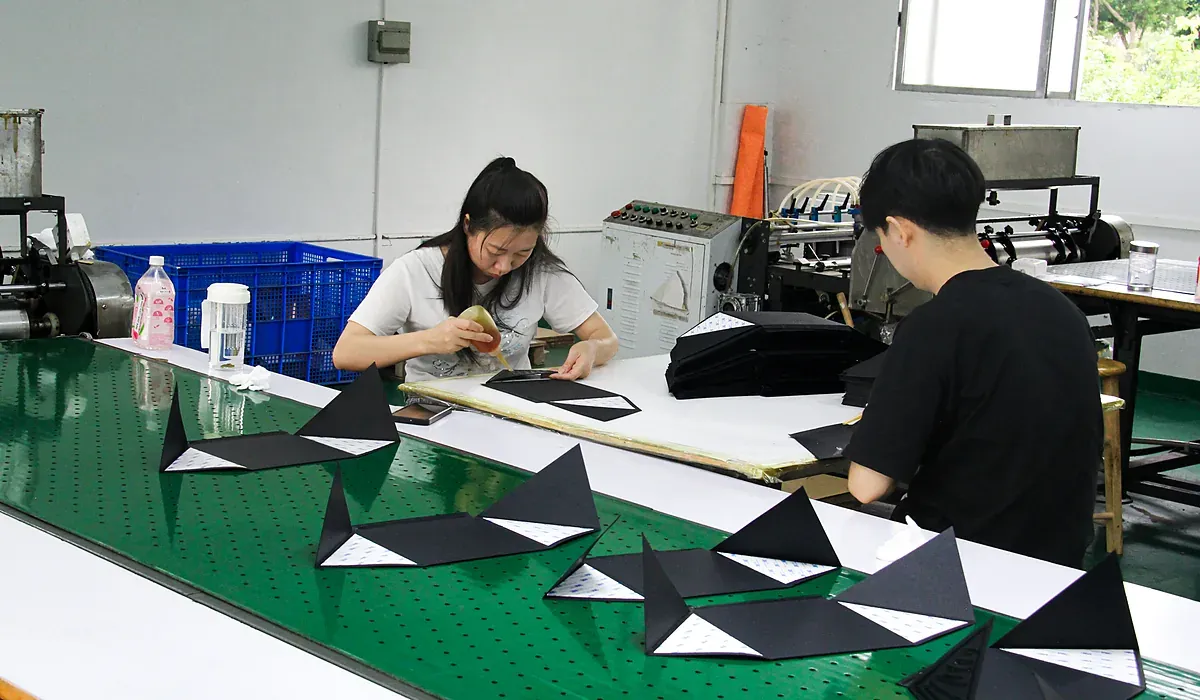
Our factory in Humen, Dongguan has run since 1998, with 5,000 m² of floor and about 100 staff delivering 1,000+ cases to buyers in 80+ countries for 50+ brands on roughly US$10 million in annual output. Rigid boxes are built on 1200 g greyboard wrapped in 157 g art paper; folding cartons use 300 to 500 g board. Board is FSC-ready, and the mill's written material declaration is attached to the order so the grade can be checked against the specification before production is scheduled. MOQ starts from 100 pcs, a free digital sample takes about 5 days, and mass production runs 10 to 20 working days after sample approval on a 30/70 payment schedule. Finished cartons pack 100 pcs per master carton at or below 22 kg, checked to AQL inspection standards before despatch. Rigid boxes ship assembled rather than flat, and bulk runs are printed by offset lithography.
FAQ
Is Vietnam cheaper than China for packaging?
Sometimes, for simple structures and standard print. For complex rigid boxes and specialty finishes, Vietnam often imports Chinese materials, so the saving can disappear once freight and tooling are counted. MOQ starts from 100 pcs and a free digital sample takes about 5 days.
Can I get low MOQ in Vietnam or India?
It is possible but less common. China's supply-chain density makes 100–500 piece runs practical across more structures and finishes. Rigid builds use 1200 g greyboard wrapped in 157 g art paper. Mass production runs 10 to 20 working days after sample approval. Cartons pack 100 pcs per master carton at or below 22 kg.
Which country is best for premium jewelry or cosmetic boxes?
China, in most cases — the combination of rigid board, velvet/foam inserts, foil, emboss and low MOQ is hardest to replicate elsewhere. Mass production runs 10 to 20 working days after sample approval. Cartons pack 100 pcs per master carton at or below 22 kg.
Does country of origin affect tariffs?
Yes, and the rules are specific and change. Confirm the current tariff and origin rules for your product and destination before committing a production run. Cartons pack 100 pcs per master carton at or below 22 kg. Board is FSC-ready, with a written material declaration attached to the order.
Should I dual-source?
Only after the design is stable. Dual-sourcing early doubles tooling and sampling cost and often produces two slightly different boxes. Board is FSC-ready, with a written material declaration attached to the order. Finished cartons are checked to AQL inspection standards before despatch. Folding cartons use 300 to 500 g board, while rigid boxes ship assembled rather than flat.
Is China vs Vietnam packaging really a cost decision?
Rarely. On custom printed work the gap is often smaller than the cost of requalifying, re-sampling and re-learning a new supplier's tolerances. Finished cartons are checked to AQL inspection standards before despatch. Folding cartons use 300 to 500 g board, while rigid boxes ship assembled rather than flat.
Conclusion
Choose the country by the box, not by the headline.
If your packaging is a premium rigid structure with inserts and multiple finishes, China's depth is hard to beat. If it is a simple carton and your tariff math favours elsewhere, test it — but budget for re-qualification, not just a new unit price. At boxeschina we build rigid, folding and mailer packaging from MOQ 100 pcs, with free customised samples in about 5 days and Since 1998, 1,000+ projects across 80+ countries. Send your dimensions, structure and quantities to our Dongguan factory and Request a Wholesale Quote.