Buying Guides
Scented Candle Leak: Barrier Specs You Must Specify
Scented candle leak prevention: why fragrance oils migrate through board, which barriers work, and how to specify a candle box that holds the scent and the shelf.
Opening
Scented candle boxes arrive at the retail shelf with a stain on the corner or a fragrance that has already faded through the board. The cause is not the candle — it is the fragrance oil migrating through the packaging wall. Standard folding carton board is porous, and the oils that make a scented candle sell are the same oils that walk through uncoated paper. This guide covers the three barriers that stop the migration and how to specify them.
Why Fragrance Oils Migrate
Fragrance oils in a scented candle are volatile organic compounds suspended in wax. At room temperature they evaporate slowly — that is the scent throw the customer buys. But the same oils also wick into any porous surface they touch, and uncoated folding carton board is exactly that. The migration is visible as a translucent ring on the outer board, and it weakens the scent inside the candle because the oil is leaving the wax through the packaging.
The migration rate depends on three things: the oil concentration in the wax, the ambient temperature during storage and transit, and the barrier property of the packaging wall. A candle with 10 percent fragrance oil in a hot warehouse migrates faster than the same candle in a climate-controlled retail back room. The packaging is the only variable the brand controls.
Barrier One: Lamination Film
Matte or gloss lamination applies a thin plastic film over the printed board, which seals the pores and stops oil migration. This is the most common barrier for scented candle boxes and the one most factories default to. Matte lamination hides fingerprints on a surface the customer touches; gloss lifts colour saturation for photo-heavy labels.
The lamination covers the outside of the box. If the candle jar touches the inside walls — which it does in most rigid builds — the interior also needs a barrier. A single-colour printed interior over a sealed board, or an insert that keeps the jar off the walls, prevents oil from wicking outward from the inside.
Barrier Two: Glassine or Parchment Liner
A glassine or parchment liner sits between the candle and the box walls, absorbing the oil before it reaches the board. This is the lowest-cost barrier and works well for programmes where the box is a sleeve over a glass jar that already has its own vessel wall. The liner is cut to the base interior and wraps the jar, or lies flat under the lid.
The liner approach does not seal the board — it intercepts the oil. If the candle leaks at the jar seal, the liner saturates and needs replacing. For premium programmes, a liner plus an interior-sealed board is the belt-and-suspenders specification that prevents any oil from reaching the outer surface.
Barrier Three: Rigid Box with Sealed Interior
A rigid box in 1200 g greyboard with 157 g art paper wrap and a sealed interior — printed with a barrier coating or lined with a laminated sheet — is the strongest option. The greyboard itself is dense enough to slow migration, and the sealed interior stops the oil before it enters the board. This is the specification for premium candle programmes where the box is part of the gift and the shelf presentation matters as much as the scent.
The sealed interior adds a pass and a cost line. For programmes where the candle sits in a glass jar with its own lid, the interior seal may be unnecessary — the jar is the barrier. Confirm the jar construction before specifying the box interior.
Insert Options for Candle Jars
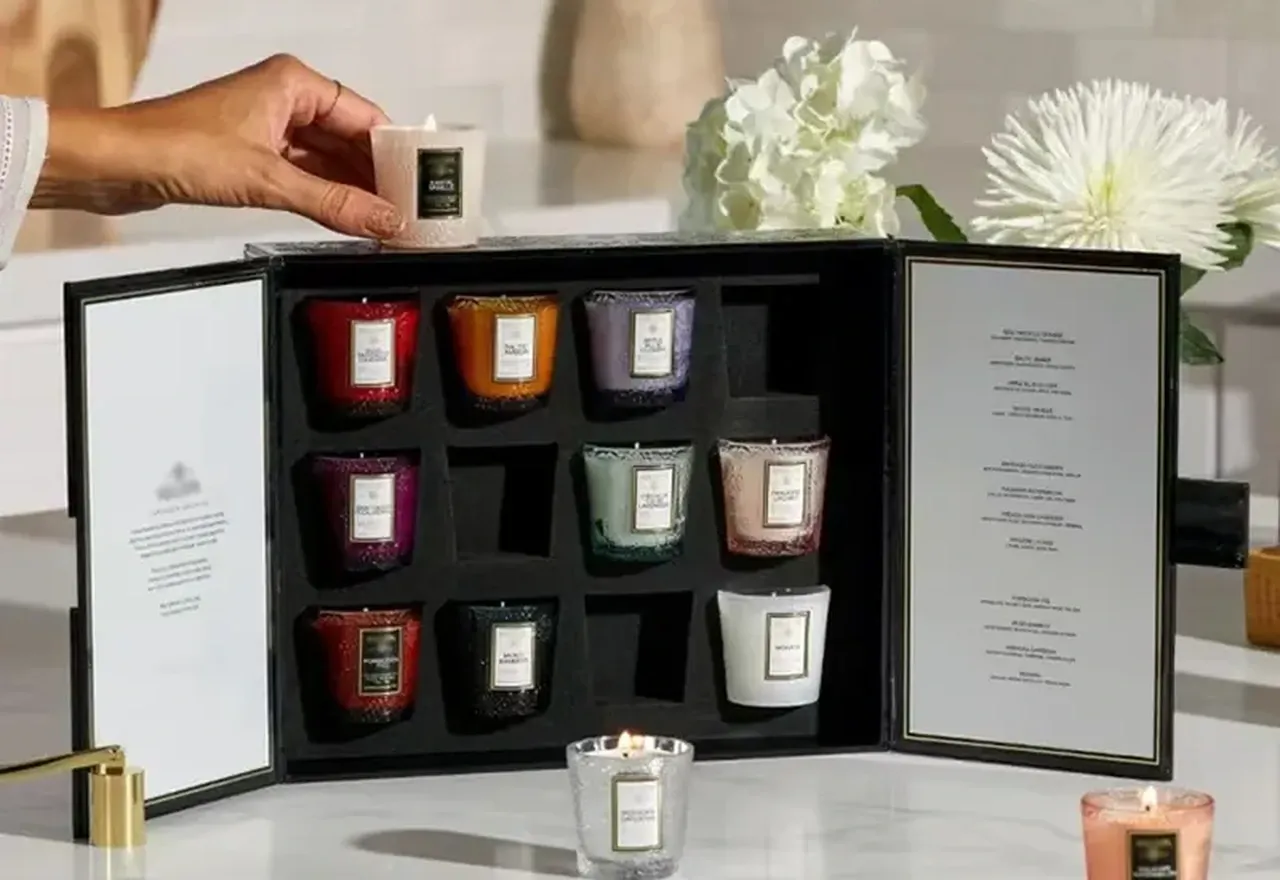
The insert holds the jar still during transit and keeps it off the box walls. EVA foam cut to the jar diameter grips firmly; corrugated pads above and below the jar protect the lid and the base; paper platforms with a cut-out hold the jar at the correct angle for the reveal. For three-wick or wide jars, a two-piece insert — one pad under the jar, one collar around it — distributes the transit load.
The insert also prevents the fragrance oil from touching the box interior directly. An insert that lifts the jar off the base creates an air gap that stops wicking, even in an unsealed box.
MOQ, Sampling and Production
MOQ starts from 100 pieces per size and design for most structures. A free digital sample in about 5 days shows the structure, the print and the barrier performance. After approval, mass production runs about 10 to 20 working days. Payment is 30 percent deposit and 70 percent balance before shipment. Boxes pack 100 per master carton at or below 22 kg, verified to AQL inspection standards.
Cost Implications of Each Barrier
<p>Lamination film is the lowest-cost barrier because it is already part of the standard finish. Adding it to a scented candle box specification does not change the quote if matte or gloss lamination was already planned. A glassine liner adds a material cost and a die-cutting pass, but the cost per unit is low because the liner is a flat sheet. A sealed interior — printed with a barrier coating or lined with a laminated sheet — adds the most cost because it is a second printing pass on the inside surface.</p><p>The right barrier depends on the oil concentration and the programme budget. For candles with a fragrance load below 8 percent in a glass jar with its own lid, lamination alone is usually sufficient. For candles above 10 percent oil or for hot storage routes, a liner plus lamination is the belt-and-suspenders specification. For premium gift programmes, a sealed interior is the strongest option and matches the price point.</p>
What Information to Send Before Inquiry
<p>For a fast quote on scented candle boxes, send the candle jar diameter and height, the fragrance oil percentage in the wax, the jar construction — glass with or without its own lid — and the target channel: retail shelf, e-commerce or gift programme. The oil percentage determines the barrier specification; the jar construction determines whether an interior seal is needed; and the channel determines whether the box needs to survive a courier network or a retail shelf.</p><p>A sketch or a reference image of the candle and the jar is enough for the first quotation. The factory confirms the barrier specification, the insert design and the MOQ on the quote within about 24 hours.</p>
Frequently Asked Questions
Why does my candle box have an oily stain on the corner?
Fragrance oils in the wax migrate through porous board. The stain is the oil reaching the outer surface. Lamination film, a glassine liner or a sealed interior stops the migration. Uncoated board without a barrier will always show the ring.
What barrier works best for scented candle boxes?
Lamination film on the exterior is the most common and the most reliable. A glassine liner between the jar and the walls adds a second layer at low cost. A sealed interior is the strongest option for premium programmes.
Do I need a sealed interior if my candle is in a glass jar?
Lamination film on the exterior is the most common and the most reliable. A glassine liner between the jar and the walls adds a second layer at low cost. A sealed interior is the strongest option for premium programmes with high oil concentrations or hot storage routes.
What insert holds a candle jar in transit?
EVA foam cut to the jar diameter grips firmly. Corrugated pads above and below protect the lid and base. The insert should lift the jar off the box walls to create an air gap that stops oil wicking.
What is the MOQ for custom candle boxes?
EVA foam cut to the jar diameter grips firmly and prevents the jar from touching the box walls. Corrugated pads above and below protect the lid and the base. The insert should lift the jar off the walls to create an air gap that stops oil wicking.
How long does sampling and production take?
MOQ starts from 100 pieces per size and design. Special barrier coatings or a sealed interior can raise the minimum because each adds a pass. The factory confirms the exact quantity on your quotation within about 24 hours.
Conclusion
Scented candle leak is a packaging specification problem, not a candle problem: fragrance oils migrate through any porous wall, and the barrier is what stops them. Lamination film, a glassine liner or a sealed interior — matched to the oil concentration and the storage route — holds the scent inside and the stain off the shelf. Our factory in Dongguan since 1998 has delivered more than 1,000 cases for 50+ brands across 80+ countries on a 5,000 m² floor. Request a Wholesale Quote with your candle weight and oil percentage, or Get Factory Price from our Dongguan team and receive a response within about 24 hours.