Buying Guides
Custom Holiday Gift Packaging: Multi-Item Season Sets
Source custom holiday gift packaging direct from a Dongguan factory. Multi-item gift set boxes with sized inserts, MOQ from 100 pcs per size, free samples.
What a Custom Holiday Gift Set Actually Consists Of
In factory terms, a holiday gift set is never a single product. It is one outer box plus a system of sized compartments or inserts that together hold two to six separate SKUs — a candle, a body lotion, a bar of soap, a tin of tea, a mini bottle. Each of those SKUs brings its own dimensions, weight, and fragility, and the set only works when every item is held firmly, separated from its neighbors, and presented in the right order as the lid opens. That is what separates a true multi-item gift set from a plain box with products dropped inside, and it is why gift set tooling cannot be quoted from an outer dimension alone.
Specifying the set means locking down three things before artwork is discussed: the outer structure, the insert system, and the print program across all surfaces. Buyers who send the outer dimensions plus a complete item list — length, width, height, and weight of every SKU — receive an accurate quote within about 24 hours. Buyers who send only a photo of a reference box receive a questionnaire instead, and lose a week. Holiday gift sets packaging has been a core program here since 1998: the Dongguan workshop runs 5,000 m² with around 100 staff, has delivered 1,000+ custom cases for 50+ brands across 80+ countries, and exports above US$10 million annually. The rest of this guide walks through each specification the way a factory estimator reads it.
Structure Choices: Rigid Boxes vs Folding Cartons
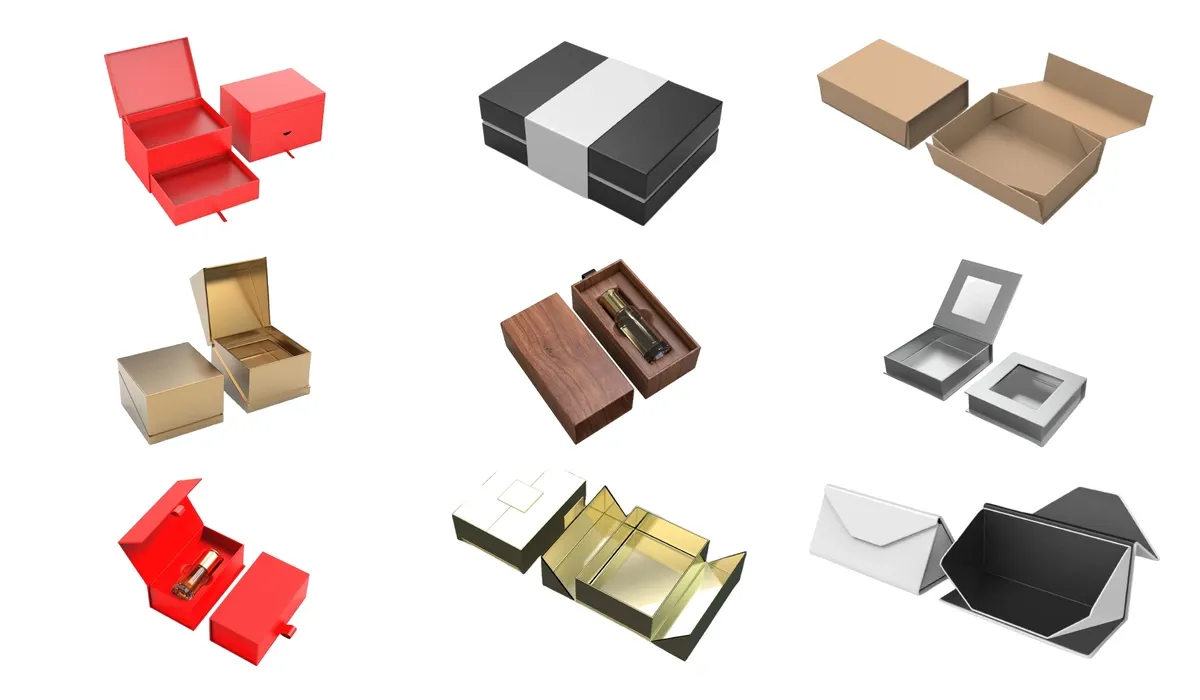
The workhorse structure for corporate holiday gift boxes is the rigid box. Standard construction is 157 g face paper laminated over 1200 g greyboard, which gives walls that stay square under stacking and a lid that seats with firm, even resistance. This is the construction buyers choose when the unboxing moment is part of the product — when a client or subscriber lifts the lid and finds the set arranged like a display case. Rigid boxes accept magnetic closures, ribbon pulls, and elastic bands, and they carry EVA or molded inserts without deforming. One volume note: for magnetic gift boxes, quantities typically run 500+ per design, because the closure assembly adds hand finishing that only pays off at that level.
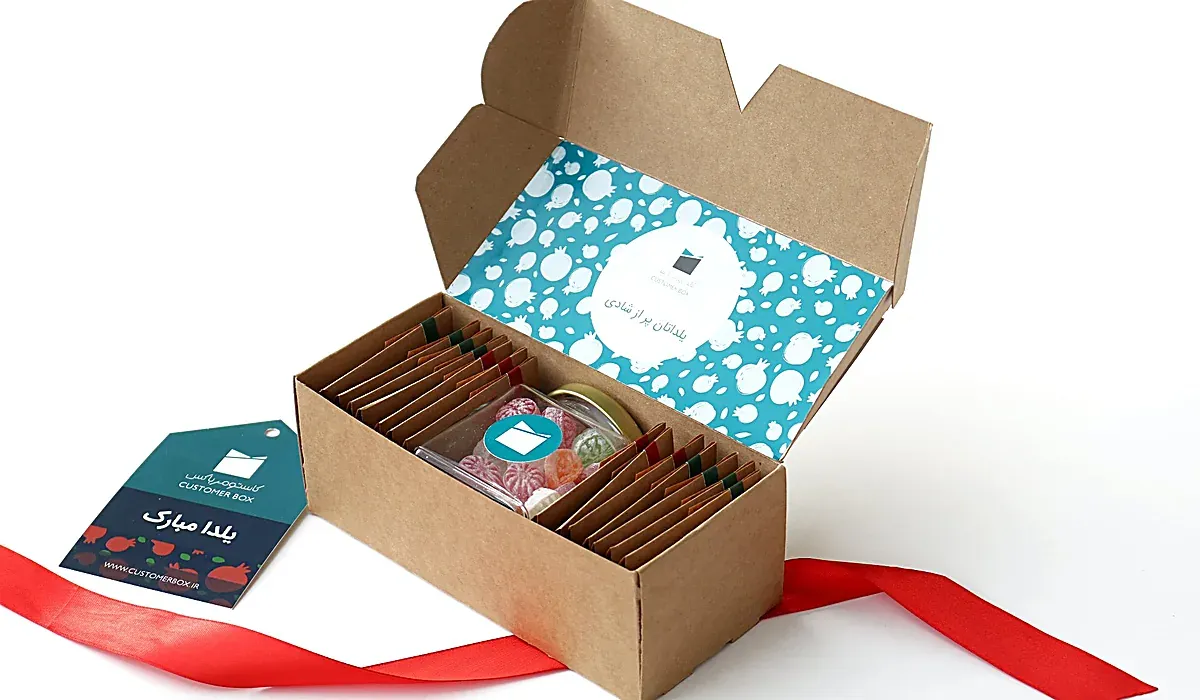
The folding carton is the second option, made from 300–500 g board, and it solves a different problem. A folding carton ships flat, costs less per unit, and assembles in seconds at the packing line, which makes it a strong match for lighter sets — teas, sachets, sheet masks, small jars. Many seasonal programs run both structures side by side: a rigid magnetic box for the flagship corporate tier and a folding carton for the retail tier, built on the same artwork family. When comparing the two, price the freight difference into the unit cost as well, because rigid boxes travel pre-assembled and occupy more shipping volume than flat-shipped cartons. The comparison usually favors the rigid box on perceived value and the carton on freight and assembly cost, and for mid-weight sets the gap is smaller than most buyers expect.
Insert Engineering for Mixed Products
The insert is where a gift set succeeds or fails, because holiday sets almost always mix product types. Four insert systems cover nearly every case. EVA foam cutouts are the premium choice: the foam is die-cut to the exact silhouette of each SKU, holds heavy items like candles and glass bottles absolutely still, and presents each product in a recessed pocket the moment the lid opens. Molded pulp inserts are the sustainable counterpart, formed to irregular shapes from recycled fiber, and they carry the environmental story many holiday campaigns are built on. Paper platforms and corrugated dividers are the budget route for light, uniform items. Printed sleeves and wraps handle the final tier — items that sit loose in the box but still need brand presence and separation.
Choosing between them is a weight and finish decision. EVA is the safe spec for glass, ceramics, and anything above roughly 200 g per compartment. Molded pulp suits irregular shapes and buyers who want the insert visible as part of the design. Paper platforms suit sets where every SKU sits under 100 g and the journey to the customer is gentle. On board and pulp materials, FSC-ready supply is available on request — certified board is reserved per order rather than held as a blanket certification, so state it in the specification instead of assuming it applies by default. Whatever insert you choose, the factory needs one drawing or one physical set of the SKUs before compartment dimensions can be quoted, and supplying that with the first inquiry is what keeps the estimate accurate.
Unified Artwork Across Sizes
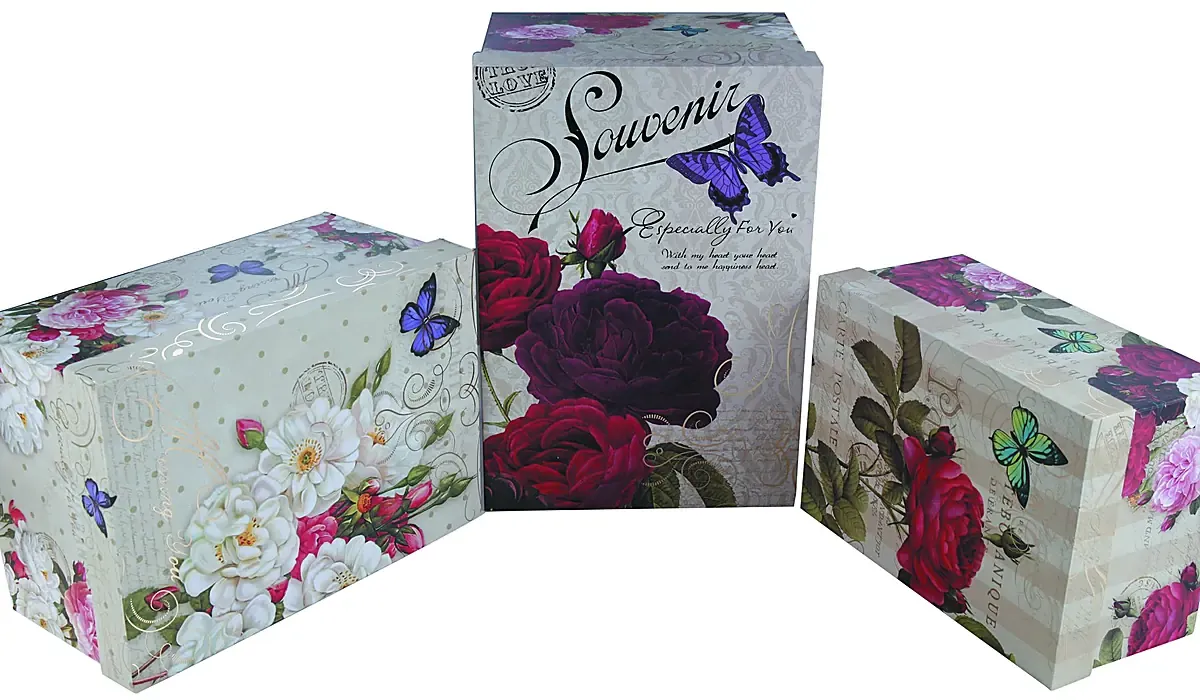
Most custom gift box sets need the same design in more than one box size — a two-item set, a four-item set, perhaps a six-item deluxe version. The efficient way to specify this is as an artwork family: one visual system applied across every size, with the same face paper, the same foil or spot color, and the same interior print treatment. This does more than keep the brand consistent on a shelf or in a campaign photo grid. Because all sizes draw from the same artwork family, printing can be consolidated, and consolidating volume across sizes is exactly what unlocks better unit pricing.
The practical rule is simple. Separate designs mean separate setup, separate sampling, and separate printing plates for every size. A shared artwork family means one setup is amortized across the whole program. When you request pricing, state clearly that three sizes share one artwork system and ask the estimator to quote the program as a consolidated volume rather than as three isolated jobs. That single sentence in the specification often moves the unit price more than any change in board weight, and it also simplifies sampling, because one approved artwork governs every size in the set.
MOQ Math for Multi-Size Gift Set Programs
The minimum order for custom holiday gift packaging is set from 100 pcs per size or per design, and that wording matters. A program with three box sizes counts as three separate minimums, not one — 100 of the small size, 100 of the medium, 100 of the large. Buyers building tiered corporate gifting programs — a director-level set, a staff-level set, a client-level set — should add the MOQ stack into the budget before deciding how many sizes to launch. Two sizes sharing one artwork family and one insert system are far cheaper to bring to market than three sizes with three distinct designs, even though the per-size minimum never changes.
Magnetic rigid boxes are the exception to watch. Quantities for magnetic gift boxes typically run 500+ per design because of the closure assembly, so a magnetic flagship tier and a 100-piece trial tier rarely coexist in the first season. If the magnetic minimum does not fit the program, a standard rigid box closed with ribbon or elastic keeps volumes in the lower range while preserving most of the premium feel. The sequence that works for most buyers is to fix the number of sizes first, confirm the full MOQ stack with the estimator second, and commit artwork last. Reversing that order is how programs end up with a size they cannot afford to produce.
The Sampling and Production Timeline, Mapped Backward From Your Deadline
The production rhythm has three fixed stages. First, quoting: send complete specifications and receive pricing within about 24 hours. Second, sampling: a free digital sample is produced in about 5 days, giving you the chance to verify structure, insert fit, and print placement against your real SKUs. Third, mass production: 10–20 working days after artwork and sample approval — approval, not request. Every day a revision round adds to sampling comes directly out of the production window, which is why complete first specifications are the cheapest schedule insurance a buyer can buy.
Map the rhythm backward from your dock date. If holiday goods must be in your warehouse by mid-November, count back 20 working days of production, then 5 days of sampling, then a buffer of several days for one revision round — artwork should be final and the sample approved by early October. Programs that start with finished artwork in September move comfortably through the queue; conversations that begin in late October are negotiating with the calendar rather than with the factory. The most effective step a buyer can take is finalizing every SKU dimension before the first quote request, because that is what allows the 24-hour quote, the 5-day sample, and the 10–20 day production window to all hold true.
Packing and Freight for Gift Set Programs
Finished boxes are packed 100 per master carton, with carton weight kept at or below 22 kg — a deliberate ceiling that keeps each carton safe to handle at the packing line and compatible with standard warehouse and freight handling rules. Gift sets in rigid outer boxes travel pre-assembled and therefore occupy more shipping volume, while folding cartons ship flat and are assembled at your line. When comparing quotes between the two structures, ask for the master carton dimensions per 100 boxes and price the freight difference into the unit cost. On long-haul holiday programs, freight per finished box is often the variable that decides between two structures that look identical on a price sheet.
If your set contains fragile SKUs, specify whether the insert must survive a drop test or only shelf handling — EVA compartments are the spec for the former, paper platforms for the latter. Inspection follows AQL standards before shipment, so a stated acceptable quality limit belongs in the specification for any set with hand-finished elements such as ribbon ties or magnetic closures. Payment terms are 30 percent deposit and 70 percent balance before shipment, and seasonal production capacity is allocated in the order deposits are received — one more reason the timeline above deserves early mapping rather than a November scramble.
Spec Details Buyers Forget That Delay Quotes
The quote response is fast — about 24 hours — but only when the specification arrives complete. The omissions that stall quotes are remarkably consistent. Missing SKU dimensions: a set is defined by what goes inside it, so a request for a box for candles and lotion cannot be estimated. Missing insert choice: EVA foam, molded pulp, paper platforms, and printed sleeves carry different tooling and unit costs. Missing closure spec: magnetic, ribbon, elastic, and friction-fit closures change both structure and price, especially the magnetic jump at 500+ quantities. Missing artwork status: buyers who write artwork coming later receive quotes built on assumptions that change at sample stage. Missing artwork-family information: without knowing that three sizes share one design, the estimator prices three setups instead of one.
The fix costs nothing. Before requesting pricing, prepare one short specification covering the outer structure and size, the full SKU list with dimensions and weights, insert preference, closure type, the number of sizes, whether they share artwork, the target in-hands date, and whether FSC-ready certified board is required for this order. A specification like that turns the 24-hour quote from a best case into the default, and it makes the first digital sample accurate enough to approve in a single round — which is where the real schedule risk of a holiday program lives.
Frequently Asked Questions
How many SKUs can a single holiday gift box hold?
Between two and six SKUs is the practical range for one outer box. Below two, you are simply buying a single-product box; above six, compartments multiply, inserts become complex, and per-unit tooling climbs. Most corporate tiers use three or four SKUs arranged in one EVA or molded pulp insert, which keeps packing-line assembly fast and the presentation clean.
What is the minimum order quantity for a gift set program?
The minimum is set from 100 pcs per size or per design, so three box sizes in one program represent three separate minimums. Magnetic gift boxes are the exception, with quantities typically running 500+ per design because of the closure assembly. Sharing one artwork family across sizes reduces launch cost without changing any individual minimum.
How long do sampling and mass production take?
A free digital sample is ready in about 5 days. Mass production takes 10–20 working days after both artwork and sample are approved, and approval means sign-off, not submission. Add a buffer of several days for one possible revision round, then map the total backward from the date goods must reach your warehouse.
Can artwork stay consistent across different box sizes?
Yes, and it should. Specifying one artwork family across all sizes keeps branding uniform across your range and allows print runs to be consolidated, which improves unit pricing. State the shared-artwork structure in your quote request so the estimator prices the program as a single volume rather than as separate jobs with separate setups.
Which insert material suits heavy items like candles?
EVA foam cutouts are the standard answer for candles, glass, and ceramics. The foam is die-cut to each SKU's silhouette and holds real weight without shifting in transit. Molded pulp handles irregular shapes and adds a sustainability story, while paper platforms should stay with lighter sets of roughly 100 g per compartment or less.
How are finished gift set boxes packed for shipping?
Boxes are packed 100 per master carton, with carton weight kept at or below 22 kg. Rigid boxes travel pre-assembled and occupy more volume, while folding cartons ship flat for assembly at your line. Ask for master carton dimensions per 100 boxes so freight can be calculated accurately into your per-unit landed cost.
What are the payment and inspection terms?
Payment runs on 30/70 terms: a 30 percent deposit confirms the order and the 70 percent balance is due before shipment. Every order is inspected to AQL standards before it leaves the factory. Seasonal capacity is allocated in deposit order, so confirming terms early protects your slot in the holiday production schedule.
Can the board be FSC certified?
Certified board is supplied on request and reserved per order rather than held as a blanket certification. If your holiday campaign carries an environmental claim, state the FSC-ready requirement in the initial specification so the correct board is allocated to your production run from the first sampling round onward.
Conclusion
Custom holiday gift packaging rewards buyers who spec like engineers: structure, insert, artwork family, sizes, and deadline, all settled before the first quote. Decide how many sizes you can genuinely afford at 100 pcs per size — or 500+ for magnetic rigid boxes — then lock artwork early enough to leave 10–20 working days of production after sample approval. Every week gained in specification is a week kept in production. Ready to build a multi-item set that ships on time? Request a Wholesale Quote from our Dongguan factory and Get Factory Price on your holiday program today.