Buying Guides
Custom Foam Inserts: Density, Cut Style and Tolerance
Custom foam inserts: density set by product weight, cavity and cruciform cuts, tolerance and assembly fit, drop tests before mass production, MOQ from 100 pcs.
Opening
Custom foam inserts are the layer of a package that actually touches the product. The box sells, the outer carton stacks, and the insert decides whether the contents arrive as they left. Because of that, an insert is engineered from the product — its weight, fragility and contact surfaces — and not from the box it sits in. Two products in identical boxes can need entirely different foams, and no artwork choice downstream repairs a wrong density decision made upstream.
Since 1998 our factory in Humen, Dongguan has engineered foam inserts alongside the boxes they serve, for jewellery, electronics, glassware and instrument brands across 80+ countries. This guide covers the decisions that decide insert performance: how density is chosen, which cut styles suit which products, how tolerance is set so the fit is secure without fighting the customer, and how drop testing at sampling validates the whole system before mass production.
The recurring theme is that the insert is a system component, not an accessory. It shares its load path with the box, its tolerances with the product and its test schedule with the distribution channel. Buyers who treat it that way — specifying product weight, fragility and channel with the first enquiry — reach a production-ready fit in one sampling round instead of three. It also changes who is in the conversation: insert decisions draw on the product team as much as the brand team, because the people who know how the product scratches, balances and seats are rarely the people who chose the box.
Density Follows the Product, Not the Box
Density is chosen from the load, and the load is the product. A heavier piece needs a higher-density foam so it does not bottom out under its own mass through a drop; a light, fragile piece needs a softer foam with more contact area so it is cradled rather than point-loaded. Box dimensions enter that calculation nowhere. A large box around a light product does not want dense foam, and a compact box around a dense product does — the geometry of the cavity is a footprint question, while density is a load question.
Density grades are specified numerically by foam suppliers, but the number a buyer meets at our end is usually a recommendation derived from the product: mass, contact surfaces, fragility and the drop heights of the channel. The specification is confirmed by feel and by test rather than by the datasheet alone, because two foams of the same grade can behave differently under a finished product at the corners of tolerance.
The second property is endurance. Foam that stays compressed loses its grip over time, and a gift box that sits on a shelf for a season needs foam that recovers after months of load, which is a different specification from a transit-only pack crushed once and discarded. Closed-cell and open-cell families behave differently here, in recovery as well as in feel, which is why the material is specified alongside the geometry rather than assumed from the product category. Endurance has a visual dimension too: foam that takes a permanent set shows a product-shaped dent after a season on the shelf, which reads as wear even when protection is intact.
The insert is specified independently of the host box. The same engineering serves a folding carton in 300 to 500 g board, a corrugated mailer, or a rigid shell of 1200 g greyboard wrapped in 157 g art paper. What changes with the host box is the footprint the insert must fill and the walls it mates against; what changes with the product is everything else — grade, cut and tolerance.
Cut Styles: Cavity, Cruciform and Layered Builds
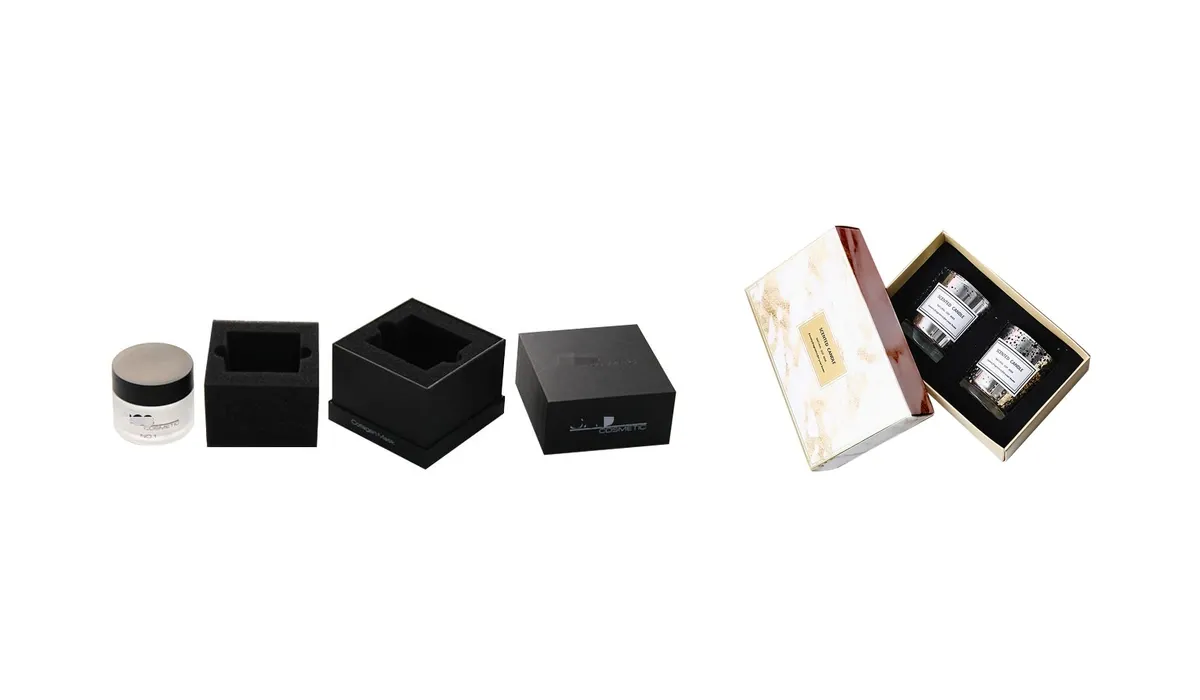
A cavity insert recesses a pocket shaped to the product's footprint: the most protective single-item build, because the product sits below the foam surface and contact is distributed across the whole recess. Lift cut-outs — finger notches under the product — are part of the design rather than an afterthought, because a customer who fights the foam on the first day judges the whole purchase by it. Cavity walls are also where subtle geometry earns its keep: a slight taper eases removal, a chamfer hides the cut line under the product's shadow line, and a recess for a label keeps the finish out of contact entirely.
A cruciform build cuts cross-shaped slits that grip items between blades of foam: the standard for jewellery slots, angled tool presentation and any set where each piece must sit at a consistent angle. The slit width is cut to the item and the angle is set by the cut, not by luck. Cruciform inserts present as well as they protect, which is why display-led programmes prefer them and why the same geometry often appears in both the shipping pack and the display stand.
Layered builds stack two or more tiers — a tray over a tray, or a cover layer over a cavity — for sets with multiple pieces that deserve a staged reveal. Layering trades some protection for presentation and for part-count: each tier is a component to assemble and inspect. The style is chosen by the range of products a line must serve, and multi-SKU programmes often standardise on one layered geometry with swappable top trays so the pack line handles every variant the same way.
Foam is one material among several in the insert family, and programmes often combine them: corrugated dividers where stacking strength is wanted, moulded pulp where the sustainability story leads, flocked card where the surface must read as fabric. Foam takes the load where the product is fragile or the geometry is precise; the others take the jobs they do better. The combination is specified as one insert system with one set of tolerances.
Tolerance: The Gap Between Fits and Fights
Tolerance is where inserts are won or lost. Too tight and the foam scuffs the finish, fights removal and reads as cheap the first time it is used; too loose and the product migrates in transit, and the protection exists only until the first corner. The working tolerance is set by the product's own dimensional variation, the cutting method and the foam's springback, and it is decided with the product in hand rather than from a drawing alone.
The test we use at the bench is blunt: the product must seat with light pressure, lift out with two fingers, and survive repeated removal cycles without wear on either surface. Across the 50+ brands we produce for, that two-finger standard has stayed the most reliable predictor of how an insert behaves in a customer's hands. Assembly trials use production-intent samples — the real finish, the real weight — because a prototype without plating or coating fits differently from the shipped article.
Revisions at the sampling stage are cheap; after tooling they are not. Geometry edits between samples are normal and expected, which is why the insert sample round closes only when the fit passes the two-finger test on the final product. Freeze the geometry there, and mass production inherits a fit that was proven rather than assumed.
The agreed geometry is documented as part of the specification: cavity positions, depths, clearances and material grade are recorded against the dieline, so a reorder a year later reproduces the fit that was tested rather than a close approximation of it. Buyers with several SKUs receive a geometry index per product family, which keeps a growing programme coherent.
Validating With Drop Testing at Sampling
An insert is a cushion system, and cushion systems are validated by dropping. Drop heights are set by the distribution channel — a courier parcel and a shelf-picked gift box live under different levels of abuse — and the orientations matter more than the height: corner drops concentrate the load, edge drops follow, face drops are the least damaging. A pack that survives its corners survives its route. The product is dropped in its final packed state — insert, box and any outer — because the system is what travels, and a pass for the insert alone says little about the pack the customer receives.
Failures are informative. A product that rebounds and strikes the cavity wall hit foam that was too hard, so contact area or softness increases; a product that shifted bottomed out, so density rises or the recess deepens. Each iteration adjusts geometry or grade, and the pack is dropped again. Only when the cycle passes is the geometry frozen for mass production, which is why we hold the sample round open until the drop test passes on the production-intent pack. The loop is deliberately cheap at this stage: foam cuts in hours, and a geometry edit between drops costs minutes, which is the whole argument for testing before tooling rather than after.
Production then runs under inspection discipline: finished packs are checked to AQL standards before dispatch, and packing follows the same master carton rules as any structure — a 22 kg handling ceiling, with the reference pack for boxed formats at 100 pcs per master carton, inserts counted in the weight. Across 1,000+ cases, the packs that never generate complaints are the ones whose geometry was frozen after a passed drop test, not before one.
MOQ, Sampling and Production
MOQ starts from 100 pcs per size and design for inserts supplied with their host box, on standard cut styles. Multi-layer builds with swappable tiers typically run from 300 to 500 pcs because each tier adds cutting and assembly set-up. Exact quantities are confirmed on the quotation, which we return within 24 hours of receiving the product specification and quantities. Insert-only enquiries are quoted against the host box dimensions; if the host box is also ours, the dieline is already in the system and the quotation closes faster.
A free sample takes about 5 days, cut on the production material and fitted with your product in mind. After approval, mass production runs 10-20 working days depending on complexity. Payment is a 30% deposit with the balance before shipment. Board for the host box is FSC-ready and can supply certified board on request, flagged at quotation so certified material is allocated before scheduling.
The floor behind those commitments is a 5,000 m² factory with about 100 staff and US$10 million annual output. Enquiries receive a reply within 12 hours, and sampling slots are allocated in the order specifications arrive. Send product weight, dimensions and fragility notes with the first message and the insert recommendation comes back with the quotation. Fragility notes need not be formal — a line about what has broken in transit before is often the most useful fact in an insert enquiry.
Frequently Asked Questions
How is foam density chosen?
From the product, not the box. Heavier pieces need higher-density foam so they do not bottom out under their own mass; light, fragile pieces need softer foam with more contact area so they are cradled rather than point-loaded. Box dimensions play no part in the choice. We confirm density against product weight and the drop heights of your channel at sampling.
Which cut style should I choose?
Cavity inserts suit single items that need the deepest protection, with the product recessed below the foam surface. Cruciform builds grip items between cross-cut slits and hold them at a set angle, which suits jewellery and presentation-led sets. Layered builds stack trays for multi-piece sets that deserve a staged reveal. The style follows the product range and how the set is meant to be opened.
How tight should the fit be?
Tight enough that the product cannot migrate in transit, loose enough to seat with light pressure and lift out with two fingers. Scuffed finishes and fought removals are signs of a fit cut too tight; movement inside the cavity means it is too loose. We pass geometry only after it survives repeated removal cycles on the production-intent product.
Do you drop test the pack before production?
Yes, at sampling. Drop heights are set by your distribution channel, and the orientations run corner, edge and face — corners concentrate load and are the honest test. Failures change geometry or foam grade, and the pack is dropped again until the cycle passes. Only then is the geometry frozen for mass production.
What is the MOQ and lead time for inserts?
MOQ starts from 100 pcs per size and design for inserts supplied with their host box; multi-layer builds with swappable tiers typically run from 300 to 500 pcs. A free sample takes about 5 days. After approval, mass production runs 10-20 working days, with payment at a 30% deposit and the balance before shipment.
Can inserts be ordered without the boxes?
They can, but we recommend specifying both together, because the insert's footprint, retention geometry and load path all assume a host structure. The same insert engineering serves a folding carton in 300 to 500 g board or a rigid shell in 1200 g greyboard wrapped in 157 g art paper. Specified together, the fit and the drop behaviour are validated once, as one system.
Conclusion
An insert earns its keep in the properties that never photograph: density matched to the product's mass, a cut style matched to how the set opens, and a tolerance that seats with light pressure and lifts with two fingers. Validate all three with drop testing at sampling, and the pack arrives as it left. Send your product weight, dimensions and fragility notes to our Dongguan team and Request a Wholesale Quote; we will specify the foam and the host box together, reply within 12 hours, and prove the fit on your product before mass production begins.