Buying Guides
Custom Christmas Gift Boxes: Holiday Rush Survival
Source custom christmas gift boxes direct from a Dongguan factory since 1998. Rigid and folding specs, MOQ from 100, free sample in 5 days, 10-20 day runs.
<!-- META_EXCERPT: Source custom christmas gift boxes direct from a Dongguan factory since 1998. Rigid and folding specs, MOQ from 100, free sample in 5 days, 10-20 day runs. -->
Christmas is the one season when packaging mistakes become expensive fastest. A rigid box that arrives warped, a foil color that drifted away from your brand red, or a shipment still sitting in production while retail shelves fill up — each of these costs far more to fix in November than to prevent in September. This guide is written for buyers, not gift-givers: brand owners, wholesalers and e-commerce sellers who need to lock specifications for custom christmas gift boxes before the seasonal crunch compresses every timeline. As a christmas gift box manufacturer based in Dongguan since 1998, operating a 5,000 m² workshop with around 100 staff and exporting above US$10 million annually, we ship holiday gift boxes bulk to more than 80 countries each year. The orders that go smoothly share one trait: the buyer decided sizes, materials, closures and artwork cutoffs early. The sections below walk through the exact parameters to decide, in the order a factory needs them.
Standard Gift Box Sizes Versus Custom Sizing
Standard gift box sizes exist because they work: they fit common product categories, they nest efficiently on pallets, and tooling costs stay low. Typical reference dimensions for rigid gift boxes run from small jewelry formats around 9 × 9 × 3 cm up to apparel formats near 40 × 30 × 10 cm, while folding cartons cover a wider spread because the board creases and folds rather than wrapping around a frame. If your product fits a standard footprint, you save on both unit price and lead time, since no custom die is required. Custom sizing earns its cost when the product is odd-shaped, when the unboxing moment is part of your brand story, or when you need a specific insert cavity for protection. Two dimensions matter most in practice: internal depth, which decides whether lids close without pressure on the product, and base width, which decides how many units fit per master carton. One rule from our factory floor: order custom sizes before mid-October for Christmas delivery. After that, die-making queues for holiday gift boxes bulk lengthen, and a two-day wait for a cutting die in early October becomes a week or more in November.2e:T
Choosing the Right Material: Rigid Board or Folding Carton
Material choice drives cost, perceived value and shipping weight more than any other decision on the specification sheet. A rigid gift box uses 157 g coated face paper wrapped over 1200 g greyboard, and the result is a box that holds its shape, protects premium contents and photographs well for e-commerce listings. Rigid construction suits candles, cosmetics, electronics, wine and curated gift sets where the box is part of the product experience rather than a wrapper. A folding carton uses 300 to 500 g board, ships flat, assembles quickly at the packing line and costs a fraction of rigid per unit at high volumes. It fits chocolate bars, small toys, greeting cards and promotional multipacks where speed and margin dominate. A useful test: if the box must survive being stacked, tossed and displayed for weeks, go rigid; if it goes inside another shipper or onto a retail planogram quickly, the folding carton wins on economics. Both constructions carry identical print work, so treat this as a structural and budget decision, not a visual one. Board weight also affects freight, because rigid boxes weigh several times more per unit, which shows up clearly in air-freighted top-up orders. Buyers with sustainability mandates can request certified board, supplied on request and reserved per order.
Closure Options: Magnetic, Ribbon and Elastic
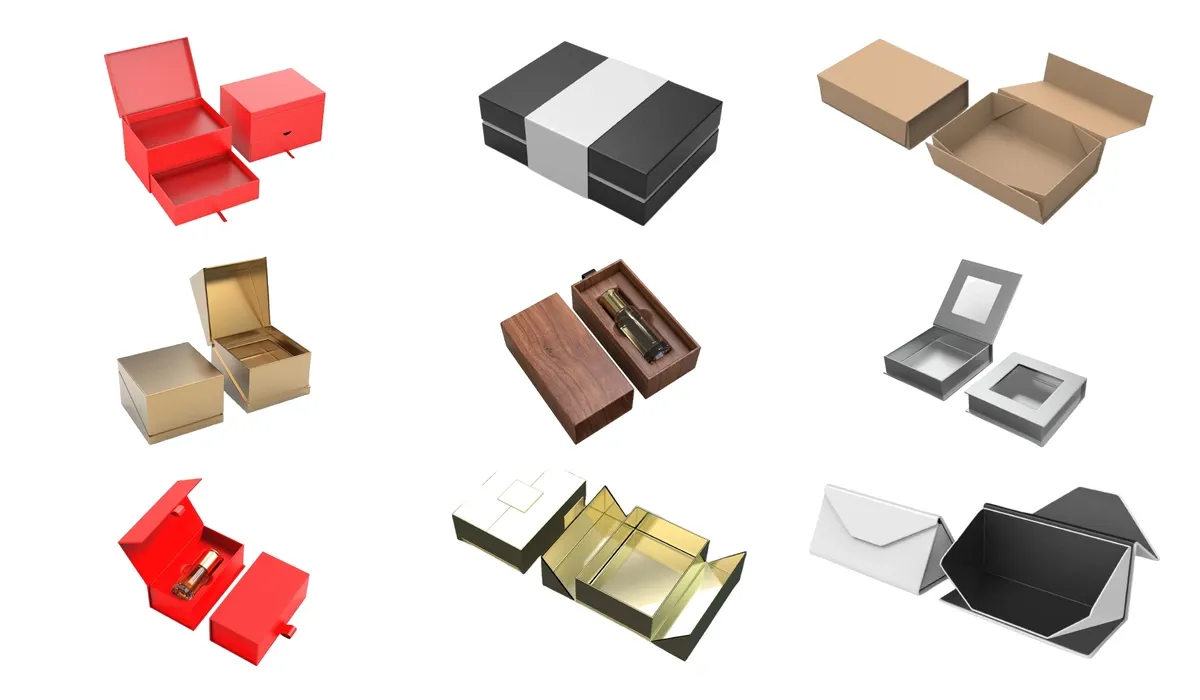
Closures change both the budget and the manufacturing queue. Magnetic closures — a rigid lid with embedded magnet pairs and a folding flap — deliver the premium snap that customers associate with holiday gift sets, but they require more hand-assembly on the line, so quantities typically run 500+ per design and unit prices sit above ribbon-closed equivalents. Magnet strength is itself a specification: standard pairs hold light contents securely, while heavier gift sets need stronger magnets that still open easily in the customer's hands. Ribbon and elastic closures cost less and assemble faster: a scored lid strip with a ribbon pull suits tea, chocolate and stationery boxes, while elastic bands allow quick re-closing for subscription-style or reuse-focused packaging. Match the closure to the weight of the contents and the journey the box will take — a 2 kg gift set in a lightly glued ribbon-closed box will pop open in transit, and a season of returns costs more than the closure upgrade ever would. If you are undecided between two closure styles, build both into the sampling round; the free digital sample stage exists precisely for this kind of comparison, and switching closure after sample approval restarts part of the tooling queue.30:T4d
Inserts That Protect and Present
An insert turns a gift box from a container into a presentation system, and the material decision matters as much as the print. EVA foam holds heavy or fragile items in laser-cut cavities and offers the tightest tolerances; it is the default for cosmetics, glassware and electronics. Molded pulp gives a recyclable, tactile, earthy look that pairs naturally with organic-brand Christmas lines and cushions irregular shapes without plastic. A paper platform — a folded board tray, often wrapped in the same face paper as the box — is the economical choice for stationery, teas and flat gift sets. A printed sleeve adds a second branded layer over the insert or over a plain inner carton, letting one physical box carry two seasonal messages across different product bundles. Supply the factory with exact product dimensions and weights at quotation time, not after sampling; insert engineering is the step buyers most often leave too late, and it directly gates sample approval. A cavity that holds a 60 mm candle loosely will not survive a courier drop test, and the fix usually means a new insert die. Insert cost scales with cavity count and tolerance, so simplifying a design from three cutouts to two saves real money at 10,000-pc volumes.31:T
Festive Print Techniques That Sell on the Shelf
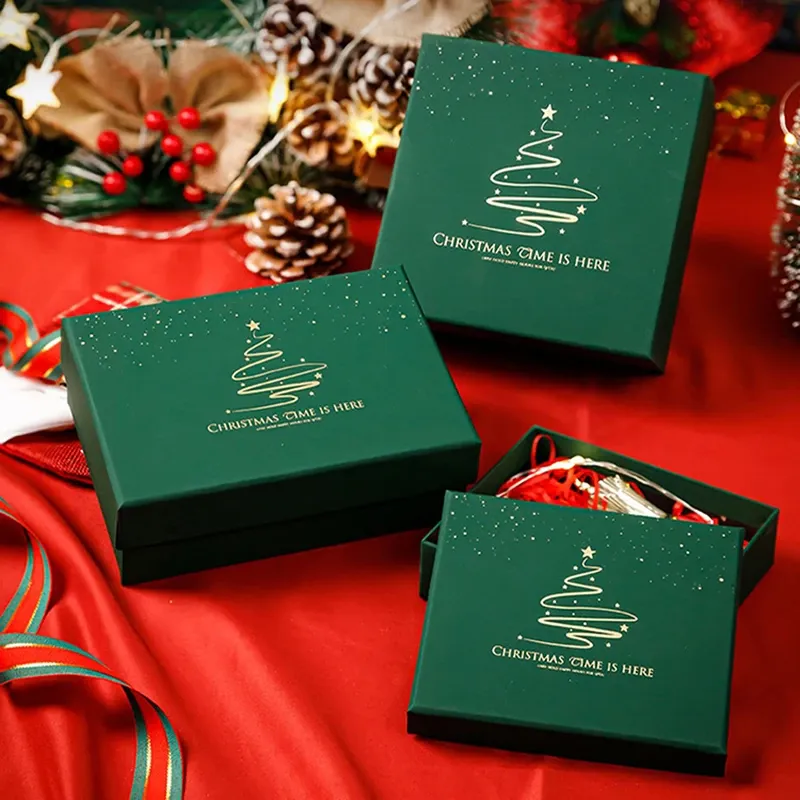
Christmas packaging competes visually on a crowded shelf, so treat print technique as a sales tool rather than a cost line. Color comes first: supply Pantone numbers for brand-critical hues so the press matches a physical ink standard, or use CMYK for full-bleed festive artwork with gradients, snowfall textures and photographic elements. Foil stamping in gold, silver or red adds the metallic warmth shoppers associate with the season and pairs especially well with deep green or navy boards. Spot UV lays a high-gloss varnish over selected areas — snowflake patterns, logotypes, reindeer line art — creating texture contrast against a matte field that reads differently under store lighting. Lamination finishes set the base tone: matte for a modern, understated hand feel, gloss for saturated color, and soft-touch lamination for the velvet surface that invites customers to pick the box up. On rigid boxes we print the 157 g face paper before wrapping it over the 1200 g greyboard; on folding cartons we print the 300 to 500 g board directly. Combinations are common and proven — foil plus spot UV over soft-touch lamination is one of the strongest Christmas looks on shelf.32:T46
Artwork Cutoff Logic for the Holiday Season
Artwork timing decides whether you ship in November or apologize to your retailers in December. Mass production of custom christmas gift boxes runs 10 to 20 working days after artwork and sample approval, which means approval must happen by late September or the very first days of October for most Christmas programs. Work backward from your deadline: set a final artwork freeze date, allow about 5 days for the free digital sample, then add revision rounds — each one restarts a slice of the production queue. Late changes to foil layers, spot UV masks or die lines are the costliest kind because they touch tooling, not just printing plates, and tooling slots are the scarcest resource in October. Lock festive artwork in August if your quantities are large, since the factory absorbs earlier orders into a smoother schedule with fewer competing jobs. If you do miss the cutoff, ask about simplified variants — a folding carton with a single-color foil can still hit a December dock date when a five-process rigid box cannot, and a simplified design shipped on time beats a perfect design that misses the season entirely.33:T
Quantity Tiers and Volume Pricing
Minimum order quantities start from 100 pcs per size or design, which lets smaller brands test a Christmas design without over-committing warehouse space or cash. Pricing then steps down at volume tiers: at 100 to 500 pcs you carry setup costs across few units, at 1,000 to 5,000 pcs unit prices drop meaningfully as plate, die and press time amortize, and above 10,000 pcs the per-unit gap versus folding cartons narrows for many rigid formats. Note that magnetic gift boxes typically run 500+ per design because of the hand-assembly content, so plan those budgets accordingly. Wholesale christmas boxes bought in a single seasonal release also consolidate freight — one shipment at a higher tier usually beats two shipments at lower tiers once freight, clearance and receiving labor are counted. Decide your tier before artwork freezes, because the tier affects paper purchasing and press scheduling on the factory side. A buyer who quotes at 3,000 pcs and later orders 800 will not get the 3,000-pc price, since the paper may already be reserved. Where possible, combine sizes into one production window: running several designs on the same board stock and press schedule trims both price and lead time.34
Packing and Logistics: Cartons, Weight and Freight
Factory packing is standardized for good reason: 100 boxes per master carton, with carton weight kept at or below 22 kg so warehouse handling stays safe and freight class stays predictable. Plan your inbound around that math — a 5,000-pc order means 50 master cartons, so confirm your warehouse can receive and stage that volume in one delivery. Boxes ship flat wherever the construction allows: folding cartons always ship flat, and rigid boxes with collapsible or flat-pack designs nest efficiently, which matters at export volumes across 80+ countries. Fully rigid one-piece boxes consume far more container space, a real cost that belongs in your landed-cost calculation rather than just the unit price. Carton dimensions are calculated so pallets square off without overhang, which protects corners during ocean freight. Quality control runs to AQL inspection standards before shipment, covering print color, construction and packing counts, and payment terms are 30% deposit with the 70% balance before shipment, which keeps your production slot confirmed. Ask for the packing specification in writing together with the quote, and expect the quote response within about 24 hours.35
Your Timeline Mapped Backward from December
Here is the sequence that works for a December shelf date, mapped backward. Step 1 — lock product specs and target quantities by early August, including insert engineering and closure choice. Step 2 — send final artwork by late August and receive the free digital sample in about 5 days. Step 3 — approve the sample and complete any revision rounds by mid-September, remembering that each revision costs days. Step 4 — pay the 30% deposit so mass production starts immediately, running 10 to 20 working days after approval. Step 5 — complete the 70% balance before shipment with AQL inspection finished, then book freight so the boxes land in October with a buffer before retail resets. Buyers who compress this schedule to a November start can still reach a December dock date with a folding carton and a single print process, but rigid multi-process boxes rarely survive that compression. The factory has delivered 1,000+ cases for 50+ brands across 80+ countries, and the smoothest projects all share the same starting point: they began early, with the specification sheet complete before the first sample was requested.
Frequently Asked Questions
What is the MOQ for custom christmas gift boxes?
Minimum order quantities start from 100 pcs per size or design, which covers most folding carton and standard rigid formats. Magnetic gift boxes are the exception: because lids, magnet placement and flap folding involve substantial hand-assembly, quantities for those typically run 500+ per design. If you are testing two designs, quote both at the 100-pc tier first, then step up on the winning version.
How long do sampling and mass production take?
You receive a free digital sample in about 5 days after artwork is complete. Mass production starts only after you approve both artwork and sample, and runs 10 to 20 working days depending on construction and print complexity. Rigid boxes with foil, spot UV and lamination sit at the longer end of that range, while simple folding cartons finish faster.
Can I get FSC-certified board for my holiday packaging?
Yes. Certified board is supplied on request and reserved per order rather than held as blanket stock, so flag the requirement at quotation time. Mill allocation needs lead time, which is another reason to finalize Christmas orders early. Certified material combines with your regular face paper and print processes without changing the construction of the box.
What is the difference between a rigid box and a folding carton?
A rigid box wraps 157 g face paper over 1200 g greyboard, producing a strong, permanent structure that arrives assembled and presents at retail level. A folding carton uses 300 to 500 g board, ships flat, and is assembled at your packing line at a lower unit cost. Choose rigid for premium gift sets and folding cartons for volume promotional items.
Do you provide a sample before mass production?
Yes, and it is free. After you submit artwork, the factory produces a digital sample in about 5 days so you can check structure, color, closure and insert fit before committing to mass production. Use this stage to compare closures or insert materials if you are undecided — revising a sample costs days, while revising a production run costs the season.
What are the payment and inspection terms?
Standard terms are 30% deposit to confirm the production slot and 70% balance before shipment. Every order passes AQL inspection standards before it leaves the factory, covering print color, construction, glue strength and packing counts. These terms apply across folding carton and rigid orders alike, and the deposit is what locks your place in the seasonal production queue.
How are the boxes packed for shipping?
Boxes are packed 100 per master carton, with carton weight kept at or below 22 kg for safe handling and predictable freight. Folding cartons and flat-pack rigid designs ship nested to save container space. Confirm receiving capacity at your warehouse before ordering — a 5,000-pc order equals 50 cartons — and request the written packing specification together with your quote.
How fast will I get a quote?
Send your specifications — sizes, quantities, materials, print processes and target date — and expect a response within about 24 hours. The quote includes unit prices at your quantity tier, the packing specification and a production timeline based on your artwork status. Factories that answer slowly before the order usually answer slowly during it, so treat response speed as part of supplier evaluation.
Conclusion
Christmas packaging rewards buyers who treat specifications as decisions, not details. The winners lock materials in August, approve samples in September and land freight in October while competitors are still choosing foil colors. The takeaway is simple: every week you delay artwork costs you a week of production capacity that no factory can manufacture back. So decide now — will this season's hero product sit in a 1200 g greyboard rigid box with a magnetic closure, or in a 400 g folding carton that maximizes margin at volume? Either way, Request a Wholesale Quote with your sizes and quantities, and Get Factory Price before the holiday queue fills. Dongguan press slots go to the buyers who ask first.